La Liturgie allemande
Mendelssohn composed the Deutsche Liturgie for church services in Berlin Cathedral using the new Agende, the order of worship for Prussia. This satisfied demands at the time to return to a simpler style of church music. At the same time it demonstrated Mendelssohn’s gift in counteracting the often dry style of the Cecilian movement by using a fine inner structure within the short movements.The first six measures of the Gloria, which are not by Mendelssohn, are not printed in this volume, but can be found in the single edition (CV 40.128/20).
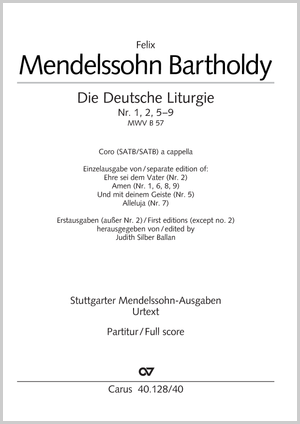
The choral score includes all of Mendelssohn’s settings. The longer numbers (no. 3, 4 and 10) are also available in separate editions, and in addition there is a separate edition for nos. 1, 2, 5 to 9.
 Consulter

 Ecouter
(3)
Ecouter
(3)
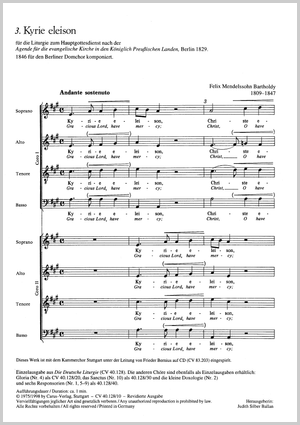
- Kyrie en la majeur
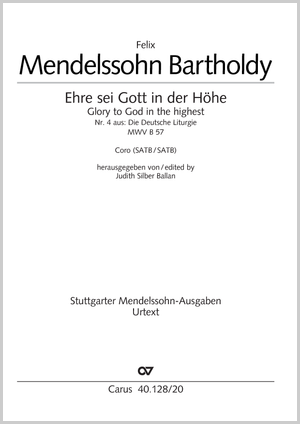
- Glory to god in the highest
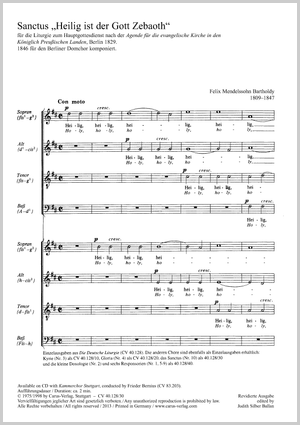
- Holy is God, the Lord Sabaoth!
Sommaire


-
Compositeur
Felix Mendelssohn Bartholdy
| 1809-1847Felix Mendelssohn Bartholdy (1809-1847) compte parmi les compositeurs les plus importants du romantisme musical. Son œuvre allie la clarté formelle du classicisme viennois à la puissance expressive propre au XIXe siècle. Son étude de la musique de Jean-Sébastien Bach a eu une influence particulièrement marquante ; il a d’ailleurs largement contribué à la redécouverte de cette œuvre en organisant l’exécution de la Passion selon saint Matthieu en 1829.
Parmi ses compositions vocales les plus célèbres figurent ses deux oratorios, Paul et Élie, ainsi que sa cantate chorale « Verleih uns Frieden gnädiglich ». Par ailleurs, Mendelssohn a exercé les fonctions de chef d’orchestre, de pianiste et de pédagogue musical, et a contribué de manière significative à la professionnalisation du monde des concerts ainsi qu’au développement du Conservatoire de Leipzig. Son œuvre occupe une place centrale dans l’histoire de la musique du XIXe siècle et allie le respect de la tradition à l’esthétique sonore romantique.
Plus d'information sur la personne
-
Éditeur
Judith Silber Ballan
Critiques
Felix Mendelssohn Bartholdy: Die Deutsche Liturgie
Felix Mendelssohn Bartholdy: Die Deutsche Liturgie
Eine wahrhaft anspruchsvolle Ausgabe hinsichtlich aller editorischer Kriterien. Allein das Vorwort kommt in seiner Fülle an Information einer wissenschaftlichen Abhandlung nahe. Das gleiche gilt für den akribischen Kritischen Bericht, die Wiedergabequalität der historischen Dokumente (vollständige Mitteilung der historischen reformierten Agende, Abbildung des Autographs) und das Notenbild im Besonderen. [ ]
In der vorliegenden Edition wird die „Deutsche Liturgie” zum ersten Mal vollständig mitgeteilt. Mendelssohns ureigenste musikalische Synthese zwischen der geforderten liturgisch-funktionalen Integrationsfähigkeit der „archaischen” italienischen Altklassik, die er in Rom so sehr bewunderte, und den Ausdrucksmitteln seiner Zeit äußert sich in der stilistischen Vielfalt der einzelnen liturgischen Stücke (homophone choralartige Sätze, Doppelchöre im Stil der Venetianischen Schule, Anklänge an die Vokaltradition Bachs). Auf den katholischen Gottesdienst ist die „Deutsche Liturgie” nur bedingt zu übertragen. Dennoch: Warum sollten Akklamationen wie „Amen”, „Und mit deinem Geiste”, „Alleluja” sowie die umfangreicheren Vertonungen des „Kyrie”, „Gloria” und „Sanctus” nicht auch einmal in der katholischen Messe oder in einer „Wort-Gottes-Feier” in der musikalischen Sprache Felix Mendelssohn Bartholdys gesungen werden? Schwierig sind diese Stücke wirklich nicht. Das Problem liegt eher in der Doppelchoranlage (8 Stimmen) der Ordinariumssätze. Für größere Chöre eine interessante Alternative zu den gewohnten, vielfach „ledernen” Rufen und „knochentrockenen” Akklamationen!
Quelle: Kirchenmusik im Bistum Limburg 2/2000, S. 31
Les évaluations sur notre site web ne peuvent être effectuées que par des clients disposant d'un compte d'utilisateur enregistré. Il n'est pas vérifié si les produits évalués ont été effectivement achetés.
Questions fréquentes sur l'œuvre
 Il n'y a pas encore de questions et réponses concernant cette œuvre ou vous n'avez pas trouvé la réponse à votre question sur l'œuvre ? Cliquez ici et envoyez votre question spécifique à notre service clients.