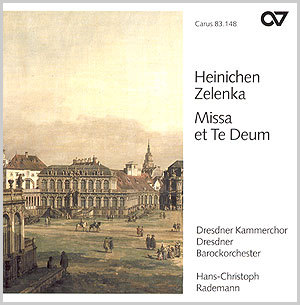
Heinichen: Missa No. 9 / Zelenka: Te Deum
 Ecouter
(26)
Ecouter
(26)
- Te Deum laudamus
- Tu rex gloriae
- Tu ad liberandum
- Tu ad dexteram Dei sedes
- Judex crederis
- Aeterna fac
- Intonatio: Salvum fac
- Et rege eos
- Per singulos dies
- In te, Domine
- Kyrie eleison
- Christe eleison
- Gloria in excelsis
- Domine Deus
- Qui tollis
- Quoniam
- Concertino
- Credo
- Crucifixus
- Et resurrexit
- Sanctus
- Benedictus
- Osanna in excelsis
- Agnus Dei
- Agnus Dei
- Dona nobis pacem
 Compléments
- Acheter des compléments au format téléchargement.
-
 Texte numérique (sans notes), licence d'impression incluse, fichier html, paroles, traduction en anglaisfichier html, paroles, traduction en anglais (Extrait)
Kyrie (Choir) Lord, have mercy on us.
Christ, have mercy on us.
Lord, have mercy on us.Gloria (Soli and Choir) Glory be to God on high
and on earth peace to men of good will.
We praise Thee; we bless Thee; we adore Thee; we glorify Thee.
We give Thee thanks for Thy great glory.
Lord God, heavenly King,
God the almighty Father.
O Lord, the only-begotten Son, Jesus Christ,
O Lord God, Lamb of God,
Son of the Father.
Thou who takest away the sins of the world,
...
-
Texte numérique (sans notes), licence d'impression incluse, fichier html, paroles, traduction allemandefichier html, paroles, traduction allemande (Extrait)
Kyrie (Chor) Herr, erbarme dich unser.
Christus, erbarme dich unser.
Herr, erbarme dich unser.Gloria (Soli und Chor) Ehre sei Gott in der Höhe
und Friede auf Erden den Menschen, die guten Willens sind.
Wir loben Dich. Wir preisen Dich. Wir beten Dich an. Wir rühmen dich.
Wir danken dir, denn groß ist deine Herrlichkeit.
Herr und Gott, König des Himmels,
Gott und Vater, Herrscher über das All,
Herr, eingeborener Sohn, Jesus Christus.
Herr und Gott, Lamm Gottes, Sohn des Vaters.
Du nimmst hinweg die Sünden der Welt:
...
-
Texte numérique (sans notes), licence d'impression incluse, fichier html, paroles, originalfichier html, paroles, original (Extrait)
Kyrie (Chor) Kyrie eleison.
Christe eleison.
Kyrie eleison.Gloria (Soli und Chor) Gloria in excelsis Deo.
Et in terra pax hominibus bonae voluntatis.
Laudamus te, benedicimus te, adoramus te, glorificamus te.
Gratias agimus tibi propter magnam gloriam tuam.
Domine Deus, Rex coelestis,
Deus Pater omnipotens.
Domine Fili unigenite, Jesu Christe.
Domine Deus, Agnus Dei, Filius Patris.
Qui tollis peccata mundi, miserere nobis.
...
-
Texte numérique (sans notes), licence d'impression incluse, fichier html, Texte introductif, françaisfichier html, Texte introductif, français (Extrait)Texte du livret du CD Carus 83.148
Katrin Bemmann
Traduction (abrégée): Jean Paul MénièreDresde connut durant la première moitié du XVIIIe siècle le développement qui lui donna l’immense et toujours actuelle réputation d’être une importante résidence baroque. Comme dans de nombreuses cours allemandes de l’époque, la capitale saxonne suivait le modèle de la cour de Louis XIV qui passait pour être l’incarnation de l’absolutisme et de son amour des fastes. La musique n’était pas la dernière à contribuer aux fonctions représentatives de la cour. La chapelle de la cour de Dresde réunissait les plus importants virtuoses de l’époque et sa haute qualité lui fit obtenir une réputation européenne. Si l’opéra avait atteint un premier sommet lorsque le compositeur italien Antonio Lotti en fut le directeur, ce fut la musique sacrée qui prit le relais à partir de 1720. Deux compositeurs marquèrent particulièrement cette époque florissante de la musique sacrée :
...
-
Texte numérique (sans notes), licence d'impression incluse, fichier html, Texte introductif, en anglaisfichier html, Texte introductif, en anglais (Extrait)Text from the CD Carus 27.048
Katrin Bemmann
Translation (abridged): John CoombsDuring the first half of the 18th century Dresden experienced a flowering of the arts which gave it a widespread and lasting reputation as a splendid example of a baroque princely residence. As at many other princely courts in Germany at that time, courtly life in the Saxon capital was modelled upon that of the glittering French court of Louis XIV, which was considered to be the supreme reflection of splendour-loving absolute monarchy. To no small extent music represented every aspect of court life and art. The Dresden Court Kapelle had in its ranks leading instrumental virtuosi of the period, and it was renowned throughout all Europe for its high quality. Opera in Dresden attained its first peak of achievement under the direction of the Italian composer Antonio Lotti and from 1720 onwards church music was also cultivated to fine effect. Two composers
...
-
Texte numérique (sans notes), licence d'impression incluse, fichier html, Texte introductif, en allemandfichier html, Texte introductif, en allemand (Extrait)Booklet-Text der CD Carus 83.148
Katrin Bemmann
In der ersten Hälfte des 18. Jahrhunderts durchlief Dresden jene Entwicklung, die der Stadt ihren bis heute so vielgerühmten Ruf als bedeutende Barockresidenz einbrachte. Wie an zahlreichen deutschen Fürstenhöfen jener Zeit eiferte man auch in der sächsischen Hauptstadt dem Vorbild des französischen Hofes unter Ludwig XIV. nach, welcher als Inbegriff der prunkliebenden absolutistischen Herrschaft galt. Die Übernahme der polnischen Königskrone durch den sächsischen Kurfürsten im Jahre 1697 ließ die Bestrebungen nach wirkungsvoller Repräsentation umso wichtiger werden. Aus dieser politischen Situation heraus konnten sich in Dresden unter der Regierung von August dem Starken und seinem Sohn, Kurfürst Friedrich August II., Architektur, Malerei, Plastik und Kunsthandwerk in voller Pracht entfalten. Daniel Matthäus Pöppelmann entwarf in diesen
...
-
Texte numérique (sans notes), licence d'impression incluse, fichier html, paroles, traduction en anglaisfichier html, paroles, traduction en anglais (Extrait)
1. Te Deum laudamus (Coro SATB/SATB) We praise thee, O God: we acknowledge thee to be the Lord.
All the earth doth worship thee: the Father everlasting.
To thee all Angels cry aloud: the Heavens, and all the Powers therein.
To thee Cherubim and Seraphim: continually do cry:
Holy, Holy, Holy: Lord God of Sabaoth.
Heaven and earth are full of the Majesty: of thy glory.
The glorious company of the Apostles: praise thee.
The goodly fellowship of the Prophets: praise thee.
The noble army of Martyrs: praise thee.
The holy Church throughout all the world: doth acknowledge thee;
The Father: of an infinite Majesty;
...
-
Texte numérique (sans notes), licence d'impression incluse, fichier html, paroles, traduction allemandefichier html, paroles, traduction allemande (Extrait)
1. Te Deum laudamus (Coro SATB/SATB) Herr, Gott, dich loben wir, Herr Gott, wir danken dir;
Dich, Vater in Ewigkeit,
ehrt die Welt weit und breit.
All Engel und Himmelsheer
und was dienet deiner Ehr,
Auch Cherubim und Seraphim
singen immer mit hoher Stimm:
Heilig ist unser Gott, heilig ist unser Gott
heilig ist unser Gott, der Herre Zebaoth.
Dein göttlich Macht und Herrlichkeit
geht über Himmel und Erden weit.
Der heiligen zwölf Boten Zahl
und die lieben Propheten all,
die teuren Märtrer allzumal,
loben dich, Herr, mit großem Schall.
...
-
Texte numérique (sans notes), licence d'impression incluse, fichier html, paroles, originalfichier html, paroles, original (Extrait)
1. Te Deum laudamus (Coro SATB/SATB) Te Deum laudamus, te Dominum confitemur.
Te aeternum Patrem omnis terra veneratur.
Tibi omnes angeli, tibi coeli et universae potestates,
tibi Cherubim et Seraphim, incessabili voce proclamant:
Sanctus, sanctus, sanctus,
Dominus Deus Sabaoth.
Pleni sunt coeli et terra majestatis gloriae tuae.
Te gloriosus apostolorum chorus,
te prophetarum laudabilis numerus,
te martyrum candidatus laudat exercitus.
Te per orbem terrarum Sancta confitetur ecclesia.
Patrem immensae majestatis;
venerandum tuum verum et unicum filium Sanctum
...
-
Texte numérique (sans notes), licence d'impression incluse, fichier html, Texte introductif, françaisfichier html, Texte introductif, français (Extrait)Texte du livret du CD Carus 83.148
Katrin Bemmann
Traduction (abrégée): Jean Paul MénièreDresde connut durant la première moitié du XVIIIe siècle le développement qui lui donna l’immense et toujours actuelle réputation d’être une importante résidence baroque. Comme dans de nombreuses cours allemandes de l’époque, la capitale saxonne suivait le modèle de la cour de Louis XIV qui passait pour être l’incarnation de l’absolutisme et de son amour des fastes. La musique n’était pas la dernière à contribuer aux fonctions représentatives de la cour. La chapelle de la cour de Dresde réunissait les plus importants virtuoses de l’époque et sa haute qualité lui fit obtenir une réputation européenne. Si l’opéra avait atteint un premier sommet lorsque le compositeur italien Antonio Lotti en fut le directeur, ce fut la musique sacrée qui prit le relais à partir de 1720. Deux compositeurs marquèrent particulièrement cette époque florissante de la musique sacrée :
...
-
Texte numérique (sans notes), licence d'impression incluse, fichier html, Texte introductif, en anglaisfichier html, Texte introductif, en anglais (Extrait)Text from the CD Carus 83.148
Katrin Bemmann
Translation (abridged): John CoombsDuring the first half of the 18th century Dresden experienced a flowering of the arts which gave it a widespread and lasting reputation as a splendid example of a baroque princely residence. As at many other princely courts in Germany at that time, courtly life in the Saxon capital was modelled upon that of the glittering French court of Louis XIV, which was considered to be the supreme reflection of splendour-loving absolute monarchy. To no small extent music represented every aspect of court life and art. The Dresden Court Kapelle had in its ranks leading instrumental virtuosi of the period, and it was renowned throughout all Europe for its high quality. Opera in Dresden attained its first peak of achievement under the direction of the Italian composer Antonio Lotti and from 1720 onwards church music was also cultivated to fine effect. Two composers
...
-
Texte numérique (sans notes), licence d'impression incluse, fichier html, Texte introductif, en allemandfichier html, Texte introductif, en allemand (Extrait)Gekürzter Booklet-Text der CD Carus 83.148
Katrin Bemmann
In der ersten Hälfte des 18. Jahrhunderts durchlief Dresden jene Entwicklung, die der Stadt ihren bis heute so vielgerühmten Ruf als bedeutende Barockresidenz einbrachte. Wie an zahlreichen deutschen Fürstenhöfen jener Zeit eiferte man auch in der sächsischen Hauptstadt dem Vorbild des französischen Hofes unter Ludwig XIV. nach, welcher als Inbegriff der prunkliebenden absolutistischen Herrschaft galt. Die Übernahme der polnischen Königskrone durch den sächsischen Kurfürsten im Jahre 1697 ließ die Bestrebungen nach wirkungsvoller Repräsentation umso wichtiger werden. Aus dieser politischen Situation heraus konnten sich in Dresden unter der Regierung von August dem Starken und seinem Sohn, Kurfürst Friedrich August II., Architektur, Malerei, Plastik und Kunsthandwerk in voller Pracht entfalten. Daniel Matthäus Pöppelmann entwarf in diesen
...


-
L'auteur de l'avant-propos
Katrin Bemmann
-
Chœur
Dresdner Kammerchor
Le Dresdner Kammerchor (Chœur de chambre de Dresde) – l’un des meilleurs chœurs d’Allemagne – est bien connu pour sa sonorité unique, faite d’une grande intensité et clarté. Rayonnement dynamique, homogénéité et transparence sonores souvent cités en exemple sont les points forts de cet ensemble demandé au niveau international. Le chœur a été créé en 1985 par Hans-Christoph Rademann et des étudiants du Conservatoire de musique « Carl Maria von Weber » de Dresde. De nombreuses tournées de concerts ont établi la notoriété de l’ensemble également hors d’Europe. En ont résulté des invitations régulières à d’importants festivals internationaux. Le répertoire du chœur va de la musique de la Renaissance à des compositions du 21ème siècle. Des interprétations de la musique chorale romantique et contemporaine ont été récompensées de prix spéciaux lors de concours internationaux, ainsi que du prix d’encouragement de la fondation Ernst von Siemens. En dehors de la pratique a cappella, le chœur de chambre se consacre intensément à la coopération avec le Dresdner Barockorchester et l’ensemble « Alte Musik Dresden », donnant des impulsions importantes à la pratique de la musique ancienne en Saxe. Une foule d’enregistrements pour la radio et pour le CD, ainsi que la coopération avec des orchestres allemands et étrangers viennent renforcer la renommée du Chœur de chambre de Dresde. Le CD paru aux Editions Carus de Stuttgart, avec le premier enregistrement mondial du Requiem en mi bémol majeur de Johann Adolf Hasse s’est vu décerner le prix de la Critique allemand du disque. Plus d'information sur la personne
-
Orchestre
Dresdner Barockorchester
Le Dresdner Barockorchester [Orchestre baroque de Dresde] a été créé en 1991 par des diplômés du Conservatoire de musique de Dresde. Au cours des années, les musiciens saxons ont révélé tout ce qu’il avaient de particulier à apporter à la scène de la musique ancienne : force émotionnelle et expressive, alliée à une musicalité éloquente, une interprétation sous un angle neuf, vivant. Les compositions de maîtres de chapelle et instrumentistes de la Chapelle de la cour de Dresde des 17ème et 18ème siècles comme Hasse, Heinichen, Zelenka, Quantz, Pisendel e. a. constituent un aspect important du répertoire du Dresdner Barockorchester. Le centre de gravité et le défi véritable pour l’ensemble est le vécu direct du concert. Plusieurs enregistrements pour le CD documentent autant l’art des interprètes que la pratique musicale éprise de magnificence de la cour baroque de Dresde. Des tournées ont conduit le Dresdner Barockorchester non seulement dans de nombreux centres musicaux d’Allemagne, mais aussi en Hollande, en Espagne, en Autriche et au Japon. Plus d'information sur la personne
-
Chef d'orchestre
Hans-Christoph Rademann
| 1965Conductor Hans-Christoph Rademann is an immensely versatile artist with a broad repertoire who devotes himself with equal passion and expertise both to the performance and rediscovery of early music and to the first performances and cultivation of Contemporary Music. Born in Dresden and raised in the Erzgebirge mountains, he was influenced at an early age by the great Central German kantorial and musical tradition. He was a student at the traditional Kreuzgymnasium, a member of the famous Kreuzchor, and studied choral and orchestral conducting at the Carl Maria von Weber University of Music in Dresden. During his studies, he founded the Dresdner Kammerchor and formed it into a top international choir which is still under his direction today. Since 2013, Hans-Christoph Rademann has been the academy director of the International Bach Academy Stuttgart. He regularly collaborates with leading choirs and ensembles of the international music scene. From 1999 to 2004 he was chief conductor of the NDR Choir and from 2007 to 2015 chief conductor of the RIAS Chamber Choir. Guest conducting engagements have led and continue to lead him to the Nederlandse Bachvereniging, the Collegium Vocale Gent, the Akademie für Alte Musik, the Freiburger Barockorchester, the Deutsche Radiophilharmonie Saarbrücken Kaiserslautern, the Sinfonieorchester Basel, the Orchestre Philharmonique de Luxembourg, among others. Hans-Christoph Rademann has been awarded prizes and honors for his artistic work, including the Johann Walter Plaque of the Saxon Music Council (2014), the Saxon Constitutional Medal (2008), the Sponsorship Prize as well as the Art Prize of the state capital Dresden (1994 and 2014 respectively). He received the Preis der Deutschen Schallplattenkritik several times for his numerous CD recordings (most recently in 2016), as well as the Grand Prix du Disque (2002), the Diapason d’Or (2006 & 2011), the CHOC de l’année 2011 and the Best Baroque Vocal Award 2014. In 2016 he was awarded the European Church Music Prize of the city of Schwäbisch Gmünd. His exemplary interpretation and recording of the complete works of Heinrich Schütz with the Dresdner Kammerchor in the Stuttgart Carus-Verlag, which was completed in 2019, was awarded the newly endowed Heinrich Schütz Prize as well as the OPUS KLASSIK 2020 in the same year. Hans-Christoph Rademann is professor of choral conducting at the Carl Maria von Weber University of Music in Dresden. He is also artistic director of the Musikfest Erzgebirge, ambassador of the Erzgebirge and patron of the Christian Hospice Service Dresden. Plus d'information sur la personne
-
Solist - soprano
Heike Hallaschka
-
Solist - soprano
Martina Lins-Reuber
-
Solist - alto
Patrick Van Goethem
Le contraténor Patrick Van Goethem a étudié auprès de Paul Esswood, Julia Hamari et Andreas Scholl. Il est spécialiste de musique ancienne. À son répertoire : des œuvres vocales de Heinichen, Monteverdi, Purcell et Zelenka ainsi que passions, cantates et la Messe en si mineur de Bach, oratorios de Haendel et le Stabat Mater de Vivaldi. Des concerts l’ont conduit à travers l’Europe, aux États-Unis et au Japon, e. a., il s’est produit avec la Niederländische Bach-Vereinigung (Gustav Leonhardt), le Bach Collegium Japan (Masaaki Suzuki), l’Amsterdam Baroque Orchestra (Ton Koopman), l’Orchestre du 18ème siècle (Frans Brüggen), le Bach-Collegium Stuttgart (Helmuth Rilling), le Barockorchester Stuttgart (Frieder Bernius), et le Gulbenkian Orchestra (Michel Corboz). Patrick Van Goethem est en outre l’invité de festivals renommés. Il se produit régulièrement avec son ensemble baroque The Flanders Baroque Consort dont il est l’un des membres fondateurs. Plus d'information sur la personne
-
Solist - ténor
Marcus Ullmann
-
Solist - basse
Jochen Kupfer
Critiques
Jan Dismas Zelenka: Te Deum ZWV 146
Jan Dismas Zelenka: Te Deum ZWV 146. Johann David Heinichen: Missa Nr. 9 D-Dur
Zurecht spielen die Kompositionen Zelenkas, des „katholischen Pendants” von Johann Sebastian Bach in den Programmen heutiger Tage eine immer größere Rolle. Beispiel hierfür kann dieses wunderschöne Te Deum sein, das in seiner Vielgestaltigkeit und Breite an Ausdruck einen großen formalen Bogen atmet. Nicht zuletzt verantwortlich für diesen Eindruck ist freilich die hervorragende Interpretation der oben genannten Ausführenden unter H.-C. Rademann. die auch die wenig bekannte Messe von Heimchen lebendig zu gestalten wissen. Frische und Differenziertheit bei technisch einwandfreier Leistung [ ] aller Beteiligten zeichnen diese Aufnahme aus. Hörens- und aufführungswert!
Quelle: Musica Sacra 6/2000, S. 44
Heinichen/Zelenka: Missa 9; Te Deum
„Heinichens Messe verwendet insbesondere die Fähigkeiten der Blechbläser für eine festliche Klangpracht. Ein vierstimmiger Trompetenchor in Verbindung mit einer doppelchörigen Gesamtanlage verleihen Zelenkas Te Deum das festliche Gepräge. Hans-Christoph Rademann führt Chor, Orchester und Solisten gleichermaßen zu Höchstleistungen. Kann wärmstens empfohlen werden.”
Quelle: Fono Forum 9/00
Heinichen / Zelenka: Missa et Te Deum
It’s easy to see--and hear--why Bach admired the music of Jan Zelenka. How can anyone resist? If you’re wondering what I’m talking about (Zelenka’s music has received inexplicably meager attention until fairly recently), just get this disc and go right to track 10. This concluding section of the Te Deum is as inventive and downright exciting as baroque music gets--infectious, dancing rhythms, soaring soprano lines, ingeniously interwoven contrapuntal lines that seem to bounce off each other, and full-bodied orchestral accompaniment--all of which makes its impact in the space of two minutes. But this is the sort of compelling music that characterizes the work’s entire 28 minutes, varied with an alto solo, duets for two sopranos and for tenor and bass, and full sections for chorus. From the very Bach-like orchestral introduction to the above-mentioned rousing conclusion, this remarkable piece should take a place among the 18th century’s standard repertoire--next to Bach’s own quick-paced, tightly-knit flash of genius, the Magnificat.
In a different vein, Johann Heinichen’s Mass No. 9 in D flows every bit as freely and beautifully and with its own complete command of style and structure. It’s a magnificent, majestic work with powerful, elegantly built choruses and fine solos. The fugal writing is especially notable. And so are the world-class performances by choir and orchestra, whose enthusiasm for this music comes through in every bar. Such dynamic, musically affecting, and technically sound singing and playing doesn’t come easily, and conductor Hans-Christoph Rademann also deserves credit for the commendable results. Particular mention must go to tenor Marcus Ullmann’s rendition of Heinichen’s Qui tollis, a lovely, surprising little gem reminiscent of and equal to Handel’s better efforts.
David Vernier
Quelle: Classics today
Die drei obengenannten Komponisten sind alle in Dresden wirksam gewesen. Aber der Unterschied zwischen beiden Aufnahmen ist riesengroß. Die erste widerspiegelt die brillante Musikkultur am Dresdner Hof. Die Qualitäten des Hoforchesters werden in den Kompositionen von Heinichen und Zelenka voll ausgenutzt. Vor allem von den Bläsern, insbesondere den Trompetern, wird vieles abverlangt. Wir haben es hier mit zwei festlichen Kompositionen zu tun. Das Te Deum von Zelenka ist wahrscheinlich aus Anlass der Geburt der Prinzessin Maria Josepha im November 1731 entstanden. Der festliche Charakter wird von der Doppelchörigkeit und der Besetzung mit einem vierstimmigen Trompetenchor unterstrichen. Heinichens Messe ist wahrscheinlich für das Weihnachtsfest komponiert worden. In dieser Messe gibt es mehrere Solo-Arien, die sich durch eine originelle Instrumentation auszeichnen. Die Darbietung von Solisten, Chor und Orchester ist erstklassig. Sowohl die Virtuosität als auch die Intimität mehrerer Solopassagen kommt gut zur Geltung. Der Dirigent Philippe Herreweghe hat mal gesagt, er möchte keine Zeit mit der Musik Zelenkas verschwenden. Vor allem ihm sei diese Aufnahme ans Herz gelegt.
Quelle: TOCCATA- 19/2005
Les évaluations sur notre site web ne peuvent être effectuées que par des clients disposant d'un compte d'utilisateur enregistré. Il n'est pas vérifié si les produits évalués ont été effectivement achetés.
Questions fréquentes sur l'œuvre
 Il n'y a pas encore de questions et réponses concernant cette œuvre ou vous n'avez pas trouvé la réponse à votre question sur l'œuvre ? Cliquez ici et envoyez votre question spécifique à notre service clients.