

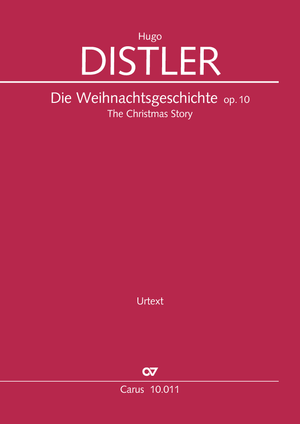
Avec sa délicatesse émouvante, la Weihnachtsgeschichte op. 10 de Hugo Distler est une des plus belles tentations pour chaque ensemble a cappella pendant la période de l’Avent et de Noël. Toutes les parties solos peuvent être assurées par le chœur. Les premier et dernier chœurs notamment, dont Distler soulignait le caractère autonome et approuvait l’exécution séparée, recèlent quelques défis : le rythme et la pulsation sont subordonnés au texte et changent donc fréquemment et avec fluidité ; l’harmonie flotte d’un nuage à l’autre, les entrées doivent donc être bien mémorisées pour être justes. Les voix sont souvent écrites en quartes et quintes – c’est à la fois inhabituel et impitoyable quand l’intonation n’est pas parfaite.
Il suffit de s'exercer. Partout. A tout moment.
Que ce soit à la maison sur votre tablette ou votre PC ou en déplacement sur votre smartphone : avec carus music, the Choir Coach, vous avez toujours vos œuvres chorales avec vous pour vous entraîner ! Avec l'application chorale de carus music, vous pouvez écouter votre partition ainsi qu'un enregistrement de première qualité sur n'importe quel appareil et vous entraîner facilement à votre propre partie de chœur avec un coach. Avec carus music, la préparation de vos concerts est facile, efficace et amusante à maîtriser !
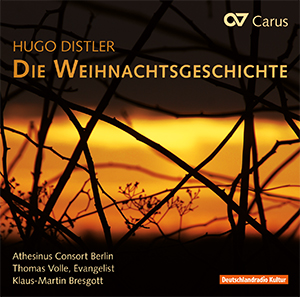
Interprètes: Ulrike Barth (soprano), Laurence Servaes (soprano), Katharina Padrok (alto), Thomas Volle (tenore), Sebastian Myrus (basso), Stefan Drexlmeier (basso) – Klaus-Martin Bresgott
Découvrir
 Ecouter
(18)
Ecouter
(18)
- Einleitungschor: Das Volk, so im Finstern wandelt
- Choral – Strophe 1: Es ist ein Ros entsprungen
- Verkündigung
- Choral – Strophe 2: Das Röslein, das ich meine
- Marias Besuch bei Elisabeth
- Magnificat/Choral – Strophe 3: Meine Seele erhebt/Wir bitten dich
- Christi Geburt
- Choral – Strophe 4: Das Blümelein, so kleine
- Die Hirten und die Menge der himmlischen Heerscharen
- Chor der Hirten
- Choral – Strophe 5: Die Hirten zu der Stunde
- Herodes und die Weisen I
- Herodes und die Hohenpriester
- Herodes und die Weisen II
- Choral – Strophe 6: Lob, Ehr sei Gott, dem Vater
- Jesus im Tempel bei Simeon
- Choral – Strophe 7: So singen wir all Amen
- Finale – Einleitungschor (Fassung 1937)
 Compléments
- Acheter des compléments au format téléchargement.
-
 Texte numérique (sans notes), licence d'impression incluse, fichier html, paroles, traduction en anglaisfichier html, paroles, traduction en anglais (Extrait)I. Introduction (Choir) The people that walked in darkness have seen a great light: they that dwell in the land of the shadow of death, upon them hath the light shined. For unto us a child is born, unto us a son is given: and the government shall be upon his shoulder: and his name shall be called Wonderful, Counsellor, The mighty God, The everlasting Father, The Prince of Peace. Of the increase of his government and peace there shall be no end … from henceforth even for ever.
Isaiah 9:1,5-6II. The Christmas Story Choral – Verse 1 Behold! a Rose is growing,
of loveliest form and grace,
as prophets sang, foreknowing;
it springs from Jesse’s race,
and comes a perfect flower,
in midst of coldest winter,
at deepest midnight hour. Trier 1587/88 Translation: Harriet Reynolds Spaeth (1845–1925)Annunciation
...
-
Texte numérique (sans notes), licence d'impression incluse, fichier html, paroles, originalfichier html, paroles, original (Extrait)
I. Einleitungschor Das Volk, so im Finstern wandelt, siehet ein groß’ Licht, und über die, die da wohnen im finstern Lande, scheinet es helle. Denn uns ist ein Kind geboren, ein Sohn ist uns gegeben, welches Herrschaft ist auf seiner Schulter; und er heißt Wunderbar, Rat, Held, Kraft, Ewig-Vater, Friede-Fürst; auf dass seine Herrschaft groß werde und des Friedens kein Ende … von nun an bis in Ewigkeit.
Jesaja 9,1.5–6II. Die Weihnachtsgeschichte Choral – Strophe 1 Es ist ein Ros entsprungen
aus einer Wurzel zart.
Als uns die Alten sungen,
von Jesse kam die Art.
Und hat ein Blümlein bracht
mitten im kalten Winter,
wohl zu der halben Nacht. Trier 1587/88Verkündigung
...
Acheter
Informations complémentaires sur l'œuvre
Sommaire

-
Compositeur
Hugo Distler
| 1908-1942
-
Ensemble
Athesinus Consort Berlin
The Athesinus Consort Berlin, named after the composer Leonhard Lechner Athesinus (ca. 1553–1606), was founded by Klaus-Martin Bresgott in 1992. He has been the conductor of the ensemble since then. The ensemble, which usually performs as a double quartet and – when enlarged – as a soloistic chamber choir, rehearses and performs both a cappella and continuo literature of the late Renaissance and Baroque as well as modern and contemporary works, which regularly result in world premieres. The ensemble members, all experienced concert singers who are also active in the Collegium Vocale Gent, the Chor des Bayerischen Rundfunks, the SWR Vokalensemble and the RIAS-Kammerchor, as well as on the stage of the Deutsches Theater Berlin, with Sasha Waltz & Guests and others, are united in their delight sounding out the verbal images of speech and suggestive arts. All of the ensemble members are active as soloists in addition to their activities in larger ensembles. The spectrum here ranges from Johann Sebastian Bach’s oratorios to experimental music of the 21st century. The latest successes of the ensemble include, among others, the world premiere of the music theatre piece Paulus. Das ängstliche Harren der Kreatur by Thomas Jennefelt in 2011, the world premiere of the tryptich Du bist mein Schlaf by Frank Schwemmer in 2012, the world premiere of Drei Gedichte von Rainer Maria Rilke by Jonathan Brell (*1987) in 2013, as well as the world premiere of Turbulent Days – fünf Spruchmotetten nach Martin Luther King und Martin Luther für 8–12-stimmiges Vokalensemble, Saxophon und Schlagwerk by Frank Schwemmer and Anyone can let you down – no one will let you down by Thomas Jennefelt in 2014. In addition to specific compositional focuses, the Athesinus Consort Berlin has committed itself to selected topics in which the texts are of definitive significance. One emphasis is on the innumerable forgotten strophes of the cornucopia of German folk song. Classical concert principles recede into the background and make way for a more individual form of expression. Exemplary thereof are the collaborations with songwriters, jazz musicians, drummers and percussionists as well as dancers and pantomimes. Since 2010 the Athesinus Consort Berlin has regularly released CDs, including O Heiland, reiß die Himmel auf … vergessene Strophen der Weihnacht (2010), Signale ( 2011) w ith w orks by Michael Praetorius and Thomas Jennefelt or Boten ( 2012) w ith w orks b y J ohann A dam Hiller, Max Bruch, Hugo Distler and others. In 2013 Leonhard Lechner: Mein süße Freud auf Erden. Sacred Choral Music was released (Carus 83.384; a tribute from the ensemble to the man who gave it its name – the works on this CD are also available complete as a music edition, Carus 4.022), followed by Frank Schwemmer: Perlmuttfalter. Contemporary Choral Music (Carus 83.464) in 2014. Plus d'information sur la personne
-
Chef d'orchestre
Klaus-Martin Bresgott
| 1967Klaus-Martin Bresgott was born 1967 in Greifswald and initially studied Protestant theology, later German language and literature and art history (M. A.), parallel thereto choral conducting. Contracts as an ensemble singer led him to the most notable concert venues in Europe under conductors such as René Jacobs, Marcus Creed, Daniel Reuss, Hans-Christoph Rademann and Fabio Luisi, and directors such as Sasha Waltz, Luc Perceval, Barrie Kosky and others. His main focus is on ensemble work that spans epochs and interdisciplinary contexts. This has led to a regular co-operation with composers and poets of our time such as Thomas Jennefelt and Frank Schwemmer as well as Christa Wolf (†) and Christian Lehnert. As well as works on art history, including Ernst Barlach, he has edited several books of choral music, including Frau Musica spricht. Chorbuch Reformation (2011) and Chorbuch Leonhard Lechner (2014, Carus 4.022), Vier Weihnachtsmotetten (2015, Carus 7.389) and Hugo Distler’s Die Weihnachtsgeschichte op. 10 (2015, Carus 10.011). He was awarded the “Preis der Deutschen Schallplattenkritik” in 2008 for the first complete recording of the Geistliche Chormusik op. 12 by Hugo Distler, 2019 the french "Choc de Classica" for Samuel Scheidt: Cantiones Sacrae. Plus d'information sur la personne
-
Solist - basse
Sebastian Myrus
| 1977
Les évaluations sur notre site web ne peuvent être effectuées que par des clients disposant d'un compte d'utilisateur enregistré. Il n'est pas vérifié si les produits évalués ont été effectivement achetés.
Aucune évaluation disponible pour ce produit.
Questions fréquentes sur l'œuvre
 Il n'y a pas encore de questions et réponses concernant cette œuvre ou vous n'avez pas trouvé la réponse à votre question sur l'œuvre ? Cliquez ici et envoyez votre question spécifique à notre service clients.