

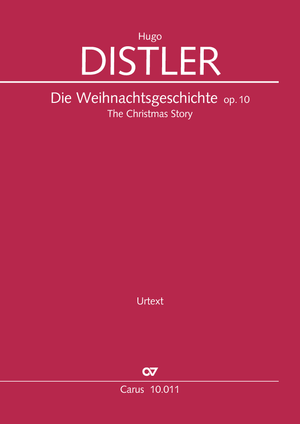
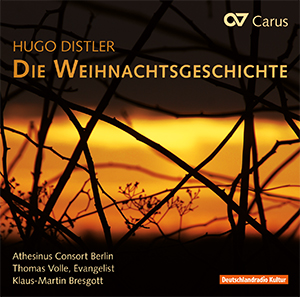
The Christmas story op. 10 by Hugo Distler is, in its touching tenderness, one of the most beautiful temptations for any a cappella ensemble in Advent or Christmas time. All the solo parts can easily be sung by members of the choir. Distler emphasized that the introductory and final choruses were independent movements and advocated performing them separately. These two in particular present some challenges: the tempo and different meters are subordinate to the text and therefore change frequently and seamlessly; the harmony floats from one cloud to the next, so that the beginning notes in particular need to be familiar in order to be able to sing them securely. The parts are frequently written in fourths and fifths which is both unusual, and uncompromising if the intonation is not perfect.
Simply practice. Anytime. Everywhere.
Whether at home on your tablet or PC or on the road on your smartphone: with carus music, the Choir Coach, you always have your choral works with you to practice! With the carus music choir app, you can listen to your score together with a first-class recording on any device and easily practice your own choir part with a coach. With carus music, your concert preparation is easy, efficient and fun to master!
Performers: Ulrike Barth (soprano), Laurence Servaes (soprano), Katharina Padrok (alto), Thomas Volle (tenore), Sebastian Myrus (basso), Stefan Drexlmeier (basso) – Klaus-Martin Bresgott
Explore
 Listen
(18)
Listen
(18)
- Einleitungschor: Das Volk, so im Finstern wandelt
- Choral – Strophe 1: Es ist ein Ros entsprungen
- Verkündigung
- Choral – Strophe 2: Das Röslein, das ich meine
- Marias Besuch bei Elisabeth
- Magnificat/Choral – Strophe 3: Meine Seele erhebt/Wir bitten dich
- Christi Geburt
- Choral – Strophe 4: Das Blümelein, so kleine
- Die Hirten und die Menge der himmlischen Heerscharen
- Chor der Hirten
- Choral – Strophe 5: Die Hirten zu der Stunde
- Herodes und die Weisen I
- Herodes und die Hohenpriester
- Herodes und die Weisen II
- Choral – Strophe 6: Lob, Ehr sei Gott, dem Vater
- Jesus im Tempel bei Simeon
- Choral – Strophe 7: So singen wir all Amen
- Finale – Einleitungschor (Fassung 1937)
 Additional material
- Purchase additional material as a download product.
-
 Digital text (without sheet music) incl. printing licence, html file, singing text, english translationhtml file, singing text, english translation (Sample)I. Introduction (Choir) The people that walked in darkness have seen a great light: they that dwell in the land of the shadow of death, upon them hath the light shined. For unto us a child is born, unto us a son is given: and the government shall be upon his shoulder: and his name shall be called Wonderful, Counsellor, The mighty God, The everlasting Father, The Prince of Peace. Of the increase of his government and peace there shall be no end … from henceforth even for ever.
Isaiah 9:1,5-6II. The Christmas Story Choral – Verse 1 Behold! a Rose is growing,
of loveliest form and grace,
as prophets sang, foreknowing;
it springs from Jesse’s race,
and comes a perfect flower,
in midst of coldest winter,
at deepest midnight hour. Trier 1587/88 Translation: Harriet Reynolds Spaeth (1845–1925)Annunciation
...
-
Digital text (without sheet music) incl. printing licence, html file, singing text, originalhtml file, singing text, original (Sample)
I. Einleitungschor Das Volk, so im Finstern wandelt, siehet ein groß’ Licht, und über die, die da wohnen im finstern Lande, scheinet es helle. Denn uns ist ein Kind geboren, ein Sohn ist uns gegeben, welches Herrschaft ist auf seiner Schulter; und er heißt Wunderbar, Rat, Held, Kraft, Ewig-Vater, Friede-Fürst; auf dass seine Herrschaft groß werde und des Friedens kein Ende … von nun an bis in Ewigkeit.
Jesaja 9,1.5–6II. Die Weihnachtsgeschichte Choral – Strophe 1 Es ist ein Ros entsprungen
aus einer Wurzel zart.
Als uns die Alten sungen,
von Jesse kam die Art.
Und hat ein Blümlein bracht
mitten im kalten Winter,
wohl zu der halben Nacht. Trier 1587/88Verkündigung
...
Purchase
Additional product information
Contents

-
Composer
Hugo Distler
| 1908-1942
-
Ensemble
Athesinus Consort Berlin
The Athesinus Consort Berlin, named after the composer Leonhard Lechner Athesinus (ca. 1553–1606), was founded by Klaus-Martin Bresgott in 1992. He has been the conductor of the ensemble since then. The ensemble, which usually performs as a double quartet and – when enlarged – as a soloistic chamber choir, rehearses and performs both a cappella and continuo literature of the late Renaissance and Baroque as well as modern and contemporary works, which regularly result in world premieres. The ensemble members, all experienced concert singers who are also active in the Collegium Vocale Gent, the Chor des Bayerischen Rundfunks, the SWR Vokalensemble and the RIAS-Kammerchor, as well as on the stage of the Deutsches Theater Berlin, with Sasha Waltz & Guests and others, are united in their delight sounding out the verbal images of speech and suggestive arts. All of the ensemble members are active as soloists in addition to their activities in larger ensembles. The spectrum here ranges from Johann Sebastian Bach’s oratorios to experimental music of the 21st century. The latest successes of the ensemble include, among others, the world premiere of the music theatre piece Paulus. Das ängstliche Harren der Kreatur by Thomas Jennefelt in 2011, the world premiere of the tryptich Du bist mein Schlaf by Frank Schwemmer in 2012, the world premiere of Drei Gedichte von Rainer Maria Rilke by Jonathan Brell (*1987) in 2013, as well as the world premiere of Turbulent Days – fünf Spruchmotetten nach Martin Luther King und Martin Luther für 8–12-stimmiges Vokalensemble, Saxophon und Schlagwerk by Frank Schwemmer and Anyone can let you down – no one will let you down by Thomas Jennefelt in 2014. In addition to specific compositional focuses, the Athesinus Consort Berlin has committed itself to selected topics in which the texts are of definitive significance. One emphasis is on the innumerable forgotten strophes of the cornucopia of German folk song. Classical concert principles recede into the background and make way for a more individual form of expression. Exemplary thereof are the collaborations with songwriters, jazz musicians, drummers and percussionists as well as dancers and pantomimes. Since 2010 the Athesinus Consort Berlin has regularly released CDs, including O Heiland, reiß die Himmel auf … vergessene Strophen der Weihnacht (2010), Signale ( 2011) w ith w orks by Michael Praetorius and Thomas Jennefelt or Boten ( 2012) w ith w orks b y J ohann A dam Hiller, Max Bruch, Hugo Distler and others. In 2013 Leonhard Lechner: Mein süße Freud auf Erden. Sacred Choral Music was released (Carus 83.384; a tribute from the ensemble to the man who gave it its name – the works on this CD are also available complete as a music edition, Carus 4.022), followed by Frank Schwemmer: Perlmuttfalter. Contemporary Choral Music (Carus 83.464) in 2014. Personal details
-
Conductor
Klaus-Martin Bresgott
| 1967Klaus-Martin Bresgott was born 1967 in Greifswald and initially studied Protestant theology, later German language and literature and art history (M. A.), parallel thereto choral conducting. Contracts as an ensemble singer led him to the most notable concert venues in Europe under conductors such as René Jacobs, Marcus Creed, Daniel Reuss, Hans-Christoph Rademann and Fabio Luisi, and directors such as Sasha Waltz, Luc Perceval, Barrie Kosky and others. His main focus is on ensemble work that spans epochs and interdisciplinary contexts. This has led to a regular co-operation with composers and poets of our time such as Thomas Jennefelt and Frank Schwemmer as well as Christa Wolf (†) and Christian Lehnert. As well as works on art history, including Ernst Barlach, he has edited several books of choral music, including Frau Musica spricht. Chorbuch Reformation (2011) and Chorbuch Leonhard Lechner (2014, Carus 4.022), Vier Weihnachtsmotetten (2015, Carus 7.389) and Hugo Distler’s Die Weihnachtsgeschichte op. 10 (2015, Carus 10.011). He was awarded the “Preis der Deutschen Schallplattenkritik” in 2008 for the first complete recording of the Geistliche Chormusik op. 12 by Hugo Distler, 2019 the french "Choc de Classica" for Samuel Scheidt: Cantiones Sacrae. Personal details
-
Soloist - bass
Sebastian Myrus
| 1977
Reviews on our website can only be submitted by customers with a registered user account. A check whether the rated products were actually purchased does not take place.
No feedback available for this product.
Frequent questions about this work
 There are no questions and answers available so far or you were unable to find an answer to your specific question about this work? Then click here and send your specific questions to our Customer Services!