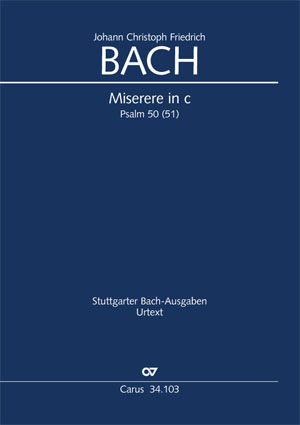
Miserere en ut mineur
BR JCFB E 1
It was not only the musicians of the 16th and 17th centuries who – for liturgical reasons – regularly presented settings of the penitential psalm 50 (51). Even in later times, composers occasionally cultivated this tradition, for example, the "Bückeburger" Johann Christoph Friedrich Bach with his 12-movement composition dated around 1770 which was only discovered in 1975. Bach’s Miserere, held almost exclusively in flat keys, consists of a balanced alternation of choral and solo sections. One common stylistic feature of all the sections is, in particular, the lavishly used "empfindsam" suspensions and small ornamental notes. As an example of the pre-Classical era, the composition is well suited for programmes featuring fast and penance compositions from several epochs.
Découvrir


Acheter
Informations complémentaires sur l'œuvre
-
Compositeur
Johann Christoph Friedrich Bach
| 1732-1795Les oeuvres de Johann Christoph Friedrich Bach (1732–1795), premier violon solo à Bückeburg, se placent sous l'influence de son frère aîné Carl Philipp Emanuel et de la musique italienne de l'époque. À côté de grands et ambitieux oratorios, il laisse deux motets de grande qualité, une série de cantates de fête, et surtout un grand nombre d'oeuvres instrumentales, qui se rapprochent déjà de l'idiome sonore classique. Plus d'information sur la personne
-
Éditeur
Wolfgang Wiemer
| 1934-2023
-
Basse continue réalisée
Wolfgang Wiemer
| 1934-2023
Les évaluations sur notre site web ne peuvent être effectuées que par des clients disposant d'un compte d'utilisateur enregistré. Il n'est pas vérifié si les produits évalués ont été effectivement achetés.
Aucune évaluation disponible pour ce produit.
Questions fréquentes sur l'œuvre
 Il n'y a pas encore de questions et réponses concernant cette œuvre ou vous n'avez pas trouvé la réponse à votre question sur l'œuvre ? Cliquez ici et envoyez votre question spécifique à notre service clients.