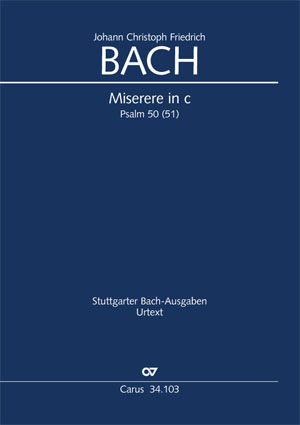
Miserere in C minor
BR JCFB E 1
It was not only the musicians of the 16th and 17th centuries who – for liturgical reasons – regularly presented settings of the penitential psalm 50 (51). Even in later times, composers occasionally cultivated this tradition, for example, the "Bückeburger" Johann Christoph Friedrich Bach with his 12-movement composition dated around 1770 which was only discovered in 1975. Bach’s Miserere, held almost exclusively in flat keys, consists of a balanced alternation of choral and solo sections. One common stylistic feature of all the sections is, in particular, the lavishly used "empfindsam" suspensions and small ornamental notes. As an example of the pre-Classical era, the composition is well suited for programmes featuring fast and penance compositions from several epochs.
Explore


Purchase
Additional product information
-
Composer
Johann Christoph Friedrich Bach
| 1732-1795The works of the concert master at Bückeburg, Johann Christoph Friedrich Bach (1732–1795), belong stylistically between the compositions of his elder brother Carl Philipp Emanuel and the contemporary Italian style. In addition to large-scale and ambitious oratorios he left two artistically fashioned motets, a series of festive cantatas, and above all, a great many instrumental works, some of which approach the tonal idiom of the classical masters. Personal details
-
Editor
Wolfgang Wiemer
| 1934-2023
-
Continuo realization
Wolfgang Wiemer
| 1934-2023
Reviews on our website can only be submitted by customers with a registered user account. A check whether the rated products were actually purchased does not take place.
No feedback available for this product.
Frequent questions about this work
 There are no questions and answers available so far or you were unable to find an answer to your specific question about this work? Then click here and send your specific questions to our Customer Services!