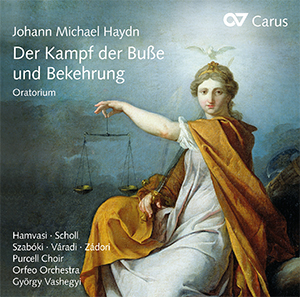
Der Kampf der Buße und Bekehrung
Oratorium 1768
The oratorio "Der Kampf der Buße und Bekehrung" (the struggle for penance and conversion) is among Johann Michael Haydn's lesser-known works. The Purcell Choir together with the Orfeo Orchestra, under the direction of György Vashegyi now present a recording of the second and only surviving part of this three-part oratorio. It is impressive, especially for its unusual scoring: All of the the five solo roles are allotted to sopranos. The artistic mixture of majestic passages, surprising turns, Baroque rhetorical figures and virtuoso arias makes clear why later composers (e.g., Mozart, Schubert or Bruckner) repeatedly took Johann Michael Haydn's music as their model.
Acheter
Informations complémentaires sur l'œuvre
Sommaire
-
Compositeur
Johann Michael Haydn
| 1737-1806Johann Michael Haydn a travaillé à partir de 1763 à la prestigieuse cour princière de Salzbourg. Au cours des 43 années qu'il y a passées, il a jeté un pont stylistique entre le classicisme précoce et le Biedermeier musical. Conformément à ses obligations de service, Haydn a contribué à pratiquement tous les genres cultivés dans la liturgie catholique : la connaissance de la fonction liturgique et l'interprétation musicale des textes religieux caractérisent la musique sacrée de Haydn. Johann Michael Haydn a d'abord été considéré par ses contemporains comme étant au même niveau que Joseph Haydn. Ce n'est que l'ascension fulgurante de son frère aîné, devenu le plus important compositeur instrumental de l'époque, qui a relégué Johann Michael Haydn dans l'ombre, d'où la joie de la découverte musicale de ces dernières années l'a de plus en plus fait sortir. Plus d'information sur la personne
-
Parolier/Librettiste
Johann Heinrich Drümel
-
L'auteur de l'avant-propos
Zsombor Németh
-
Ensemble
Purcell Choir
The Purcell Choir was founded in 1990 in Budapest by György Vashegyi for the performance of Purcell’s Baroque opera Dido & Aeneas. Few suspected at the time that the group would become the most respected choir in Hungary fifteen years later. All of the choir members are excellent professional singers, musicians and instrumentalists, and some of them are also members of other choirs and orchestras. The core repertoire of the Purcell Choir ranges from works by Gesualdo to Mozart, but the ensemble also performs works by more modern composers. The Purcell Choir is a regular participant at the Haydn Festivals in Hungary; for example, the choir performed with the Capella Savaria Ensemble in 2004, conducted by Nicholas McGegan. The Purcell Choir and the Orfeo Orchestra are closely connected as performing partners and together they have taken part in a large number of TV, CD and concert recordings in Hungary. Plus d'information sur la personne
-
Ensemble
Orfeo Orchestra
The Orfeo Orchestra was founded in Budapest in 1991 by György Vashegyi, taking its name from Monteverdi’s L’Orfeo, after the ensemble presented the first complete performance of this opera in Hungary. The orchestra consists of professional musicians with experience in Hungary as well as on the international scene, either as members of the orchestra or as instrumental soloists. The Orfeo Orchestra is the most authentic exponent of classical music in Hungary and it has given many first performances on period instruments under the baton of György Vashegyi. Between 2002 and 2007 the ensemble performed the first eighty symphonies composed by Haydn as part of Mr. Vashegyi’s own concert series (at Esterházy Palace), enabling these to be heard there for the first time since the 18th century with the same number of musicians, on period instruments, as Haydn himself used to perform them. The names of the Orfeo Orchestra and the Purcell Choir have now become inseparably linked with that of Mr. Vashegyi, who can rightly be described as the outstanding exponent of classical and early music in Hungary and the person who has revitalized these works this country. Plus d'information sur la personne
-
Ensemble
György Vashegyi
György Vashegyi was born in Budapest in 1970 and began his musical studies as an instrumentalist: he played the violin, flauto dolce, the oboe and the harpsichord. At just 18 he became a student of conducting under Ervin Lukács at the Ferenc Liszt Academy of Music in Budapest, obtaining his diploma with distinction in 1993. He was a frequent participant in the conducting master classes of John Eliot Gardiner and Helmuth Rilling and from 1994 to 1997 he was a student in the continuo master class of John Toll in Dresden, where he also studied chamber music with Jaap ter Linden and Simon Standage. He has performed as a continuo player in leading Hungarian chamber orchestras such as the Ferenc Liszt Chamber Orchestra and Concerto Armonico. In 1990 he founded the Purcell Choir in Budapest and one year later the Orfeo Orchestra. In 1991 Vashegyi made his operatic debut with Gluck’s Orfeo together with the Budapest Chamber Opera. He undertook successful tours with Orfeo in France, Switzerland and Luxembourg. In his concerts (mostly in Budapest) he has conducted many important works of the 17–18th centuries which until then had never been performed in Hungary, including Buxtehude’s Membra Jesu Nostri, Purcell’s The Fairy Queen, Funeral Anthem and Theodora by Handel, and the Requiem by Kraus. Nevertheless, he primary emphasis is on the research and performance of 18th century works by Hungarian composers which are still unknown internationally. He works primarily with his own ensembles but also gives concerts with other early music groups, including Concerto Armonico, Capella Savaria and Musica Aeterna, as well as with modern symphony orchestras and chamber orchestras as a guest conductor. He made his debut at the Hungarian State Opera of Budapest (with the Orfeo Orchestra) in August 2000 with Haydn’s L’infedeltà delusa; this was the first opera performance with period instruments in the history of the Hungarian State Opera. Since 2001 he has conducted regularly at the State Opera. In 2004 he conducted the Prague Chamber Orchestra in Würzburg (at the Mozart Fest) and Kloster Eberbach (at the Rheingau Festival). Plus d'information sur la personne
-
Solist - soprano
Sylvia Hamvasi
Soprano Sylvia Hamvasi studied at the Liszt Academy of music in her hometown of Budapest. She attended master classes with Vera Rózsa, Julia Hamari, Nicholas Clapton; her master teachers were Ilona Bakonyi, Julia Bikfalvy, and Gabor Jelinek. She has won prizes at the international Lucia Popp and Francesco Vignas competitions. She debuted in the roles of Gilda and Pamina at the Hungarian State Opera. In Budapest, she has given many concerts and made recordings for the Hungarian Radio under the direction of Tamás Vásáry with the Hungarian Radio Orchestra. She has also participated in several early music projects with the Orfeo Orchestra under György Vashegyi. She has given concerts in Belgium, Spain, Italy, and France, and also presented a song recital at the Wigmore Hall in London. She has also performed at the Hamburg State Opera. Sylvia Hamvasi has been a member of the Deutsche Oper am Rhein since 2001/02. During this time she has gained acclaim for her performance of major operatic roles by Mozart and Britten, a.o. In 2013 she performed Richard Strauss’s Four Last Songs under Axel Kober in the Tonhalle of Düsseldorf, and in May 2014 she gives her debut as Elsa in Wagner’s Lohengrin. Plus d'information sur la personne
-
Solist - soprano
Elisabeth Scholl
Elisabeth Scholl began her vocal education with Eduard Wollitz. This was followed by studies in early music and historic performance practice at the Schola Cantorum Basiliensis under René Jacobs. There she developed a strong interest in musicological research, editing musical manuscripts and performing them. One result of these studies is a CD with cantatas by Alessandro Scarlatti, produced in November 2004 with Modo Antiquo. Elisabeth Scholl has been invited to prestigious European festivals, and has worked with conductors such as René Jacobs, Jos van Immerseel, Frieder Bernius, Enoch zu Guttenberg, Bruno Weil, Nicholas McGegan, Sir Neville Marriner and others. In addition to her concert performances, she gives lieder recitals and has been invited to perform, among others, at the Aalto Theater in Essen (countess in Mozart’s Figaro, Caio in Vivaldi’s Ottone in villa), at the Vlaamse Opera in Ghent (Mozart’s Donna Elvira) and the Deutsche Staatsoper Berlin (Haydn, Il mondo della luna). Since 2009 she has taught as Professor for Baroque Singing at the Musikhochschule in Nuremberg. Plus d'information sur la personne
-
Solist - soprano
Tünde Szabóki
Tünde Szabóki was born in Budapest. She studied piano, singing and choral conducting in Budapest and Graz. She has won prizes at several international singing competitions and was awarded the Ferenc Liszt Prize and the Artisjus Prize by the Hungarian Ministry of Culture in 2011. As a concert singer, she has performed at renowned festivals such as the Salzburg Festival, the Rheingau Festival, the Festival de Montpellier and the Budapest Spring Festival, as well as the Bernstein Festival in Jerusalem. As an opera singer, she has performed at the Gran Theatro Liceu in Barcelona, the Graz Opera, the Debrecen and Miskolc National Theaters, as well as at the Hungarian State Opera, performing such roles as Leonore in Beethoven’s Fidelio, Vitellia in Mozart’s La clemenza di Tito, the Feldmarschallin in Rosenkavalier, as well as the third Norn (Götterdämmerung) and Gerhilde (Walküre) at the “Wagner in Budapest” Opera Festival. In 2013, she sang the soprano solo in the première of Penderecki’s Eighth Symphony, conducted by Maestro Penderecki himself. Numerous CD and DVD recordings bear witness to the artistic presence of this much sought-after soprano. Plus d'information sur la personne
-
Solist - soprano
Zita Váradi
Zita Váradi studied at the Liszt Academy of Music in Budapest (1990–1995). After completing her diploma, she studied under Vera Rózsa, Julia Hamari, Paolo Montarsolo and Ionel Pantea within the framework of her postgraduate education. Between 1994 and 2000, she won numerous prizes at different competitions, including first prizes at both the Katia Ricciarelli Singing Competition in Mantova, Italy and at the Franz Lehar Operetta Competition in Komarno, Slovakia. In 1995 Váradi became a member of the Csokonai Theater in Debrecen. Since 2001, she has been a freelance singer at the Hungarian State Opera, successfully performing lyric soprano roles of both the Italian (Liu, Musetta, Adina, Norina) and the German repertoire (Susanna, Zdenka, Pamina, Despina, Zerlina, Naiad, Marzelline, first Flower Maiden.) She performs as a concert soloist, especially in works of the Baroque and Classical era; but she also gained critical acclaim throughout Europe as the soprano soloist in Liszt’s oratorio Christus, which she performed during the Liszt bicentenary. In 2012, Zita Váradi was awarded the distinguished title of “Kammersängerin of the Hungarian State Opera.” Plus d'information sur la personne
-
Solist - soprano
Mária Zádori
Mária Zádori is soloist and founding member of the Ars Renata Vocal Ensemble, of the Early Music Society of Hungary and of the Hungarian Bach Society. She was a member of the Hungarian Radio & Television Chorus until 1986, after which she became a soloist with the National Philharmonia. Her most important awards include the Niveau Prize of Hungarian Radio (1987), the Liszt Prize (1989) and the title Honoured Artist of the Hungarian Republic in 1999. She has made more than 50 recordings of Renaissance and Baroque Music with the baroque orchestras Capella Savaria, Concerto Armonico and Orfeo Chamber Orchestra. Four of these, namely Handel’s Johannes Passion and the Brockes Passions, Duets & Cantatas (with Paul Esswood), Monteverdi’s Tancredi e Clorinda & Madrigali (under Nicholas McGegan’s direction) were awarded the Hungarian Record of the Year prize. Mária Zádori has performed throughout Europe, in the United States and Australia and makes frequent appearances at the early music festivals. Plus d'information sur la personne
-
Solist - clavecin
Levente Gyöngyösi
Critiques
Vashegyi guides an involving reading of this fascinating work […] Well worth investigating.
Philip Reed, Choir & Organ, September/Oktober 2014
Les évaluations sur notre site web ne peuvent être effectuées que par des clients disposant d'un compte d'utilisateur enregistré. Il n'est pas vérifié si les produits évalués ont été effectivement achetés.
Aucune évaluation disponible pour ce produit.
Questions fréquentes sur l'œuvre
 Il n'y a pas encore de questions et réponses concernant cette œuvre ou vous n'avez pas trouvé la réponse à votre question sur l'œuvre ? Cliquez ici et envoyez votre question spécifique à notre service clients.