

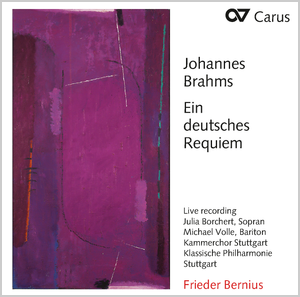
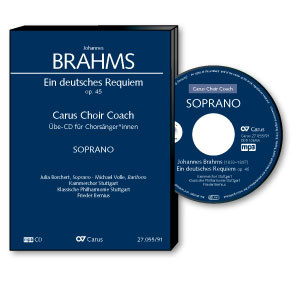
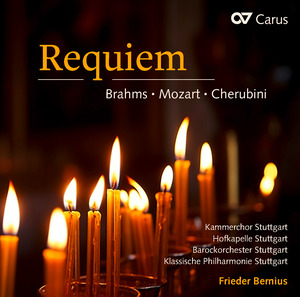
Depuis sa première représentation intégrale à la cathédrale de Brême en 1868, le Requiem allemand de Brahms compte indiscutablement parmi les oeuvres clés de l'histoire de l'oratorio. La valeur de cette oeuvre ne résulte pas seulement de sa facture musicale inhabituellement dense, mais aussi de son idée textuelle d'origine : Brahms y assemble lui-même les sentences de l'Ancien et du Nouveau Testament dans la traduction de Luther, de façon à ce que les idées de "deuil" et de "réconfort" soient reliées de manière évidente. À l'inverse de nombreux oratorios du 19ème siècle, Brahms place le chœur, c'est à dire les voix de l'assemblée, au centre de cette messe des morts oecuménique.
Découvrir
 Consulter

 Ecouter
(7)
Ecouter
(7)
- Selig, sind, die da Leid tragen
- Denn alles Fleisch es ist wie Gras
- Herr, lehre mich
- Wie lieblich sind deine Wohnungen
- Ihr habt nur Traurigkeit
- Denn wir haben hier keine bleibende Statt
- Selig sind die Toten
 S`exercer
-
-
Aides à l'apprentissage
-
Aides à l'apprentissage voix soprano
- Selig, sind, die da Leid tragen (Choir Coach)
- Selig, sind, die da Leid tragen (Choir Coach, Slow mode)
- Denn alles Fleisch es ist wie Gras (Choir Coach)
- Denn alles Fleisch es ist wie Gras (Choir Coach, Slow mode)
- Herr, lehre mich (Choir Coach)
- Herr, lehre mich (Choir Coach, Slow mode)
- Wie lieblich sind deine Wohnungen (Choir Coach)
- Wie lieblich sind deine Wohnungen (Choir Coach, Slow mode)
- Ihr habt nur Traurigkeit (Choir Coach)
- Ihr habt nur Traurigkeit (Choir Coach, Slow mode)
- Denn wir haben hier keine bleibende Statt (Choir Coach)
- Denn wir haben hier keine bleibende Statt (Choir Coach, Slow mode)
- Selig sind die Toten (Choir Coach)
- Selig sind die Toten (Choir Coach, Slow mode)
-
Aides à l'apprentissage voix alto
- Selig, sind, die da Leid tragen (Choir Coach)
- Selig, sind, die da Leid tragen (Choir Coach, Slow mode)
- Denn alles Fleisch es ist wie Gras (Choir Coach)
- Denn alles Fleisch es ist wie Gras (Choir Coach, Slow mode)
- Herr, lehre mich (Choir Coach)
- Herr, lehre mich (Choir Coach, Slow mode)
- Wie lieblich sind deine Wohnungen (Choir Coach)
- Wie lieblich sind deine Wohnungen (Choir Coach, Slow mode)
- Ihr habt nur Traurigkeit (Choir Coach)
- Ihr habt nur Traurigkeit (Choir Coach, Slow mode)
- Denn wir haben hier keine bleibende Statt (Choir Coach)
- Denn wir haben hier keine bleibende Statt (Choir Coach, Slow mode)
- Selig sind die Toten (Choir Coach)
- Selig sind die Toten (Choir Coach, Slow mode)
-
Aides à l'apprentissage voix tenore
- Selig, sind, die da Leid tragen (Choir Coach)
- Selig, sind, die da Leid tragen (Choir Coach, Slow mode)
- Denn alles Fleisch es ist wie Gras (Choir Coach)
- Denn alles Fleisch es ist wie Gras (Choir Coach, Slow mode)
- Herr, lehre mich (Choir Coach)
- Herr, lehre mich (Choir Coach, Slow mode)
- Wie lieblich sind deine Wohnungen (Choir Coach)
- Wie lieblich sind deine Wohnungen (Choir Coach, Slow mode)
- Ihr habt nur Traurigkeit (Choir Coach)
- Ihr habt nur Traurigkeit (Choir Coach, Slow mode)
- Denn wir haben hier keine bleibende Statt (Choir Coach)
- Denn wir haben hier keine bleibende Statt (Choir Coach, Slow mode)
- Selig sind die Toten (Choir Coach)
- Selig sind die Toten (Choir Coach, Slow mode)
-
Aides à l'apprentissage voix basse
- Selig, sind, die da Leid tragen (Choir Coach)
- Selig, sind, die da Leid tragen (Choir Coach, Slow mode)
- Denn alles Fleisch es ist wie Gras (Choir Coach)
- Denn alles Fleisch es ist wie Gras (Choir Coach, Slow mode)
- Herr, lehre mich (Choir Coach)
- Herr, lehre mich (Choir Coach, Slow mode)
- Wie lieblich sind deine Wohnungen (Choir Coach)
- Wie lieblich sind deine Wohnungen (Choir Coach, Slow mode)
- Ihr habt nur Traurigkeit (Choir Coach)
- Ihr habt nur Traurigkeit (Choir Coach, Slow mode)
- Denn wir haben hier keine bleibende Statt (Choir Coach)
- Denn wir haben hier keine bleibende Statt (Choir Coach, Slow mode)
- Selig sind die Toten (Choir Coach)
- Selig sind die Toten (Choir Coach, Slow mode)
-

 Compléments
- Acheter des compléments au format téléchargement.
-
 Texte numérique (sans notes), licence d'impression incluse, fichier html, paroles, originalfichier html, paroles, original (Extrait)I Selig sind die da Leid tragen (Coro)
Selig sind, die da Leid tragen,
II Denn alles Fleisch es ist wie Gras (Coro)
denn sie sollen getröstet werden.
(Matthäus 5, 4)
Die Tränen säen, werden mit Freuden ernten.
Sie gehen hin und weinen und tragen edlen Samen,
und kommen mit Freuden und bringen ihre Gaben.
(1. Petrus 1, 24)
Denn alles Fleisch, es ist wie Gras
und alle Herrlichkeit des Menschen wie des Grases Blumen.
Das Gras ist verdorret und die Blume abgefallen.
(1. Petrus, 1, 24)So seid nun geduldig, lieben Brüder,
bis auf die Zukunft des Herrn.
Siehe, ein Ackermann wartet
auf die köstliche Frucht der Erde
und ist geduldig darüber,
bis er empfahe
den Morgenregen
und Abendregen.
So seid geduldig.
(Jakobus 5, 7)Denn alles Fleisch es ist wie Gras
und alle Herrlichkeit des Menschen wie des Grases Blumen.
Das Gras ist verdorret und die Blume abgefallen.
Aber des Herrn Wort bleibet in Ewigkeit.
(1. Petrus 1, 24+25)
Die Erlöseten des Herrn werden wiederkommen,
und gen Zion kommen...
-
Texte numérique (sans notes), licence d'impression incluse, fichier html, Texte introductif, en anglaisfichier html, Texte introductif, en anglais (Extrait)Abridged Foreword of the Edition Carus 27.055
Günter Graulich
Translation: Peter PalmerTogether with the Passions of J. S. Bach and the Requiem by W. A. Mozart, Johannes Brahms’s Ein deutsches Requiem (A German Requiem) occupies a preeminent place in the choral works of the concert repertoire. Brahms’s contemporaries laid particular emphasis on three things: the undogmatic, ultimately ecumenical choice of biblical texts, the balance and consistency in the design, and the masterly ease with which the composer succeeded in combining historical techniques and harmonies new for the period into a convincing unity.
The choice of texts is of a completely new kind. The traditional Latin requiem text is a prayer for the deceased in light of the imminent Last Judgement. Those biblical passages which Brahms selected, on the other hand, emphasize that it is not the dead but the bereaved who are in need of peace and consolation. It is true that Brahms alludes to the Last Judgement, for the line “For the trumpet shall sound” from the First Epistle to the Corinthians clearly recalls the “Tuba mirum spargens sonum“ of the liturgical text. But immediately the hope is expressed
...
-
Texte numérique (sans notes), licence d'impression incluse, fichier html, Texte introductif, en allemandfichier html, Texte introductif, en allemand (Extrait)Gekürztes Vorwort der Ausgabe Carus 27.055
Günter Graulich
Unter den Chorwerken des Konzertrepertoires nimmt Ein deutsches Requiem von Johannes Brahms mit den Passionen von Johann Sebastian Bach und dem Requiem von Wolfgang Amadeus Mozart einen führenden Platz ein. Brahms’ Zeitgenossen hoben drei Dinge besonders hervor: die undogmatische, letztlich überkonfessionelle Auswahl der Textstellen, die Ausgewogenheit und Geschlossenheit der Werkanlage und die Souveränität, mit der es der Komponist verstanden hatte, historische Satztechniken und damals neue Harmonien zu einer überzeugenden Einheit zu verbinden.
Gänzlich neuartig ist die Textwahl: Der traditionelle lateinische Requiemtext ist ein Gebet für den Verstorbenen angesichts des drohenden Jüngsten Gerichts. Die von Brahms gewählten Bibelstellen betonen hingegen, dass nicht die Toten, sondern die Hinterbliebenen der Ruhe und des Trostes bedürfen. Brahms spielt zwar auf das Jüngste Gericht an: Der Vers „Denn es wird die Posaune schallen“ aus dem ersten Korintherbrief erinnert deutlich an das „Tuba mirum spargens sonum“ des liturgischen Textes. Es wird aber sofort die Hoffnung ausgesprochen, dass
...
Acheter
Informations complémentaires sur l'œuvre
Sommaire


-
Compositeur
Johannes Brahms
| 1833-1897Johannes Brahms' study of musical tradition was of crucial importance to his output: he combined church modes, canonic technique, Baroque style and diction, Bach's counterpoint and Beethoven's thematic-motivic work with the harmonic and expressive achievements of Romanticism to form his own distinctive style. In this respect his choral songs and vocal quartets (e.g. the “Liebeslieder Waltzes” and “New Liebeslieder Waltzes”), often to folk song texts, in which a musical microcosm unfolds, are examplary. His “Deutsches Requiem”, available from Carus in several different versions, constitutes one of the most fascinating confessions of faith in the history of music. Plus d'information sur la personne
-
L'auteur de l'avant-propos
Thomas Schnidt-Beste
-
Chœur
Kammerchor Stuttgart
The Kammerchor Stuttgart is regarded as one of the best ensembles of its kind. Over its fifty-year existence, Frieder Bernius has developed the choir into an exceptional ensemble acclaimed by audiences and press alike. This has led to invitations for the choir to perform at all the important European festivals. In Germany the chamber choir performs at festivals and in concert halls in repertoire ranging from the 17th to the 21st century. Frieder Bernius and his ensemble have received numerous accolades for their contribution to new music. The Kammerchor Stuttgart has made over 80 CDs and LPs, numerous of which have been awarded international recording prizes (including the Edison award, Diapason d’or, Gramophone Choice, Classical Internet Award, International Classical Music Award, and German Record Critics’ Award prizes). The International Federation for Choral Music has invited the ensemble to sing at the 1st, 4th and 10th World Symposia on Choral Music in Vienna, Sydney and Seoul. Regular tours of North America and Asia since 1988 and a South America tour reflect the Kammerchor Stuttgart’s international reputation. Since 1984 the top ensemble has also been invited to Israel biennially. Plus d'information sur la personne
-
Ensemble
Klassische Philharmonie Stuttgart
La Klassische Philharmonie Stuttgart se compose de musiciens d’orchestres symphoniques et d’ensembles chambristes allemands de première classe qui travaillent depuis longtemps avec Frieder Bernius. L’orchestre joue sur des instruments modernes mais chef d’orchestre et musiciens accordent une importance particulière à la différenciation stylistique. Dans la représentation d’œuvres symphoniques chorales à grande distribution, la Klassische Philharmonie Stuttgart est le pendant orchestral au Kammerchor Stuttgart. La Klassische Philharmonie Stuttgart a participé à différents festivals comme le Festival musical du Rheingau, le Festival musical européen de Stuttgart, le Festival international de Bade-Wurtemberg, le festival « Wratislavia Cantans » de Wroc³aw (Pologne), les Journées musicales de Kassel, la Société philharmonique de Bruxelles et les Herbstliche Musiktage de Bad Urach. L’idée de créer un partenaire instrumental de niveau équivalent au Kammerchor Stuttgart a été dernièrement consacrée par le Requiem allemand de Johannes Brahms enregistré ensemble. La revue française Répertoire a certifié à Frieder Bernius que sa vision de l’œuvre est une « pulvérisation discographique ». Plus d'information sur la personne
-
Chef d'orchestre
Frieder Bernius
| 1947Frieder Bernius’s work has earned great worldwide recognition. He is in demand internationally as a conductor and as a teacher. His principal artistic collaborators are the ensembles he founded himself, the Kammerchor Stuttgart, the Barockorchester Stuttgart, the Hofkapelle Stuttgart and the Klassische Philharmonie Stuttgart. As a guest conductor, he has collaborated repeatedly with, for example, the SWR Vokalensemble Stuttgart, the Deutsche Kammerphilharmonie Bremen, the Stuttgarter Kammerorchester and the Streicherakademie Bozen. Great stylistic versatility is Frieder Bernius’s hallmark. Whether he conducts vocal works by Monteverdi, Bach, Händel, Mozart, Beethoven, Fauré and Ligeti, stage music by Mendelssohn or symphonies by Haydn, Burgmüller and Schubert, his work always aims for a sound that is at once unmistakably personal and at the same time oriented towards the original period sound ideal. He devotes himself equally to the rediscovery of 18th century operas and to first performances of contemporary compositions. He is particularly interested in the musical history of southwestern Germany. Carus-Verlag has awarded Frieder Bernius a Golden CD for his complete recording of the sacred music of Felix Mendelssohn Bartholdy. The award was presented to him during the German Choir Festival in Stuttgart 2016. The sale of over 250,000 recordings, which has been acclaimed with a number of awards, has made a not insignificant contribution to what today is the obvious presence of Mendelssohn's complete œuvre in the concert repertoire. Plus d'information sur la personne
-
Solist - soprano
Julia Borchert
Julia Borchert ist seit 1997 als lyrischer Sopran am Niedersächsischen Staatstheater Hannover verpflichtet. Die in Bad Pyrmont geborene Sängerin begann an der Essener Folkwangschule ein Musiktheaterstudium, das sie bei Professor Ingeborg Most in Freiburg fortsetzte und 1991 im Rahmen der Künstlerischen Reifeprüfung mit Auszeichnung abschloß. Im selben Jahr trat sie ihr erstes Engagement am Nationaltheater Mannheim an und blieb dem Hause sechs Jahre lang verbunden. Als ständiger Gast singt die Künstlerin im Württembergischen Staatstheater Stuttgart seit 1995 die Gretel (Hänsel und Gretel). Weitere Gastspiele führten sie nach Karlsruhe, Bern, Düsseldorf, Köln und an die Bayerische Staatsoper München. Neben dem Opernfach gilt Julia Borcherts besondere Liebe dem Lied- und Konzertgesang. Plus d'information sur la personne
-
solist - baryton
Michael Volle
Critiques
Ballastfrei
A crack choir and an orchestra that yield little to more prestigious bands, infused with love for the work by a conductor who, most of all, lets the detail of the score do the work.
Gramophone, April 2008
Eine Wohltat: Der Kammerchor Stuttgart darf mit seiner vollumfänglichen Eloquenz glänzen; jedes Pianissimo, jeder gestalterische Akzent, auch die Intonation sitzen vernehmlich. Vernehmlich meint: nicht von jener romantischen Sauce überdeckt, mit der man gewöhnlich diesem Werk auf großsinfonische Beine aufhelfen zu müssen glaubt. Zudem schreitet Frieder Bernius voran wie weiland Klemperer, ohne die dem Werk inhärente Trauer in die Breite und damit platt zu drücken. Eine empfehlenswerte Alternative zu Abbado, Barenboim, Karajan etc.
Fono Forum 2/1999
1897 wurde des 100. Todestages von Johannes Brahms gedacht. Aus diesem Anlass führte der Kammerchor Stuttgart mit der Klassischen Philharmonie Stuttgart am 2. November in einem Konzert sein „Deutsches Requiem” auf, das zwischen 1861 und 1868 komponiert wurde. Den Text für die 7 Sätze stellte Brahms selbst nach Worten des Alten und Neuen Testaments zusammen. Der vorliegende CD-Mitschnitt des Konzertes dokumentiert aufs Eindringlichste die Kompetenz der beiden Ensembles unter Frieder Bernius, wobei die beiden Solisten nicht unwesentlich zum überaus positiven Gesamtbild beitragen!
Singende Kirche 4/1999
Auch wenn sich das Brahms-Requiem, was den Repertoirewert einer Aufnahme betrifft, nicht gerade einen Spitzenplatz erhoffen kann, so lohnt die Anschaffung dieser CD dennoch. Zwei hervorragende Solisten, der gekonnt die großen Bögen herausarbeitende Dirigent und die sich in differenzierten dynamischen Staffelungen hervorragend bewährenden Ensembles, Chor und Orchester, hinterlassen bei einer sehr plastischen Aufnahme einen Gesamteindruck der Spitzenklasse.
Württembergische Blätter für Kirchenmusik 6/2000
Les évaluations sur notre site web ne peuvent être effectuées que par des clients disposant d'un compte d'utilisateur enregistré. Il n'est pas vérifié si les produits évalués ont été effectivement achetés.
Aucune évaluation disponible pour ce produit.
Questions fréquentes sur l'œuvre
 Il n'y a pas encore de questions et réponses concernant cette œuvre ou vous n'avez pas trouvé la réponse à votre question sur l'œuvre ? Cliquez ici et envoyez votre question spécifique à notre service clients.