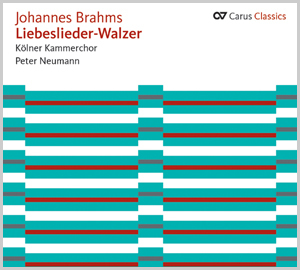
Liebeslieder-Walzer (Carus Classics)
Carus Classics features outstanding CD productions from the past library of recordings. This exclusive collection, designed by Friedrich Forssman and Cornelia Feyll, is presented in high-quality DigiPacs and each CD includes an extensive booklet.
"All four parts blend nicely, even at high dynamic level. The chorus sings with good line and the ‘pleading’ phrasing, which communicates these love-songs so well, is beautifully done."
American Record Guide, May 1992
Découvrir
 Ecouter
(17)
Ecouter
(17)
- Le soir
- Rede, Mädchen | Am Gesteine rauscht die Flut
- O die Frauen | Wie des Abends schöne Röte | Die grüne Hopfenranke
- Ein kleiner, hübscher Vogel | Wohl schön bewandt war
- Wenn so lind dein Auge mir | Am Donaustrande | O wie sanft
- Nein, es ist nicht auszukommen | Schlosser, auf, und mache Schlösser
- Vögelein durchrauscht die Luft | Sieh, wie ist die Welle klar | Nachtigall, sie singt so schön
- Ein dunkeler Schacht ist Liebe | Nicht wandle, mein Licht | Es bebet das Gesträuche
- Verzicht, o Herz, auf Rettung | Finstere Schatten der Nacht
- An jeder Hand die Finger | Ihr schwarzen Augen |Wahre, wahre deinen Sohn | Rosen steckt mir an die Mutter
- Vom Gebirge Well auf Well | Weiche Gräser im Revier
- Nagen am Herzen | Ich kose süß | Alles, alles in den Wind
- Schwarzer Wald, dein Schatten | Nein, Geliebter, setze dich | Flammenauge, dunkles Haar
- Zum Schluss: Nun, ihr Musen, genug
- Sehnsucht
- Nächtens
- Vier Zigeunerlieder: Himmel strahlt so helle | Rote Rosenknospen künden | Brennessel steht an Weges Rand | Liebe Schwalbe, kleine Schwalbe
Acheter
Informations complémentaires sur l'œuvre
Sommaire


-
Compositeur
Johannes Brahms
| 1833-1897Johannes Brahms' study of musical tradition was of crucial importance to his output: he combined church modes, canonic technique, Baroque style and diction, Bach's counterpoint and Beethoven's thematic-motivic work with the harmonic and expressive achievements of Romanticism to form his own distinctive style. In this respect his choral songs and vocal quartets (e.g. the “Liebeslieder Waltzes” and “New Liebeslieder Waltzes”), often to folk song texts, in which a musical microcosm unfolds, are examplary. His “Deutsches Requiem”, available from Carus in several different versions, constitutes one of the most fascinating confessions of faith in the history of music. Plus d'information sur la personne
-
L'auteur de l'avant-propos
Roland Kunz
| 1960Roland Kunz was born in Saarlouis in 1960 and studied musicology, art history and literature in Saarbrücken before completing vocal studies in Holland and Frankfurt / Main. As a countertenor he was a permanent member of numerous ensembles. Since 1983 he has been a radio presenter and programmer for SR 2 KulturRadio, BR, SWR and WDR and is involved in music education. He has composed numerous full-length works, including three oratorios “Der Seele Ruh,” “PAX!” and “Hildegard,” as well as the song cycle “nine-and-fifty-swans,” which was nominated for the German Record Critics’ Award. For his work he was nominated for the “European Radio Award” and received the culture award of the city and district of Saarlouis. Plus d'information sur la personne
-
Ensemble
Kölner Kammerchor
-
Chef d'orchestre
Peter Neumann
| 1940-2025In recent years Peter Neumann, born in Karlsruhe, has made a name for himself particularly as a conductor of Handel’s music. This is demonstrated both by the concert series “250 Years Handel Oratorios” which he initiated – performing nine music dramas in accordance with Handel’s concert schedule of 1749–1752 – and by his numerous CD recordings. He has performed masterworks from vocal and orchestral music in the European musical capitals and at many renowned festivals, ranging from Monteverdi’s L’Orfeo and Vespers for the Blessed Virgin (Palais Garnier, Paris) through J. S. Bach’s passions (last in Moscow, Oslo and Versailles) and Mass in B minor (BBC Proms) to Debussy’s Le Martyre de Saint Sébastien at the MusikTriennale in Cologne. 2010, Peter Neumann and his ensembles Kolner Kammerchor and Collegium Cartusianum were guests at the Rheingau Music Festival with Schumann’s Das Paradies und die Peri and at the Schumann Festival in Dusseldorf as well as the Leipzig Bach Festival in 2011. In June 2012 he made his highly acclaimed debut at the Cologne Opera with Handel’s Alcina. As a guest conductor, Neumann has collaborated with, among others, ChorWerkRuhr, the Netherlands Chamber Choir, the SWR Vokalensemble Stuttgart, the NDR Choir, the Schola Cantorum Tokyo, the Concertgebouw Orchestra Amsterdam, the Jerusalem Symphony Orchestra, the Junge Deutsche Philharmonie and Concerto Koln. Highlights of his extensive discography include the complete recording of Mozart’s masses (Gramophone “Crown of Crowns”), Schutz’s Musical Vesper, Schumann’s Missa sacra (Diapason d’Or) and recordings of Bach’s St. John Passion and Handel’s Alexander’s Feast and Brockes Passion (Carus). Plus d'information sur la personne
-
Solist - piano
Andreas Rothkopf
-
Solist - piano
Barbara Nußbaum
Critiques
Untitled Document
Mit Sicherheit liegt hier eine beispielhafte Einspielung dieser beiden Kompositionen vor.
Markus Schauermann, Singende Kirche, 2/2016
Das Werk mündet in requiem-ungewohnte, jubelnden Töne, die das ensemble3 unter Hans Michael Beuerle mit leichter Hand umsetzt.
APA, 07.06.2016
Les évaluations sur notre site web ne peuvent être effectuées que par des clients disposant d'un compte d'utilisateur enregistré. Il n'est pas vérifié si les produits évalués ont été effectivement achetés.
Aucune évaluation disponible pour ce produit.
Questions fréquentes sur l'œuvre
 Il n'y a pas encore de questions et réponses concernant cette œuvre ou vous n'avez pas trouvé la réponse à votre question sur l'œuvre ? Cliquez ici et envoyez votre question spécifique à notre service clients.