

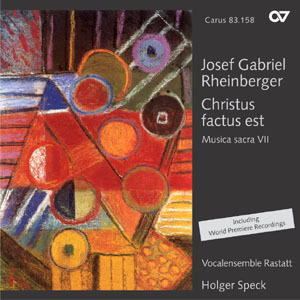
Christus factus est (Musica sacra VII)
 Ecouter
(22)
Ecouter
(22)
- Prope est Dominus
- Universi
- Qui sedes
- Meditabor (Denken will ich)
- Christus factus est (Christus ward für uns gehorsam)
- Kyrie
- Gloria
- Credo
- Sanctus
- Benedictus
- Agnus Dei
- Ad te levavi
- Ex Sion
- Deus tu convertens
- Benedixisti
- Rorate coeli
- Ave Maria
- Kyrie
- Gloria
- Credo
- Sanctus/Benedictus
- Agnus Dei
 Compléments
-
 Texte numérique (sans notes), licence d'impression incluse, fichier html, paroles, traduction en anglaisfichier html, paroles, traduction en anglais (Extrait)1. Kyrie
Lord, have mercy on us.
2. Gloria
Christ, have mercy on us.
Lord, have mercy on us.Glory be to God on high
3. Credo
and on earth peace to men of good will.
We praise thee; we bless thee; we adore thee; we glorify thee.
We give thee thanks for thy great glory.
Lord God, heavenly King, God the almighty Father.
O Lord, the only-begotten Son, Jesus Christ,
O Lord God, Lamb of God, Son of the Father.
Thou who takest away the sins of the world, have mercy upon us.
Thou who takest away the sins of the world, receive our prayer.
Thou that sittest at the right hand of God the Father, have mercy upon us.
For thou alone art the Holy One, thou alone art the Lord,
thou alone art the Most High, Jesus Christ.
With the Holy Ghost in the glory of God the Father. Amen.I believe in one God, the Father almighty,
Maker of heaven and earth
and of all things visible and invisible.
And in one Lord Jesus Christ,
the only-begotten Son of God,
begotten of his Father before all ages.
God of God, light of light, true God of true God,
begotten, not made, being of one substance with the Father,
by whom all things were made....
-
Texte numérique (sans notes), licence d'impression incluse, fichier html, paroles, traduction allemandefichier html, paroles, traduction allemande (Extrait)1. Kyrie
Herr, erbarme dich unser.
2. Gloria
Christus, erbarme dich unser.
Herr, erbarme dich unser.Ehre sei Gott in der Höhe
3. Credo
und Friede auf Erden den Menschen, die guten Willens sind.
Wir loben dich, wir preisen dich, wir beten dich an, wir rühmen dich.
Wir danken dir, denn groß ist deine Herrlichkeit.
Herr und Gott, König des Himmels, Gott, allmächtiger Vater.
Herr Jesus Christus, eingeborener Sohn,
Herr und Gott, Lamm Gottes, Sohn des Vaters.
Du nimmst hinweg die Sünden der Welt, erbarme dich unser;
Du nimmst hinweg die Sünden der Welt, nimm an unser Gebet.
Du sitzest zur Rechten des Vaters: erbarme dich unser.
Denn du allein bist der Heilige, du allein der Herr,
du allein der Höchste, Jesus Christus.
Mit dem Heiligen Geist, zur Ehre Gottes, des Vaters. Amen.Ich glaube an den einen Gott, den allmächtigen Vater,
der alles geschaffen hat, Himmel und Erde,
die sichtbare und die unsichtbare Welt.
Und an den einen Herrn Jesus Christus,
Gottes eingeborenen Sohn,
aus dem Vater geboren vor aller Zeit:
Gott von Gott, Licht vom Licht, wahrer Gott vom wahren Gott,...
-
Texte numérique (sans notes), licence d'impression incluse, fichier html, paroles, originalfichier html, paroles, original (Extrait)1. Kyrie
Kyrie eleison,
2. Gloria
Christe eleison,
Kyrie eleison.Gloria in excelsis Deo.
3. Credo
Et in terra pax hominibus bonae voluntatis.
Laudamus te, benedicimus te, adoramus te, glorificamus te,
gratias agimus tibi propter magnam gloriam tuam.
Domine Deus, rex coelestis, Deus Pater omnipotens.
Domine Fili unigenite, Jesu Christe.
Domine Deus, Agnus Dei, Filius Patris,
qui tollis peccata mundi, miserere nobis.
Qui tollis peccata mundi, suscipe deprecationem nostram.
Qui sedes ad dexteram Patris, miserere nobis.
Quoniam tu solus Sanctus, tu solus Dominus,
tu solus Altissimus, Jesu Christe,
cum sancto spiritu in gloria Dei Patris. Amen.Credo in unum Deum, Patrem omnipotentem,
factorem coeli et terrae,
visibilium omnium et invisibilium.
Et in unum Dominum Jesum Christum,
Filium Dei unigenitum,
et ex Patre natum ante omnia saecula.
Deum de Deo, lumen de lumine, Deum verum de Deo vero,
genitum, non factum, consubstantialem Patri:
per quem omnia facta sunt.
Et incarnatus est de spiritu sancto ex Maria Virgine
et homo factus est.
Crucifixus etiam pro nobis:
sub Pontio...
-
Texte numérique (sans notes), licence d'impression incluse, fichier html, Texte introductif, en anglaisfichier html, Texte introductif, en anglais (Extrait)Abridged text from the CD Carus 83.467
Barbara Mohn
Translation: Earl RosenbaumWhen Josef Gabriel Rheinberger, Professor of composition at the Royal School of Music in Munich, was appointed Court Conductor for church music by the Bavarian King Ludwig II he took on one of the central positions, most rich in tradition in Catholic church music – it was once held by Orlando di Lasso. Rheinberger was responsible for directing church music at the All Saints Church in Munich on Sundays and feast days, from December through May. This meant that on normal Sundays a mass and two motets (for the Graduale and the Offertorium) were performed. For these performances he had a mixed choir of about 40 well-trained singers at his disposal. Rheinberger took great pleasure in his new duties. According to his wife Fanny, more than once he told her “he would not yearn for any other position in his lifetime.” He personally copied out numerous autographs from the 16th–18th centuries in order to expand the repertoire of the Court Choir and he dedicated himself with new enthusiasm to the composition of church music.
Since the days of his childhood Rheinberger regarded sacred music as his special love. His musical career began at the age of
...
-
Texte numérique (sans notes), licence d'impression incluse, fichier html, Texte introductif, en allemandfichier html, Texte introductif, en allemand (Extrait)Gekürzter Booklet-Text der CD Carus 83.467
Barbara Mohn
Als Josef Gabriel Rheinberger, Professor für Komposition an der Königlichen Musikschule in München, 1877 vom bayerischen König Ludwig II. zum Hofkapellmeister für Kirchenmusik ernannt wurde, übernahm er eines der zentralen und traditionsreichsten Ämter innerhalb der katholischen Kirchenmusik im Deutschen Reich – ein Amt, das einst ein Orlando di Lasso innegehabt hatte. Rheinberger oblag die Leitung der Kirchenmusik an der Allerheiligen-Hofkapelle in München an allen Sonn- und Festtagen von Dezember bis Mai. Dies bedeutete an gewöhnlichen Sonntagen die Aufführung einer Messe und zweier Motetten (zum Graduale und Offertorium) mit einem Chor von rund 40 gut ausgebildeten Sängerinnen und Sängern. Rheinberger fand an seinen neuen Aufgaben großen Gefallen; seiner Frau Fanny zufolge sagte er mehr als einmal, „er würde sich in seinem Leben nach keiner anderen Stelle sehnen.“ Eigenhändig schrieb er zahlreiche Musikhandschriften des 16. bis 18. Jahrhunderts ab, um das Repertoire der Hofkapelle zu erweitern, und widmete sich selbst mit neuer Begeisterung der Komposition von Kirchenmusik.
Rheinbergers
...
Sommaire


-
Compositeur
Josef Gabriel Rheinberger
| 1839-1901Josef Gabriel Rheinberger, né en 1839 à Vaduz, mort en 1901 à Munich. Élève de J.G. Herzog, J.J. Maier et Fr. Lachner. Considéré comme l'une des personnalités les plus importantes de l'enseignement du 19e siècle ; a travaillé à partir de 1859 comme professeur à l'école royale de musique de Munich, puis comme professeur de composition et d'orgue ; maître de chapelle de la cour en 1877. De son vaste opus se distinguent les 20 sonates pour orgue ; outre ses œuvres de musique de chambre, ses œuvres chorales sacrées et profanes sont également précieuses. Plus d'information sur la personne
-
L'auteur de l'avant-propos
Barbara Mohn
-
Chœur
Vocalensemble Rastatt
Alongside its dedication to a core repertoire of composers such as Monteverdi, Schütz, Bach, Mozart, Haydn, Schumann, and Brahms, the Vocalensemble Rastatt & Les Favorites frequently explore new terrain with premiere performances. On the heels of its successes in national and international choir competitions, the ensemble has taken part in numerous internationally acclaimed CD recordings as well as radio, and television productions for SWR, Radio France, Deutschlandradio Kultur, and Deutschlandfunk. The Vocalensemble Rastatt & Les Favorites have performed in the Festspielhaus Baden-Baden, the Musikfest Bremen, the Kölner Philharmonie, the SWR RheinVokal Festival, the Europäisches Musikfest Stuttgart, the Schwetzinger Festspiele, the Deutschlandradio Kultur Wartburgkonzerte, the Internationale Musiktage im Dom zu Speyer, the Philharmonie in Mulhouse, and the Centre de Musique “Les Dominicains” in Guebwiller, France, among other venues. The flexible choir does not shy away from excursions into the world of opera, having performed Donizetti’s Lucia di Lammermoor and Bellini’s Norma with Edita Gruberova, and Mozart’s Don Giovanni and Così fan tutte with Rolando Villazón. Together with Klaus Maria Brandauer and the Chamber Orchestra of Europe, the choir also performed Mendelssohn’s Sommernachtstraum at the Musikfest Bremen. The ensemble is sponsored by the German state of Baden-Württemberg in co-operation with its “Kunst 2020” program, as well as by its home city of Rastatt. Plus d'information sur la personne
-
Chef d'orchestre
Holger Speck
Holger Speck enjoys an international reputation as a charismatic conductor who succeeds both in realizing stylistic characteristics in an innovative manner and in conveying emotional content. Fanfare magazine from the USA attests to his “undeniable authority.” With his distinctive sense of sound and compelling, lively and authentic interpretations, he shapes the image of his own ensembles as well as the choirs and orchestras with which he works as a guest conductor. The president of the German Bundestag Dr. Wolfgang Schäuble engaged him and his Vocalensemble Rastatt for a concert during the G20 summit. Speck established the Grammy-nominated Vocalensemble Rastatt and the Baroque orchestra Les Favorites internationally with exciting concert programs and outstanding CD recordings on the Carus label containing music by Buxtehude, Telemann, Handel and Brahms, among others. For Deutsche Grammophon productions, he was responsible for the choral sections of the Mozart operas “Die Entführung aus dem Serail,” “Le nozze di Figaro,” “Così fan tutte,” and “Don Giovanni.” Holger Speck teaches at the University of Music in Karlsruhe; in addition to being the artistic director of Vocalensemble Rastatt & Les Favorites, he works as a guest conductor with the NDR Vokalensemble, the Freiburg Baroque Orchestra, the Akademie für Alte Musik Berlin, and the choir and orchestra of the Slovenian Philharmonic Orchestra in Ljubljana, among others. The ballet director John Neumeier engaged Speck to conduct his last major creation “Dona nobis pacem” with Bach’s Mass in B minor at the Hamburg State Opera and the Festspielhaus Baden-Baden. . Plus d'information sur la personne
-
Solist - orgue
Thomas Berning
Critiques
Rheinberger, Josef Gabriel: Christus factus est
Josef Gabriel Rheinberger
Artistic Quality 10/10 Sound Quality
When you hear music of such high caliber, much of which is being recorded for the first time, you have to wonder why it’s remained in obscurity for so long. Although Josef Rheinberger is not one of the 19th century’s ”big names”, he should be. In a review of an earlier Carus CD of Rheinberger’s music for women’s voices (type Q4701 in Search Reviews) I mentioned the inevitable comparisons with Brahms, who was an almost exact contemporary. Here, if there are any similarities worth mentioning, they extend to the chromaticism characteristic of Bruckner’s motets (Rheinberger’s Universi and Deus tu convertens motets, for example) and the gently contoured melodic features and tightly-knit harmonic style of Stanford (Benedixisti). But for the most part, these works, including the two masses, exhibit Rheinberger’s own straightforward yet extremely effective treatment of texts, highlighted by his masterful use of harmony and rhythmic inflection to color and inform the phrases.
The Missa in G, one of the three world-premieres on the program, deserves serious attention by all choirs who perform sacred music. While perfectly suited for the context of a service, the sophistication of the writing and unusually eloquent, articulate text-setting takes this mass way beyond the merely functional to a rare and sublime realm that compels careful listening--and feeling. When you can make even the Credo interesting--and then finish with one of the more beautiful realizations of the Sanctus/Benedictus/Agnus Dei sequence ever created, you belong to the ranks of only the most gifted church music composers. Although the Missa in A (another world-premiere), scored for three-part women’s chorus, three soloists, and organ, isn’t quite as musically interesting as the G major work, it does have its very lovely moments (especially in the Sanctus and Benedictus) and nevertheless is uniformly tuneful, harmonically engaging (with some very nice ”chant” effects in the Credo), and compact--ideal for liturgical use. The beautiful Agnus Dei easily could stand alone as a church anthem.
Of the two longer motets, the Christus factus est is a challenging, ambitious work if more traditional in form with its declamatory, homophonic opening and elaborate, fugal ending. The Meditabor, scored for six-part chorus (SSATTB) is a miniature masterpiece that shows Rheinberger’s most accomplished vocal writing in the context of rich textures, judicious use of chromatic harmony, and simple yet affecting melodies. Each oft the nine Advent motets is a sparkling little gem - again, this is music that should be in the performing repertoire of every good choir - and in the CD collection of every true choral fan.
And as for the choir on ibis recording - the Vocalensemble Rastatt, a group of 20-plus young singers that specializes in 19th- and 20th-century a cappella music - it’s hard to imagine a finer advocate for Rheinberger’s work, nor is it possible to offer anything but praise for the quality of the singing (lovely sopranos!), the attention to ensemble balance, and the careful shaping of phrases and expressive nuances. The sound is vibrant yet nicely detailed, creating an ideal sense of space while preserving the music’s essential intimacy.
David Vernier
Quelle: Classics Today.com, 3.4.2000
Rheinberger, Josef Gabriel: Christus factus est
Kein Zweifel – in den letzten Jahren hat eine lebendige Rheinberger-Renaissance eingesetzt, die sich nicht nur zunehmend im Kirchenchor-Repertoire niederschlägt, sondern auch auf dem CD-Markt, und das durch alle Besetzungssparten. Im besten Sinne schuldig ist hier der Stuttgarter Carus-Verlag mit seiner Notengesamtausgabe der Werke des gebürtigen Liechtensteiners, die bis 2008 abgeschlossen sein soll. Sozusagen zwangsläufig bieten sich aus dem dort erschlossenen Fundus des Spätromantikers (1839–1901) immer wieder Weltersteinspielungen für die Tonträgerindustrie an, und Carus mischt auch da erfreulich aktiv mit. Gleich zwei Messen sowie das „Christus factus est” erklingen erstmals auf dessen neuester Hausproduktion, und man fragt sich bereits nach den ersten Takten, warum diese Werke so lange von den Programm-Machern unerhört blieben. Dem Vocalensemble Rastatt gelingt jene feingliedrige Durchsichtigkeit, die die fragile Architektur in keinem Moment erschüttert. Nach dieser Veröffentlichung werden die Nachfragen nach entsprechendem Notenmaterial womöglich abrupt in die Höhe schnellen ...und das völlig zu Recht!
Quelle: Cantate, Mai-Juni 2003
Rheinberger, Josef Gabriel: Christus factus est
Josef Gabriel Rheinberger’s sacred vocal music is becoming much better known but until now there have been no recordings available of same of his important church music works. This CD includes two frequently performed masses: the Missa St. Crucis and the Mass for women’s choir (in aversion with organ accompaniment). There are also several interesting motets by Rheinberger, including the Nine Advent Motets, the six-voice Meditabor and Christus factus est (another a world premiere). The excellent Vocalensemble Rastatt is directed by Holger Speck, and gives outstanding performances of same of Rheinberger’s best-known and loved compositions.
Quelle: New Classics, 09/05
Les évaluations sur notre site web ne peuvent être effectuées que par des clients disposant d'un compte d'utilisateur enregistré. Il n'est pas vérifié si les produits évalués ont été effectivement achetés.
Questions fréquentes sur l'œuvre
 Il n'y a pas encore de questions et réponses concernant cette œuvre ou vous n'avez pas trouvé la réponse à votre question sur l'œuvre ? Cliquez ici et envoyez votre question spécifique à notre service clients.