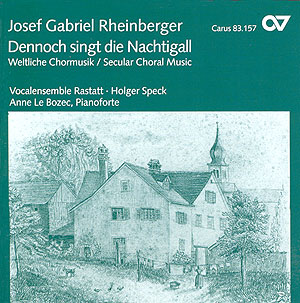
Dennoch singt die Nachtigall. Musique profane pour chœur.


 Ecouter
(23)
Ecouter
(23)
- L'amour est un bouquet de roses
- La source
- Dennoch singt die Nachtigall
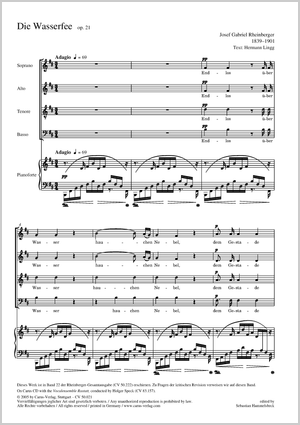
- Die Wasserfee
- Lockung
- En mars
- All meine Gedanken
- Perte
- Frühling ohn’ Ende
- Vent du Nord
- Früh morgens
- Repos de midi
- Retour à la maison
- Der Strom
- Rhapsody
- Salut à la forêt
- Thievish love
- Trois randonneurs
- Calme du soir
- Bonne nuit
- Im Erdenraum
- St. Nepomuks Vorabend
- Die Nacht
Sommaire


-
Compositeur
Josef Gabriel Rheinberger
| 1839-1901Josef Gabriel Rheinberger, né en 1839 à Vaduz, mort en 1901 à Munich. Élève de J.G. Herzog, J.J. Maier et Fr. Lachner. Considéré comme l'une des personnalités les plus importantes de l'enseignement du 19e siècle ; a travaillé à partir de 1859 comme professeur à l'école royale de musique de Munich, puis comme professeur de composition et d'orgue ; maître de chapelle de la cour en 1877. De son vaste opus se distinguent les 20 sonates pour orgue ; outre ses œuvres de musique de chambre, ses œuvres chorales sacrées et profanes sont également précieuses. Plus d'information sur la personne
-
L'auteur de l'avant-propos
Barbara Mohn
-
Chœur
Vocalensemble Rastatt
Alongside its dedication to a core repertoire of composers such as Monteverdi, Schütz, Bach, Mozart, Haydn, Schumann, and Brahms, the Vocalensemble Rastatt & Les Favorites frequently explore new terrain with premiere performances. On the heels of its successes in national and international choir competitions, the ensemble has taken part in numerous internationally acclaimed CD recordings as well as radio, and television productions for SWR, Radio France, Deutschlandradio Kultur, and Deutschlandfunk. The Vocalensemble Rastatt & Les Favorites have performed in the Festspielhaus Baden-Baden, the Musikfest Bremen, the Kölner Philharmonie, the SWR RheinVokal Festival, the Europäisches Musikfest Stuttgart, the Schwetzinger Festspiele, the Deutschlandradio Kultur Wartburgkonzerte, the Internationale Musiktage im Dom zu Speyer, the Philharmonie in Mulhouse, and the Centre de Musique “Les Dominicains” in Guebwiller, France, among other venues. The flexible choir does not shy away from excursions into the world of opera, having performed Donizetti’s Lucia di Lammermoor and Bellini’s Norma with Edita Gruberova, and Mozart’s Don Giovanni and Così fan tutte with Rolando Villazón. Together with Klaus Maria Brandauer and the Chamber Orchestra of Europe, the choir also performed Mendelssohn’s Sommernachtstraum at the Musikfest Bremen. The ensemble is sponsored by the German state of Baden-Württemberg in co-operation with its “Kunst 2020” program, as well as by its home city of Rastatt. Plus d'information sur la personne
-
Chef d'orchestre
Holger Speck
Holger Speck enjoys an international reputation as a charismatic conductor who succeeds both in realizing stylistic characteristics in an innovative manner and in conveying emotional content. Fanfare magazine from the USA attests to his “undeniable authority.” With his distinctive sense of sound and compelling, lively and authentic interpretations, he shapes the image of his own ensembles as well as the choirs and orchestras with which he works as a guest conductor. The president of the German Bundestag Dr. Wolfgang Schäuble engaged him and his Vocalensemble Rastatt for a concert during the G20 summit. Speck established the Grammy-nominated Vocalensemble Rastatt and the Baroque orchestra Les Favorites internationally with exciting concert programs and outstanding CD recordings on the Carus label containing music by Buxtehude, Telemann, Handel and Brahms, among others. For Deutsche Grammophon productions, he was responsible for the choral sections of the Mozart operas “Die Entführung aus dem Serail,” “Le nozze di Figaro,” “Così fan tutte,” and “Don Giovanni.” Holger Speck teaches at the University of Music in Karlsruhe; in addition to being the artistic director of Vocalensemble Rastatt & Les Favorites, he works as a guest conductor with the NDR Vokalensemble, the Freiburg Baroque Orchestra, the Akademie für Alte Musik Berlin, and the choir and orchestra of the Slovenian Philharmonic Orchestra in Ljubljana, among others. The ballet director John Neumeier engaged Speck to conduct his last major creation “Dona nobis pacem” with Bach’s Mass in B minor at the Hamburg State Opera and the Festspielhaus Baden-Baden. . Plus d'information sur la personne
-
Solist - piano
Anne Le Bozec
Critiques
Rheinberger: Secular Choral Music
Rheinberger: Secular Choral Music
Carus Verlag, Stuttgart, the publisher of the new complete edition of Rheinberger’s works, has also brought out eight CDs of his music, primarily choral music. Each of these is of highest quality, not only in the excellence of its performers but in every aspect of its production--all of which applies in special measure to this newest release.
First and foremost to be noted is the remarkable artistry of the Rastatt Ensemble (once the workplace of JKF Fischer) and its young director, Holger Speck. The sound of this 27-voice mixed choir is akin to pure gold. It is not like the American choral timbre or the English boy choir sound. The Rastatt choral sonority has a translucent purity and clarity, impeccable intonation, perfect ensemble, a wide spectrum of lovely colors, and ravishing dynamic plasticity and control. The perfection of the high notes in the soprano, whether loud or muted, is astonishing. Only a very few times in my life have I heard such glorious choral work.
This selection of 23 of Rheinberger’s secular choral songs is a cross-section of pieces for various vocal ensembles--SATB, SSA, TTBB, etc--affording us the opportunity to hear each section of the choral group--and includes many types of pieces in diverse moods. Some are bright folksong-like partsongs; others are deeply sensual or thoughtful. A few are supplied with piano accompaniment, beautifully performed by Mile LeBozec, and the last has a string ensemble with piano. The superb notes inform us that secular choral music constituted a quarter of Rheinberger’s oeuvre! In style , these works belong to the body of romantic lieder by Schubert, Schumann, and Brahms. They are richly melodious, with independence of all vocal parts, set in tapestries of luminous harmony, and show an especially sensitive treatment of the German words. This last may be difficult to appreciate fully, since there is no translation, but Rheinberger’s sure hand at text setting is nothing short of cloquent.
Hearing the music and following the romantic, image-saturated poetry reminded me of how intensively 19th Century artists lived, immersed in the inner world of the imagination, and of how affected they were by feelings; also of how estranged from this ephemeral world we have become in our deteminedly technocratic times. This recording was made in the studio-auditorium of the Southwest Radio, Karlsruhe. Nevertheless, the sound is enhanced by surprising resonance and is warm and natural. This is an exceptional recording, not to be overlooked.
Quelle: COPYRIGHT 2002 Record Guide Productions
Les évaluations sur notre site web ne peuvent être effectuées que par des clients disposant d'un compte d'utilisateur enregistré. Il n'est pas vérifié si les produits évalués ont été effectivement achetés.
Questions fréquentes sur l'œuvre
 Il n'y a pas encore de questions et réponses concernant cette œuvre ou vous n'avez pas trouvé la réponse à votre question sur l'œuvre ? Cliquez ici et envoyez votre question spécifique à notre service clients.