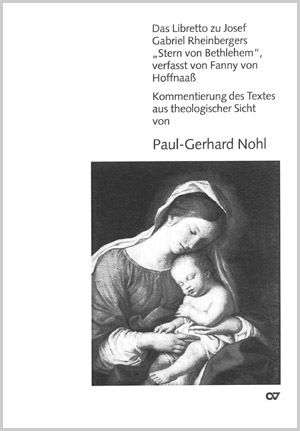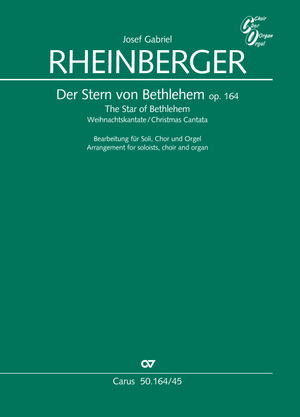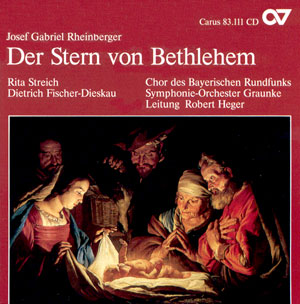
Si vous cherchez une œuvre poétique et lyrique, gratifiante pour votre chœur, Stern von Bethlehem (L’étoile de Bethléem) de Rheinberger est la pièce qu’il vous faut. Le compositeur réalise un tableau poétique de l’histoire de Noël en neuf scènes (l’attente, les bergers, l’apparition de l’ange, l’étoile,…). Les chœurs mélodieux et bucoliques, une partie de soprano profonde et enfin le cheminement évocateur des couleurs de l’Orient des mages dans le désert apportent à cette œuvre composée en 1890 une popularité croissante. Le texte a été écrit par Fanny, l’épouse de Rheinberger.
En raison de leur effectif similaire, l’œuvre peut être associée à Vom Himmel hoch (Carus 40.189/00) ou Die Geburt Christi (Carus 40.131/00) de Mendelssohn. Pour rendre cette œuvre si poétique, colorée et romantique au bon sens du terme accessible à un nombre encore plus grand de chœurs, Carus propose une adaptation pour solistes, chœur et orgue (Carus 50.164/45).
Découvrir


 Ecouter
(10)
Ecouter
(10)
- Erscheinung des Engels
- Anbetung der Weisen
- Die Hirten an der Krippe
- Erwartung
- Die Hirten. Pastorale
- Bethlehem
- Die Hirten an der Krippe
- Der Stern
- Maria
- Erfüllung
Acheter
Informations complémentaires sur l'œuvre
Sommaire


-
Compositeur
Josef Gabriel Rheinberger
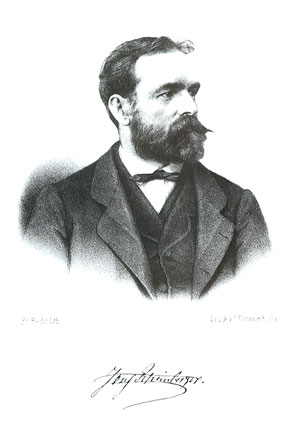
| 1839-1901Josef Gabriel Rheinberger, né en 1839 à Vaduz, mort en 1901 à Munich. Élève de J.G. Herzog, J.J. Maier et Fr. Lachner. Considéré comme l'une des personnalités les plus importantes de l'enseignement du 19e siècle ; a travaillé à partir de 1859 comme professeur à l'école royale de musique de Munich, puis comme professeur de composition et d'orgue ; maître de chapelle de la cour en 1877. De son vaste opus se distinguent les 20 sonates pour orgue ; outre ses œuvres de musique de chambre, ses œuvres chorales sacrées et profanes sont également précieuses. Plus d'information sur la personne
-
Parolier/Librettiste
Franziska (Fanny) von Hoffnaaß
| 1831-1892Fanny von Hoffnaaß, geb. 1831 in Schloss Maxlrain, gest. 1892 in München. Gattin Josef Rheinbergers. Schrieb Gedichte und Prosa. Plus d'information sur la personne
-
L'auteur de l'avant-propos
Hans-Josef Irmen
| 1938-2007
-
L'auteur de l'avant-propos
Harald Wanger
| 1933-2011
-
Ensemble
Chor des Bayerischen Rundfunks
-
Ensemble
Symphonie-Orchester Graunke
-
Chef d'orchestre
Robert Heger
-
Solist - soprano
Rita Streich
-
solist - baryton
Dietrich Fischer-Dieskau
Critiques
Carus 83
Josef GabrieI Rheinberger: Der Stern von Bethlehem, op. 164
Nach der Herausgabe von Klavierauszug und Partitur (Reprints der Originalausgaben von 1891) ist nun die vor zwanzig Jahren erfolgte Einspielung dieses stimmungsvollen Werkes auf CD in hervorragender Tonqualität erhältlich. Die Weihnachtskantate steht in Rheinbergers Schaffen am Ende einer Reihe von Chorwerken, die ihre Entstehung der mehr als zwanzig Jahre dauernden Verbindung zum Münchner Oratorienverein verdanken; zugleich ist sie auch das letzte oratorische Werk, dem Rheinberger einen Text seiner Gattin Fanny von Hoffnaaß zugrunde legte. Der neunteilige Gedichtzyklus behandelt die Weihnachtsgeschichte nach den Evangelisten Lukas und Matthäus in stimmungsvollen Bildern, wobei es der Verfasserin mit ihrer freien Deutung der biblischen Ereignisse gelingt, Stimmung und Wärme der alpenländischen Weihnacht einzufangen. Ein imposantes Werk, das in einer wunderschönen Einspielung viel von der Freude der Heiligen Nacht mitteilen kann.
Walter Sengstschmid
Quelle: Singende Kirche 3/1988, S. 157
Die Aufnahme ist in vielerlei Hinsicht hochkarätig: Insbesondere Dietrich Fischer-Dieskaus Bariton ist über jede Kritik erhaben, aber auch die Leistungen aller anderen Solisten sind untadelig. Dabei verfällt die Aufnahme von 1968 weder in sentimentale Rührung noch verharrt sie in makelloser, aber trockener Stillosigkeit, sie findet die gelungene Balance zwischen diesen Extremen und schafft so eine überzeugende Darstellung.
Quelle: Kirchenmusik im Bistum Limburg 1/2001, S. 60
This is a classic recording of a rare Christmas piece. Its origins are in the 1960s and an EMI Electrola session in Munich.
You are immediately aware of Rheinberger’s almost nerveless, serene, undulating continuity of expression. Majesty too shines through these pages with the great choral cries at 5.45 and 6.10 leaving us in no doubt that the composer had hit a very strong vein of inspiration. Of course the idiom is late-romantic. Beyond that you can imagine a passionate and blessed land between say Wagner’s Tannhäuser, Beethoven’s Pastoral and Brahms’ German Requiem. Streich is superb, almost childlike yet full of tone; not at all operatic. In fact her style is more liederabend than theatre; just as with Fischer-Dieskau. The engineers wrought a perfect full-throttle balance between Streich’s voice and the starry powers of the massed choir. The Bavarian Radio choir are also good at the intimacy of the crib scene (tr. 5) with its glances towards Berlioz and his l’Enfance du Christe. This score is packed tight with eloquent, pungent and passionate writing distinguished by some meltingly lovely writing for the soloists (especially Streich), the radiant chorus, the harp (try tr. 8 Maria) and the woodwind. The high leaping melodic theme which weaves its delight throughout this work is perhaps part of the inspiration behind Othmar Schoeck’s more intimate vocal style.
The sung text is printed in German and English although not side by side. There are extremely full notes in German and a much shorter though adequate text in English. The words of Stern are by the composer’s wife Franziska who died seven days after its world premiere at the Dresden Kreuzkirche on 24 December. Rheinberger could never bring himself to hear the work again. It brought back memories that were too sorrowful to be supportable. Rheinberger himself died in his adopted home city of Munich on 25 November 1901. He first came to Munich in 1851 to study at the Conservatoire. After the Second World War his remains were exhumed from the Munich cemetery and returned to his native town of Vaduz in Liechtenstein where he had been born on 17 March 1839.
Not with standing the short playing time this work, rather like Cyril Rootham’s Ode on the Morn of Christ’s Nativity, is far too good to be heard only at Christmas.
Rob Barnett
Quelle: Classical Music on the Web www.musicweb.uk.net (March 2003)
Les évaluations sur notre site web ne peuvent être effectuées que par des clients disposant d'un compte d'utilisateur enregistré. Il n'est pas vérifié si les produits évalués ont été effectivement achetés.
Aucune évaluation disponible pour ce produit.
Questions fréquentes sur l'œuvre
 Il n'y a pas encore de questions et réponses concernant cette œuvre ou vous n'avez pas trouvé la réponse à votre question sur l'œuvre ? Cliquez ici et envoyez votre question spécifique à notre service clients.