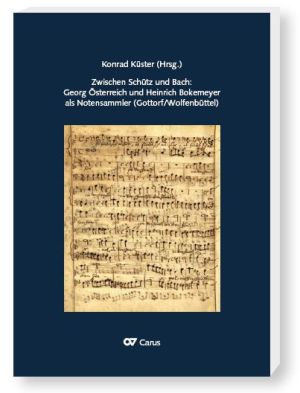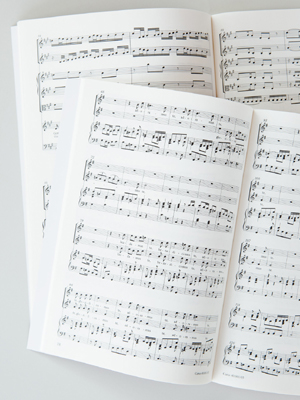
Heinrich Schütz und andere zeitgenössische Musiker in der Lehre Giovanni Gabrielis
Studien zu ihren Madrigalen
-
L'auteur
Siegfried Schmalzriedt
| 1941-2008
-
Éditeur
Georg von Dadelsen
| 1918-2007
-
Sujet (livre)
Giovanni Gabrieli
| 1554-1612Année de naissance incertaine : 1554 ou 1557 à Venise, décédé en 1612 là-bas.
Giovanni Gabrieli était l'un des musiciens les plus marquants de l'école vénitienne du 16e siècle. Il était musicien d'église à la basilique Saint-Marc de Venise, où Monteverdi lui a succédé après sa mort. Parmi les élèves les plus importants de Gabrieli figure Heinrich Schütz, qui a suivi une formation de trois ans auprès de Gabrieli.
Le style de Gabrieli se caractérise par la polychoralité vénitienne, la basse continue et la théorie des affects ; il écrivit également des madrigaux. Ses motets polychoraux sont écrits pour jusqu'à 16 voix et 15 instruments et témoignent de la splendeur sonore qui devait régner à l'époque dans la basilique Saint-Marc. Ses Symphoniae Sacrae I et II ainsi que ses nombreuses canzoni sont bien connues. Gabrieli écrivait principalement de la musique chorale sacrée.
Plus d'information sur la personne
-
Sujet (livre)
Heinrich Schütz
| 1585-1672Heinrich Schütz is regarded as the first German musician of European stature. As a choirboy from 1599 at the court of Landgrave Moritz of Hessen-Kassel, he received a thorough education. In 1608 he began a law degree in Marburg, but broke this off in 1609 in order, with the support of the Landgrave, to study composition with Giovanni Gabrieli, organist at St Mark’s in Venice. In 1613 Schütz returned to Kassel, but two years later was enticed away by Elector Johann Georg I of Saxony to the Dresden court as “Organist und Director der Musica”, where he held the position of Hofkapellmeister (court Kapellmeister) from 1617 until his death. Schütz’s great cycles of vocal works marked the high point of his reputation in Germany and northern Europe. But these represent only part of Schütz’s output; individual works are represented in printed collections with works by other composers, others only survive in manuscript, and much has been lost. The Stuttgart Schütz Edition makes available Schütz’s complete oeuvre, and all works are also published in practical Urtext editions. Plus d'information sur la personne
Les évaluations sur notre site web ne peuvent être effectuées que par des clients disposant d'un compte d'utilisateur enregistré. Il n'est pas vérifié si les produits évalués ont été effectivement achetés.
Questions fréquentes sur l'œuvre
 Il n'y a pas encore de questions et réponses concernant cette œuvre ou vous n'avez pas trouvé la réponse à votre question sur l'œuvre ? Cliquez ici et envoyez votre question spécifique à notre service clients.