

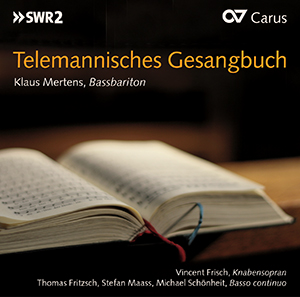
Telemannisches Gesangbuch
 Ecouter
(30)
Ecouter
(30)
- Gott des Himmels und der Erden
- Gott Lob, der Sonntag kommt herbei
- Mit Ernst, o Menschenkinder
- Puer natus in Bethlehem / Ein Kind geborn zu Bethlehem
- Freuet euch, ihr Christen alle
- Nun lasst uns gehn und treten
- Herr, nun läss'st du deinen Diener im Friede fahren
- O Lamm Gottes, unschuldig
- O Haupt voll Blut und Wunden
- Erstanden ist der heilig Christ
- Jesus, meine Zuversicht
- Komm, Heiliger Geist, Herre Gott
- Wir gläuben all an einen Gott
- Ein feste Burg
- Wenn dich Unglück hat betreten
- Aus tiefer Not schrei ich zu dir
- Befiehl du deine Wege
- Jesu, meine Freude, meines Herzens Weide
- Wer weiß, wie nahe mir mein Ende?
- Wenn wir in höchsten Nöten sein
- Auf meinen lieben Gott
- Nun lob, mein Seel, den Herren
- Ach wie nichtig, ach wie flüchtig
- Mitten wir im Leben sind
- Valet will ich dir geben
- Wach't auf, ruft uns die Stimme / Auf, auf! und lasst uns wachsam sein
- Jesaja, dem Propheten, das geschah
- O Wonn, o Freud, o Herrlichkeit
- Wie der Hirsch im großen Dürsten
- Nun danket alle Gott
 Compléments
-
 Texte numérique (sans notes), licence d'impression incluse, fichier html, paroles, traduction en anglaisfichier html, paroles, traduction en anglais (Extrait)??
1. Solo Soprano and Chorus Now thank we all our God, who wondrous things has done through ages without end.
2. Duet (Tenor and Basso) Who from our mother’s loving arms has blest us with gifts of love for all your needs.
3. Aria (Alto) He gives to us a joyful heart and everlasting peace to cheer us in this time in Israel.
4. Chorus And his gracious mercy stays with us always and delivers us so long as we are living.
Jesus Sirach 50:24–26
Translation: Robert Scandrett...
-
Texte numérique (sans notes), licence d'impression incluse, fichier html, paroles, originalfichier html, paroles, original (Extrait)
1. Solo Sopran und Chor Nun danket alle Gott, der große Dinge tut an allen Enden.
2. Duett (Tenor und Bass) Der uns von Mutterleibe an lebendig erhält und tut uns alles Guts.
3. Arie (Alt) Er gebe uns ein fröhliches Herz, und verleihe immerdar Friede zu unsrer Zeit in Israel.
4. Chor Auf dass seine Gnade stets bei uns bleibe und erlöse uns, solange wir leben.
Jesus Sirach 50,24–26
...
-
Texte numérique (sans notes), licence d'impression incluse, fichier html, Texte introductif, françaisfichier html, Texte introductif, français (Extrait)Texte du CD Carus 83.439
Klaus Hofmann
Traduction (abrégée): Sylvie CoquillatLa longue vie de Georg Philipp Telemann est l’histoire d’un succès tel que ne le connurent que très peu de compositeurs à son époque. Il fit par trois fois le récit de sa vie, en 1718, en 1729 et en 1740. Dans les témoignages de 1718 et 1740, il décrit son parcours en détail d’une plume alerte et divertissante – et parfois, ses descriptions se lisent presque comme l’exposé d’un roman.
Un roman qui commence à Magdebourg, où Telemann naît le 14 mars 1681. Son père, prédicateur à l’église du Saint-Esprit, meurt dès 1685. Les dons musicaux du fils se révèlent très tôt, héritage venu de sa mère qui, après que le garçon de douze ans avait fait représenter un opéra de sa plume, et inquiète qu’il ne devienne un « saltimbanque, un funambule, un joueur des rues, un montreur de marmottes etc. », s’efforce cependant de l’orienter vers
...
-
Texte numérique (sans notes), licence d'impression incluse, fichier html, Texte introductif, en anglaisfichier html, Texte introductif, en anglais (Extrait)Text from the CD Carus 83.439
Klaus Hofmann
Translation (abridged): Elizabeth RobinsonGeorg Philipp Telemann’s long life was a success story, the like of which was enjoyed by very few composers of his era. He wrote his autobiography three times – in 1718, 1729 and 1740. In his 1718 and 1740 accounts, he described his career in detail, with an adept turn of phrase and in storytelling mode; in parts, his description reads almost like the plot of a novel.
The story begins in Magdeburg, where Telemann was born on 14 March 1681. His father, a clergyman at the Heilig-Geist-Kirche, died in 1685. His son’s musical ability was evident at an early age, inherited from his mother’s side of the family. However, after her twelve-year-old son performed an opera he had composed himself, Telemann’s mother, concerned that he would become a “juggler, tightrope walker, minstrel, marmot driver, etc.”,
...
-
Texte numérique (sans notes), licence d'impression incluse, fichier html, Texte introductif, en allemandfichier html, Texte introductif, en allemand (Extrait)Booklet-Text der CD Carus 83.439
Klaus Hofmann
Georg Philipp Telemanns langes Leben ist eine Erfolgsgeschichte, wie sie nur wenigen Komponisten seiner Epoche beschieden war. Dreimal hat er selbst sein Leben beschrieben, zuerst 1718 für den Abdruck in Johann Matthesons Großer General-Baß-Schule, dann erneut 1729 für Johann Gottfried Walthers Musicalisches Lexicon (1732) und ein drittes Mal 1740 für Matthesons Grundlage einer Ehren-Pforte. Während der Lebensabriss für das Lexikon knapp gehalten ist, schildert Telemann in den beiden Berichten für Mattheson seinen Werdegang mit gewandter Feder ausführlich und in Erzähllaune – und partienweise liest sich seine Darstellung fast wie das Exposé eines Romans.
Dieser Roman beginnt in Magdeburg, wo Telemann am 14. März 1681 zur Welt kommt. Früh zeigt sich die musikalische Begabung des Sohnes, ein Erbe von Seiten der Mutter, die sich indes, nachdem der Zwölfjährige eine selbstkomponierte
...


-
L'auteur de l'avant-propos
Thomas Fritzsch
Thomas Fritzsch, a specialist for the music of the 17th and 18th centuries, is an internationally renowned and celebrated viola da gamba player. He performs in the concert halls of Europe as well as on the stages of metropolises such as New York, Boston, Tokyo, Seoul, Abu Dhabi, Dubai, Havana, Jerusalem and Tel Aviv. The names of the artists with whom Thomas Fritzsch has collaborated over the past three decades reads like a ‘Who’s Who’ of the international music scene. His profound knowledge of the field of historical music is documented in a plethora of radio and television productions, an extensive discography as well as various editions and musicological publications. Time and again, he has succeeded in making startling discoveries in seemingly well-known fields, such as, most recently, the world premiere and first recording of four hitherto unknown sonatas for viola da gamba and cembalo or fortepiano by Johann Christian Bach. Plus d'information sur la personne
-
Solist - soprano
Vincent Frisch
Vincent Frisch is a member of the boys' choir collegium iuvenum Stuttgart (cis). The choir was founded in 1989. Working with around about 180 boys and young men, the choir’s musical aims are to perpetuate the heritage and riches of sacred choral music from many epochs at the highest artistic level. As well as this, choral singing contributes greatly to the personal development of the singers. Friedemann Keck, a retired university music director, school and church musician, has directed the choir since 1990. The choir is supported by the Friends of the collegium iuvenum Stuttgart e.V. Plus d'information sur la personne
-
solist - baryton
Klaus Mertens
-
solist - luth
Stefan Maass
Stefan Maass studied classical guitar and lute, specializing in music of the 17th and 18th centuries, both as a soloist and as a continuo player. He is Lord of Batzdorf Castle near Meißen and co-founder of the Batzdorf Hofkapelle. He regularly performs in the opera houses of Halle and Karlsruhe, the Semper Opera Dresden and the Gran Teatre del Liceu in Barcelona. His numerous CD productions include collaborations with the Dresdner Kammerchor conducted by Hans-Christoph Rademann and the Capella Sagittariana, the Dresdner Staatskapelle, Thomas Quasthoff, Daniel Hope and the contralto Britta Schwarz, as well as with the actors Corinna Harfouch and Michael Quast. Stefan Maass was awarded the prestigious Arras Prize for Art and Culture in Dresden in March 2000. Plus d'information sur la personne
-
Solist - orgue
Michael Schönheit
Michael Schönheit was the winner of the 1984 International Johann Sebastian Bach Competition in Leipzig. He was appointed organist of the Gewandhaus Leipzig in 1986, where – together with the ensemble ‘Merseburger Hofmusik’, which he founded in 1998 – he performed the complete cantatas and organ works of Dieterich Buxtehude in a threeyear concert series commemorating the 300th anniversary of Buxtehude’s death. Schönheit is also cathedral organist in Merseburg and artistic director of the ‘Merseburger Orgeltage’. He teaches organ at the ‘Hochschule für Musik Nürnberg’ and acts as juror in international competitions. He regularly performs with the Gewandhaus Orchestra Leipzig and has appeared with the ‘Sächsische Staatskapelle Dresden’, the Munich Philharmonic Orchestra and the New York Philharmonic Orchestra, as well as playing solo concerts in Europe, the USA and Japan. Plus d'information sur la personne
-
Solist - violoncelle
Thomas Fritzsch
Thomas Fritzsch, a specialist for the music of the 17th and 18th centuries, is an internationally renowned and celebrated viola da gamba player. He performs in the concert halls of Europe as well as on the stages of metropolises such as New York, Boston, Tokyo, Seoul, Abu Dhabi, Dubai, Havana, Jerusalem and Tel Aviv. The names of the artists with whom Thomas Fritzsch has collaborated over the past three decades reads like a ‘Who’s Who’ of the international music scene. His profound knowledge of the field of historical music is documented in a plethora of radio and television productions, an extensive discography as well as various editions and musicological publications. Time and again, he has succeeded in making startling discoveries in seemingly well-known fields, such as, most recently, the world premiere and first recording of four hitherto unknown sonatas for viola da gamba and cembalo or fortepiano by Johann Christian Bach. Plus d'information sur la personne
Critiques
They are substantial additions to our knowledge of Telemann's compositional activities and of musical and spiritual life of his time. Add to that the outstanding performances and one may understand that these discs deserve an emphatic recommendation.
Johan van Veen, Musica Dei Donum, 2018
Klaus Mertens erweist sich hier als ein exzellenter Meister seines Faches, der auf einfühlsame Art jedem der einzelnen Choräle gerecht wird. […] Die Continuospieler unterstützen die Sänger auf eine Art und Weise, die auch Maßstäbe setzt.
Manfred H. Harras, Mitteilungen der Viola-da-gamba-Gesellschaft, Dezember 2013
Die Schönheit mancher Komposition […] wird in dieser Besetzung richtig deutlich. Gut, wenn eine Lieder-Sammlung nicht nur auf dem Papier bedeutsam ist, sondern so zum Leben erweckt wird.
Christine Lanz, Concerto Nr. 252, November/Dezember 2013
[…] ein Programm, das zuncähst durch die kluge Dramaturgie überzeugt. […] Klaus Mertens singt die Melodien ohne erhabenes Getöse. Er repektiert ihre geistliche Schlichtheit, ihre sakrale Innigkeit. […] Der Bassbariton formt die Texte mit natürlicher barocker Rhetorik. Er gestaltet die Worte klar und deutlich, in allen Lagne stimmlich ausgeglichen. Einen erfrischenden Kontrapunkt setzt die jugendliche Sopranstimme von Vincent Frisch.
pizzicato, 5/2013
Fraglos ein Plädoyer für Lied und Gesangbuch.
Johannes Adam, Badische Zeitung, 10. Mai 2013
Hervorzuheben ist das klar gegliederte, außerordentlich plastische Klangbild, das sämtliche Details wunderbar deutlich und doch integriert in einen Gesamtzusammenhang präsentiert. Dazu sind die Strukturen der Konstellation in einer angemessenen strukturellen Tiefe abgebildet.
Dr. Matthias Lange, klassik.com, 19, März 2013
[…] 30 dieser Melodien wurden für die vorliegende CD realisiert und zwar in sehr abwechslungsreichen Instrumentierungen, die von der Orgel-Solobegleitung über die Barocklaute und den Cembalo-Continuo bis hin zum Ensembleklang reichen. An der Seite des wunderbar unprätentiös gestaltenden Bariton Klaus Mertens gesellt sich in einigen Liedern der Stuttgarter Knabensopran Vincent Frisch dazu, was dieser Weltersteinspielung zusätzliches Kolorit verleiht.
Matthias Keller, BR-Klassik, CD-Tipps, 4. Februar 2013
Mit Mertens hat Fritsch den idealen Sänger für sein Projekt gewinnen können. Schlicht und voll inniger Empfindung singt der Bariton diese alten Lieder.
Ulrike Henningsen, NDR Kultur, 11. Februar 2013
Eine Sternstunde der Musica sacra! Die wunderbar schlanke, klar deklinierende Bass-Stimme von Klaus Mertens mit einfühlsam spielender Continuo-Gruppe - mehr braucht es nicht, um „häusliche Andacht” in Vollendung zu bieten. Die geistlichen Lieder in der Bearbeitung Telemanns liegen erstmals auf CD vor - endlich!
MDR Figaro, Take 5 - Klassik-Empfehlungen, 11. Februar 2013
Les évaluations sur notre site web ne peuvent être effectuées que par des clients disposant d'un compte d'utilisateur enregistré. Il n'est pas vérifié si les produits évalués ont été effectivement achetés.
Questions fréquentes sur l'œuvre
 Il n'y a pas encore de questions et réponses concernant cette œuvre ou vous n'avez pas trouvé la réponse à votre question sur l'œuvre ? Cliquez ici et envoyez votre question spécifique à notre service clients.