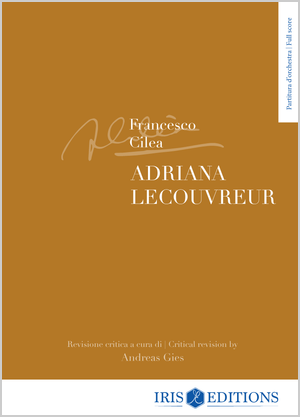
Adriana Lecouvreur


-
Compositeur
Francesco Cilea
| 1866-1950
-
Éditeur
Andreas Gies
| 1993Andreas Gies, né de parents italo-allemands, a étudié la flûte, le piano, la composition, le chant et la direction d'orchestre aux conservatoires de Castelfranco V, Venise et Milan. Après avoir obtenu une licence et deux masters, il a suivi des master classes auprès de chefs d'orchestres renommés tels que M. Beltrami et D. Gatti. Gies a été chef d'orchestre assistant dans des théâtres tels que La Fenice di Venezia et Regio di Torino. En 2019, il a remporté le « Premio Nazionale delle Arti » et a dirigé l'orchestre « La Verdi » à Milan. Il a dirigé des premières et de répresentations à Milan, Nice, Novara et Sofia.
En tant que compositeur, Gies a remporté plusieurs concours et ses œvres ont été interprétées par de grands orchestres aux États-Unis et en Italie. En collaboration avec le musicologue C. Orselli, il publie également des éditions critiques d'opéras italiens moins connus. Ses compositions comprennent des pièces pour des ensembles de musique de chambre, des orchestres et des opéras de chambre.
Plus d'information sur la personne
-
Parolier/Librettiste
Arturo Colautti
Les évaluations sur notre site web ne peuvent être effectuées que par des clients disposant d'un compte d'utilisateur enregistré. Il n'est pas vérifié si les produits évalués ont été effectivement achetés.
Questions fréquentes sur l'œuvre
 Il n'y a pas encore de questions et réponses concernant cette œuvre ou vous n'avez pas trouvé la réponse à votre question sur l'œuvre ? Cliquez ici et envoyez votre question spécifique à notre service clients.