
Francesco Cilea: Adriana Lecouvreur - Sheet music | Carus-Verlag
Iris Editions

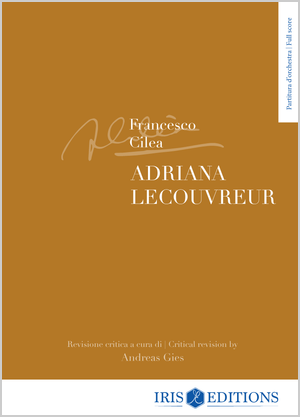
Francesco Cilea Adriana Lecouvreur

Read and write feedback
Francesco Cilea’s opera Adriana Lecouvreur has been celebrated by critics and audiences alike since its premiere in 1902. Its musical references to the eighteenth century, familiar to Cilea since his student days at the venerable Naples Conservatory, are combined with lively, lyrical melodies and the harmonious, dramatic language of verismo to create an authentic masterpiece. The autograph of the opera is in private hands and is not accessible. Cilea revised his opera in the early 1930s, and the 2021 edition by Andreas Gies is based on this revised version. It is the first printed edition of the work, which until now was available only as handwritten, facsimile performance material. Gies presents a clear, corrected musical score based on a comparison of all available sources, providing the ideal conditions for successful performances.
Purchase
Full score, for hire, foreword in Italian and English Carus 97.403/00 516 pages, 25,2 x 35,0 cm, paperback
Vocal score, for hire Carus 97.403/03 348 pages, DIN A4, paperback
Set of parts, complete orchestral parts, for hire, also available in digital form Carus 97.403/19
Full score digital (download), pdf file, for hire Carus 97.403/00-010-000 516 pages, 25,2 x 35,0 cm
Vocal score digital (download), pdf file, for hire Carus 97.403/03-010-000 348 pages, DIN A4
Set of parts digital (download), zip file, pdf file, complete orchestral parts, for hire Carus 97.403/19-010-000
We find ourselves in 1730 in the foyer of the Comédie-Française, just before an evening performance of Jean Racine’s Bajazet. The Prince de Bouillon and the Abbé de Chazeuil arrive. The latter intercepts a letter supposedly written by the actress Duclos (the Prince’s mistress). In reality, it is from the Princess de Bouillon to her former lover, Maurizio, Count of Saxony. The famous actress Adriana Lecouvreur is just going over her lines. The stage manager, Michonnet, confesses his love for her, only to learn that she in turn loves an officer serving the Count of Saxony. Meanwhile, the Prince finds an invitation in the intercepted letter to a rendezvous at Duclos’s villa and decides to surprise her there. Count Maurizio, disguised as the officer, arranges to meet Adriana after the performance but cancels once he receives the Princess’s letter, which requests a meeting about an important political matter. At this meeting, the Princess surprises Maurizio with a passionate declaration of love. To get rid of her, he hands over a bouquet of violets originally from Adriana. When the Prince suddenly arrives with the theater troupe, Maurizio convinces the jealous Adriana (who recognizes him as her beloved officer) to help smuggle the Princess out of the house. Though they cannot see each other in the dark, the two women realize they are in love with the same man. Later, at a party hosted by the Prince, Adriana is asked to perform a recitation. She and the Princess recognize each other’s voices. While the Princess provokes Adriana with mocking remarks, Adriana takes her revenge by directing the final lines of her monologue at the Princess. Back at Adriana’s house, Michonnet and the other actors gather to celebrate her birthday. A messenger brings the now withered violets and a card from Count Maurizio. Overcome with sadness, Adriana breathes in the scent of the flowers before throwing them into the fire. Maurizio arrives and convinces her of his true love, but she begins to hallucinate: the flowers were poisoned by the Princess. Adriana dies.
  • Andreas Gies, born in Italy to Italian and German parents, studied flute, piano, composition, singing, and conducting at conservatories in Castelfranco V., Venice, and Milan. He holds a bachelor’s and two master’s degrees and attended masterclasses with renowned conductors like M. Beltrami and D. Gatti. Gies has been assistant conductor at theaters such as La Fenice di Venezia and Regio di Torino. In 2019, he won the “Premio Nazionale delle Arti” and conducted the “La Verdi” orchestra of Milan. His conducting debut was in 2016 at the Mainfranken Theater Würzburg. He has conducted premieres and performances in Milan, Nice, Novara, and Sofia.

    As a composer, Gies has won several competitions and his works have been performed by major orchestras in the USA and Italy. He also produces critical editions of lesser-known Italian operas, collaborating with musicologist C. Orselli. His compositions include pieces for chamber groups, orchestras, and chamber operas.

    Personal details

Reviews on our website can only be submitted by customers with a registered user account. A check whether the rated products were actually purchased does not take place.

No feedback available for this product.

Frequent questions about this work

Pencil symbol There are no questions and answers available so far or you were unable to find an answer to your specific question about this work? Then click here and send your specific questions to our Customer Services!