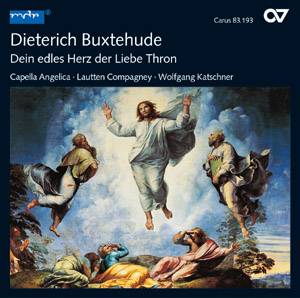
Dein edles Herz, der Liebe Thron – Kantaten
Récompensé par le BBC-Radio 3: Critics Disc of the Year
 Ecouter
(36)
Ecouter
(36)
- Nun danket alle Gott
- Sinfonia
- "Wo soll ich fliehen hin"
- "Kommt her zu mir alle"
- "O Jesu voller Gnad"
- "So wahr ich lebe"
- Adagio
- Aria "Klopfet an die Himmelspforte"
- "So komm ich nun"
- "Stärk mich mit deinem Gnadengeist"
- Befiehl dem Engel, dass er komm
- Sonata
- 1. Versus "Dein edles Herz, der Liebe Thron"
- 2. Versus "Herr, deine Liebe war zu groß"
- 3. Versus "Durch deinen Tod"
- 4. Versus "O wertes Herz"
- 5. Versus "Mein Herz ist härter als ein Stein"
- 6. Versus "O liebstes Herz, eröffne dich" + 7. Versus "O Jesu, deiner Liebe Brunst"
- Sonata
- Tutti "Jesu, meine Freude"
- Aria "Unter deinem Schirmen"
- Aria "Trotz dem alten Drachen"
- Tutti "Weg mit allen Schätzen"
- Aria "Gute Nacht"
- Tutti "Weicht, ihr Trauergeister"
- Erhalt uns, Herr, bei deinem Wort
- Sonatina
- Coro "Eins bitte ich vom Herrn"
- Aria. 1. Vers "Liebster Herr Jesu"
- Coro. 2. Vers "Es ist genug"
- Aria. 3. Vers "Ich mag nicht wohnen"
- Coro. 4. Vers "Mit der Welt"
- Aria. 5. Vers "Wenn ich in Nöten"
- Coro. 6. Vers "Alles ist eitel"
- Coro. 7. Vers "Allbereit schmücke dich"
- Coro repetatur "Eins bitte ich vom Herrn"
Sommaire

-
Compositeur
Dieterich Buxtehude
| 1637-1707There are few documents concerning Buxtehude’s life. From a contemporary article in Nova literaria Maris Balthici, published soon after his death, we know that he regarded “Denmark as his homeland, from where he came to our region.”Dieterich Buxtehude, to use the spelling of his forename which he used when signing letters, was born about 1637 in Helsingborg, so he was a subject of the King of Denmark. His father, Johannes Buxtehude, was an organist, and taught his son sufficiently for him to become, in 1657 or 1658, an organist in Helsingborg and later in Helsingør. On the 11 April 1668 he was chosen to succeed Franz Tunder as organist at St. Marien in Lübeck, and until his death on 9 May 1707 Buxtehude remained in that position, one of the most important in northern Germany. After his death in 1707 musical experts praised Dieterich Buxtehude particularly for his keyboard music. For example, Johann Mattheson referred to him as a “highly regarded, former Lübeck organist.” That appreciation was based not on printed works, but on manuscript copies of his keyboard compositions, and on his reputation as a virtuoso which he enjoyed throughout Germany. Thus in 1703 Georg Friedrich Händel and Johann Mattheson were in Lübeck, and during the winter of 1705–06 Johann Sebastian Bach also went to Lübeck to study under Buxtehude so as to perfect his technique in composition and organ playing. Together with vocal music and music for keyboard instruments, two publications of his trio sonatas are extant. We know of the “Abendmusiken” in Lübeck from libretti printed for those occasions, but unfortunately the music is lost. That tradition of events similar to concerts was taken over by Buxtehude from his predecessor Franz Tunder. Plus d'information sur la personne
-
L'auteur de l'avant-propos
Erik Dremel
-
Ensemble
Lautten Compagney Berlin
The Lautten Compagney is one of the most renowned and creative baroque instrument ensembles in Germany. Their concerts, under the artistic direction of Wolfgang Katschner, have fascinated audiences for three decades. With their infectious joy in performing and their innovative concepts, these ‘early musicians’ effortlessly translate the musical language of the Baroque to the present. Whether it’s as a solo chamber ensemble or an opera orchestra, the ensemble is continually crossing boundaries and seeking out encounters with new sounds and other art forms. The ensemble has received numerous awards for its exciting musical collaborations. For its CD recording of the program Timeless, combining early Baroque music with works by Philip Glass, it received an ECHO Klassik award in 2010. And their winning the Rheingau Musik Prize 2012 was in recognition of the Lautten Compagney’s creative concert programming. The ensemble has a particular interest in music theater, especially the works of George Frideric Handel. Their performances of Handel’s Serse on a tour of New Zealand in 2011 took both audiences and press by storm. Their production of Rinaldo, a collaboration with the Milan puppet company Carlo Colla e Figli, was enthusiastically received by young and old alike. The Lautten Compagney is a regular guest at leading national and international concert halls and festivals, including the Konzerthaus and Radialsystem V in Berlin, the Leipzig Gewandhaus, Frauenkirche Dresden, Concertgebouw Amsterdam, Vienna Musikverein, Warsaw Philharmonic, An unmistakable sound, breathtaking blend, tremendous sense of musical assurance and a good portion of charm and wit are amarcord’s special hallmarks. The group’s extremely diverse and wide-ranging repertoire encompasses medieval songs, Renaissance madrigals and masses, compositions and cycles of works from the European Romantic and 20th century as well as a cappella arrangements of folk songs from all over the world, and well-known rock, pop, soul, and jazz songs. The ensemble has won prizes at numerous international competitions. In 2002 amarcord won the Deutscher Musikwettbewerb. Alongside the Gewandhaus Orchestra and St. Thomas’s Choir, amarcord is one of the most important representatives of the music city of Leipzig at home and abroad. The group is a frequent guest at leading music festivals. Numerous concert tours have taken the singers to over fifty countries and to almost every continent in the world. In association with the Goethe-Institut they have given guest performances in Australia, South East Asia, the Middle East, Russia, Africa, and Central America. The International Festival for Vocal Music “a cappella” (www.a-cappella-festival.de), inaugurated by amarcord in 1997, has become one of the most important festivals of its kind under the group’s artistic direction. Numerous CDs impressively document the different facets of amarcord’s repertoire, and have won many prizes such as ECHO Klassik (2010, 2012), the International Classical Music Award, Supersonic Award and the Contemporary A Cappella Recording Award. Plus d'information sur la personne
-
Ensemble
Capella Angelica
-
Chef d'orchestre
Wolfgang Katschner
Wolfgang Katschner studied guitar at the Hanns Eisler High School for Music in Berlin and lute at the High School for Music and Theatrical Arts in Frankfurt am Main. Following an engagement at the Schwerin Theater, he has worked as a freelance musician since 1984. His posts have included that of manager and dramaturg for the Schütz Academy as well as a professor of lute and guitar at the Music High Schools of Berlin and Dresden. Today much of his artistic work is with the Lautten Compagney and Capella Angelica ensembles. In recent years he has also figured more and more as a conductor, enjoying great success in that role. Plus d'information sur la personne
Critiques
(BC) These CDs from Carus continue that company's splendid tercentenary tribute to the composer's sacred music. Dein edles Herz features no fewer than three world premiere recordings, one of which lasts over 17 minutes, so is hardly a minor work by 17th-century Standards! Wolfgang Katschner directs his ensemble Lautten Compagney and the vocal group he formed for larger projects, the two-to-a-part Capella Angelica, in seven works in total, which highlight the rich variety of Buxthude's output. While most of our readers will be familiar with the influence Buxtehude had on the following generation of composers (especially a certain Herr Bach), there were moments on this disc when, actually for the first time (for me, at least), I heard echoes of the past - several passages put me in mind of Tunder. The playing and singing is both very enjoyable and of the highest order, and I recommend the disc to any of our readers, not just 17th -Century fans.
Quelle: Early Music Review, June 2007
[...] Katschner verzichtet auf eigens benannte Solisten. Er findet sie in seinem ausgezeichneten Chor, dessen Mitglieder alle solistischen Passagen mustergültig singen. Die Stimmen sind schlank und klar. Strahlend schön klingen die Soprane. Indem Solisten und Choristen eins sind, gewinnt die Musik interpretatorische Dichte. Die Tontechnik erhält den Eindruck, rückt die Soli nicht über Gebühr in den Vordergrund. Auch auf Grund der Kürze der Ariosos ist der Wechsel von Arie und Chor sehr organisch.[...]
Zum immer wieder hören sind die Choräle. Die meisten der sieben hier eingespielten Stücke beruhen auf Choralmelodien. Buxtehude genügt es jedoch selten, sie am Ende seiner Kantaten einfach absingen zu lassen. Vielleicht noch stärker als dies bei Bach der Fall ist, deutet Buxtehude den Text durch Harmonik und Anlage aus. Exemplarisch geschieht dies in ,Stärk mich mit deinem Gnadengeist' von BuxVW 112. Wie schmerzlich schön es doch klingen kann, wenn sich ein Meister wünscht, in seiner letzten Stund mit ,Todesschweiß' gewaschen zu werden.
Thomas Vitzthum
Quelle: klassik.com, 23.06.2007
Les évaluations sur notre site web ne peuvent être effectuées que par des clients disposant d'un compte d'utilisateur enregistré. Il n'est pas vérifié si les produits évalués ont été effectivement achetés.
Questions fréquentes sur l'œuvre
 Il n'y a pas encore de questions et réponses concernant cette œuvre ou vous n'avez pas trouvé la réponse à votre question sur l'œuvre ? Cliquez ici et envoyez votre question spécifique à notre service clients.