

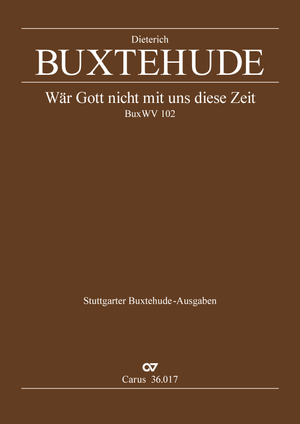
Cette mise en musique d’un chant luthérien est représentative de la composition générale d’une cantate sur choral telle que la concevait Buxtehude. Un choral à 4 voix homophones énonce le texte des 2 premières strophes, vers après vers. Les 2 violons relient le choral par des divertissements et amènent la strophe suivante par une sorte de ritournelle. Dans la troisième et dernière strophe, Buxtehude s’éloigne de ce modèle en introduisant les violons pendant l’exécution du choral et en regroupant plusieurs vers. La cantate nous est parvenue au sein d’une tablature de la collection Düben. Elle fait partie d’un corpus de cantates copiées aux alentours de 1685.
Découvrir
 Consulter
 Ecouter
(1)
Ecouter
(1)
- Wär Gott nicht mit uns diese Zeit
 Compléments
- Acheter des compléments au format téléchargement.
-
 Texte numérique (sans notes), licence d'impression incluse, fichier html, paroles, traduction en anglaisfichier html, paroles, traduction en anglais (Extrait)
If God were not on our side this day,
Israel should say,
if God were not on our side this day,
we would have had to resign,
being such a poor little band,
despised by so many sons of man,
all at war with us.
So great is their wrath against us,
that if God had allowed it,
they would have swallowed us up
life and limb entirely;
we would have been engulfed
and overwhelmed by the tide
and drowned with violence.
Praise and thank God, who did not let
us be caught in their chasm.
As a bird evades the snare,
our soul has escaped.
...
-
Texte numérique (sans notes), licence d'impression incluse, fichier html, paroles, originalfichier html, paroles, original (Extrait)
Wär Gott nicht mit uns diese Zeit,
so sollt Israel sagen,
wär Gott nicht mit uns diese Zeit,
wir hätten müssn verzagen,
die so ein armes Häuflein sind,
veracht’ von so viel Menschenkind,
die an uns setzen alle.
Auf uns ist so zornig ihr Sinn,
wo Gott das hätt zugeben,
verschlungen hätten sie uns hin
mit ganzem Leib und Leben;
wir wärn als die ein Flut ersäuft
und über die groß Wasser läuft
und mit Gewalt verschwemmet.
Gott Lob und Dank, der nicht zugab,
dass ihr Schlund uns möcht fangen.
Wie ein Vogel des Stricks kommt ab,
ist unser Seel entgangen.
...
Acheter
Informations complémentaires sur l'œuvre
-
Compositeur
Dieterich Buxtehude
| 1637-1707There are few documents concerning Buxtehude’s life. From a contemporary article in Nova literaria Maris Balthici, published soon after his death, we know that he regarded “Denmark as his homeland, from where he came to our region.”Dieterich Buxtehude, to use the spelling of his forename which he used when signing letters, was born about 1637 in Helsingborg, so he was a subject of the King of Denmark. His father, Johannes Buxtehude, was an organist, and taught his son sufficiently for him to become, in 1657 or 1658, an organist in Helsingborg and later in Helsingør. On the 11 April 1668 he was chosen to succeed Franz Tunder as organist at St. Marien in Lübeck, and until his death on 9 May 1707 Buxtehude remained in that position, one of the most important in northern Germany. After his death in 1707 musical experts praised Dieterich Buxtehude particularly for his keyboard music. For example, Johann Mattheson referred to him as a “highly regarded, former Lübeck organist.” That appreciation was based not on printed works, but on manuscript copies of his keyboard compositions, and on his reputation as a virtuoso which he enjoyed throughout Germany. Thus in 1703 Georg Friedrich Händel and Johann Mattheson were in Lübeck, and during the winter of 1705–06 Johann Sebastian Bach also went to Lübeck to study under Buxtehude so as to perfect his technique in composition and organ playing. Together with vocal music and music for keyboard instruments, two publications of his trio sonatas are extant. We know of the “Abendmusiken” in Lübeck from libretti printed for those occasions, but unfortunately the music is lost. That tradition of events similar to concerts was taken over by Buxtehude from his predecessor Franz Tunder. Plus d'information sur la personne
-
Éditeur
Thomas Schlage
-
Parolier/Librettiste
Martin Luther
| 1483-1546
Les évaluations sur notre site web ne peuvent être effectuées que par des clients disposant d'un compte d'utilisateur enregistré. Il n'est pas vérifié si les produits évalués ont été effectivement achetés.
Aucune évaluation disponible pour ce produit.
Questions fréquentes sur l'œuvre
 Il n'y a pas encore de questions et réponses concernant cette œuvre ou vous n'avez pas trouvé la réponse à votre question sur l'œuvre ? Cliquez ici et envoyez votre question spécifique à notre service clients.