Leo S. Olschki
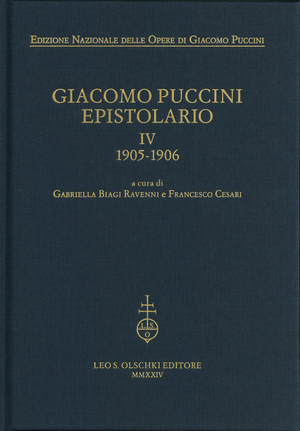
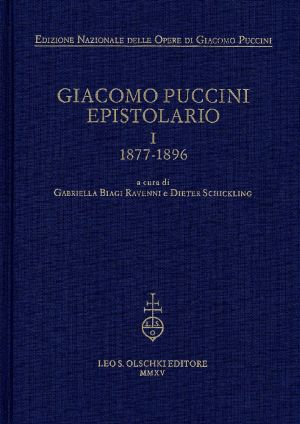
Epistolario I, 1877-1896
Edizione Nazionale Delle Opere di Giacomo Puccini
The first volume contains 784 letters, 150 of which are published for the first time. The majority of the others have been newly transcribed, corrected through comparison with their sources, or with improved dating in the frequent cases of undated autographs.
The collection conveys an image of twenty years in the life and career of Giacomo Puccini marked by radical changes. It documents the interlaced relationships with his friends and family, the ambition and difficulties he endured to sustain them, his brave existential choices. On the professional side, it illustrates the final part of his studies and his artistic growth, from Le Villi, to Edgar, to the first undisputed success of Manon Lescaut, to the final consecration of La Bohème. The letters included in this volume are also documents of the creation of Puccini’s peculiar writing qualities. The variety of addressees and of themes is matched, in fact, by a variety of tones and styles. Tender, friendly, confidential tones alternate with formal, professional, deferential, or even soapy accents. The letters mix everyday chronicles, common requests, scholarly quotes, bawdy language, and invectives. A penchant for poetry appears in the recurring rhymes that peep out in his prose, transforming the letters in poems, especially as a reply to other poetical messages. A strong graphic inspiration shines through his habit of using pictures instead of some key words, and through his original use of the space of sheets and postcards.
Published by Olschki, Florence
Acheter
Informations complémentaires sur l'œuvre
-
L'auteur
Giacomo Puccini
| 1858-1924Giacomo Puccini est issu d'une dynastie de musiciens d'église travaillant dans la ville toscane de Lucca. Sa Messa a 4 con orchestra, créée dans cette ville en 1880, semble le montrer sur cette voie, mais il entre immédiatement au Conservatoire de Milan dans le but de devenir compositeur d'opéra. C'est là qu'il écrivit ses seules pièces orchestrales indépendantes, Preludio sinfonico (1882) et Capriccio sinfonico (1883), ainsi que quelques-uns de ses 16 chants pour piano (canti), qui ont été conservés dans leur intégralité et qu'il composa presque tout au long de sa carrière en faisant souvent référence à ses opéras. C'est avec Manon Lescaut (1893) qu'il perce en tant que compositeur d'opéras ; entre 1893 et 1904, il compose ses œuvres les plus jouées à ce jour, La Bohème, Tosca et Madama Butterfly. Ces dernières années, on s'est rendu compte que l'ensemble de l'œuvre de Puccini nécessitait une réévaluation. Il est ainsi de plus en plus considéré comme un musicien à la recherche d'un nouveau départ vers la modernité. Plus d'information sur la personne
-
Éditeur
Gabriella Biagi Ravenni
-
Éditeur
Dieter Schickling
| 1939-2023Nach dem Studium der Germanistik,Anglistik und Philosophie und der Promotion in Germanistik war Dieter Schickling hauptsächlich für das Fernsehen des Süddeutschen Rundfunks Stuttgart tätig, zuletzt als Leiter der Hauptabteilung Bildung, Spiel, Unterhaltung. Seine intensive Auseinandersetzung mit Musik führte zu langjähriger Forschung über Puccini,die in verschiedene Publikationen mündete, u.a. das erste umfassende Werkverzeichnis Puccinis, 2003. Plus d'information sur la personne
Les évaluations sur notre site web ne peuvent être effectuées que par des clients disposant d'un compte d'utilisateur enregistré. Il n'est pas vérifié si les produits évalués ont été effectivement achetés.
Aucune évaluation disponible pour ce produit.
Questions fréquentes sur l'œuvre
 Il n'y a pas encore de questions et réponses concernant cette œuvre ou vous n'avez pas trouvé la réponse à votre question sur l'œuvre ? Cliquez ici et envoyez votre question spécifique à notre service clients.