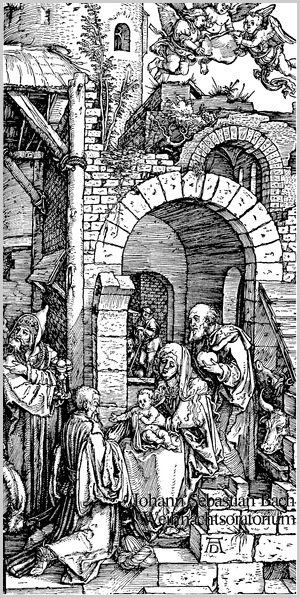
L’Oratorio de Noël est incontestablement le numéro UN du répertoire de Noël des chœurs et très apprécié par le public. L’histoire de Noël d’après le texte biblique selon Luc et Matthieu, associé à des vers libres et quelques strophes de cantiques, avec la musique baroque festive clairement structurée, dégage un rayonnement pictural d’une beauté intemporelle. Pour pouvoir suivre dans les nombreuses coloratures de doubles croches, parfois très rapides, comme « herrliche Chöre » (n°1), « Wohlgefallen » (n°21, Vivace), « Schnauben » des fiers ennemis (n°54), il est fortement recommandé de travailler avec le mode ralenti de l’application.
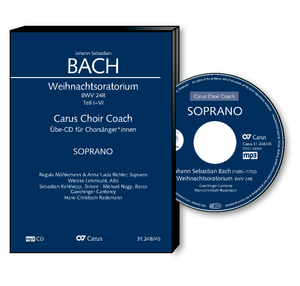
Le Carus Choir Coach offre aux choristes une aide unique pour apprendre leur voix au sein de la sonorité du chœur et de l’orchestre. Pour chaque voix, un CD audio ou MP3 et un téléchargement est disponible avec tous les mouvements chantés par le chœur. Le CD se base sur un enregistrement d’interprètes prestigieux, qui ont pour celui-ci utilisé l’édition Urtext de Carus. Chaque mouvement est présenté en trois variantes :
- Version originale
- Coach : la voix sélectionnée est jouée au piano, avec l’enregistrement original en arrière-plan
- Coach en mode ralenti : l’enregistrement comme le coach sont ralentis à environ 70 % du tempo initial, ainsi les passages difficiles peuvent être travaillés efficacement.
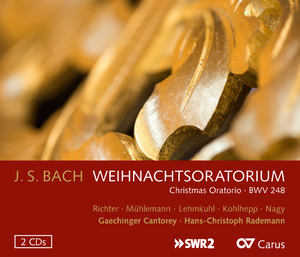
Interprètes : Regula Mühlemann (soprano), Anna Lucia Richter (soprano), Wiebke Lehmkuhl (alto), Sebastian Kohlhepp (tenore), Michael Nagy (basso) – Gaechinger Cantorey – Hans-Christoph Rademann
Découvrir
 Ecouter
(24)
Ecouter
(24)
- Coro: Jauchzet, frohlocket, auf, preiset die Tage
- Choral: Wie soll ich dich empfangen
- Choral von Recitativo (Soprano e Basso): Er ist auf Erden kommen arm
- Choral: Ach mein herzliebes Jesulein
- Choral: Brich an, o schönes Morgenlicht
- Choral: Schaut hin, dort liegt im finstern Stall
- Coro: Ehre sei Gott in der Höh
- Choral: Wir singen dir in deinem Heer
- Coro: Herrscher des Himmels, erhöre das Lallen
- Chorus: Lasset uns nun gehen
- Choral: Dies hat er alles uns getan
- Choral: Ich will dich mit Fleiß bewahren
- Choral: Seid froh dieweil
- Coro: Fallt mir Danken, fallt mit Loben
- Recitativo e Choral (Soprano e Basso): Immanuel, o süßes Wort!
- Recitativo e Choral (Soprano e Basso): Wohlan, dein Name soll allein
- Choral: Jesus richte mein Beginnen
- Coro: Ehre sei dir, Gott, gesungen
- Chorus von Recitativo (Alto): Wo ist der neugeborene König
- Choral: Dein Glanz all Finsteris verzehrt
- Choral: Zwar ist solche Herzensstube
- Coro: Herr, wenn die Stolzen Feinde schnauben
- Choral: Ich steh an deiner Krippen hier
- Choral: Nun seid ihr wohl gerochen
 S`exercer
-
-
Aides à l'apprentissage
-
Aides à l'apprentissage voix alto
- Coro: Jauchzet, frohlocket, auf, preiset die Tage (Choir Coach)
- Coro: Jauchzet, frohlocket, auf, preiset die Tage (Choir Coach, Slow mode)
- Choral: Wie soll ich dich empfangen (Choir Coach)
- Choral: Wie soll ich dich empfangen (Choir Coach, Slow mode)
- Choral: Ach mein herzliebes Jesulein (Choir Coach)
- Choral: Ach mein herzliebes Jesulein (Choir Coach, Slow mode)
- Choral: Brich an, o schönes Morgenlicht (Choir Coach)
- Choral: Brich an, o schönes Morgenlicht (Choir Coach, Slow mode)
- Choral: Schaut hin, dort liegt im finstern Stall (Choir Coach)
- Choral: Schaut hin, dort liegt im finstern Stall (Choir Coach, Slow mode)
- Coro: Ehre sei Gott in der Höh (Choir Coach)
- Coro: Ehre sei Gott in der Höh (Choir Coach, Slow mode)
- Choral: Wir singen dir in deinem Heer (Choir Coach)
- Choral: Wir singen dir in deinem Heer (Choir Coach, Slow mode)
- Coro: Herrscher des Himmels, erhöre das Lallen (Choir Coach)
- Coro: Herrscher des Himmels, erhöre das Lallen (Choir Coach, Slow mode)
- Chorus: Lasset uns nun gehen (Choir Coach)
- Chorus: Lasset uns nun gehen (Choir Coach, Slow mode)
- Choral: Dies hat er alles uns getan (Choir Coach)
- Choral: Dies hat er alles uns getan (Choir Coach, Slow mode)
- Choral: Ich will dich mit Fleiß bewahren (Choir Coach)
- Choral: Ich will dich mit Fleiß bewahren (Choir Coach, Slow mode)
- Choral: Seid froh dieweil (Choir Coach)
- Choral: Seid froh dieweil (Choir Coach, Slow mode)
- Coro: Fallt mir Danken, fallt mit Loben (Choir Coach)
- Coro: Fallt mir Danken, fallt mit Loben (Choir Coach, Slow mode)
- Choral: Jesus richte mein Beginnen (Choir Coach)
- Choral: Jesus richte mein Beginnen (Choir Coach, Slow mode)
- Coro: Ehre sei dir, Gott, gesungen (Choir Coach)
- Coro: Ehre sei dir, Gott, gesungen (Choir Coach, Slow mode)
- Chorus von Recitativo (Alto): Wo ist der neugeborene König (Choir Coach)
- Chorus von Recitativo (Alto): Wo ist der neugeborene König (Choir Coach, Slow mode)
- Choral: Dein Glanz all Finsteris verzehrt (Choir Coach)
- Choral: Dein Glanz all Finsteris verzehrt (Choir Coach, Slow mode)
- Choral: Zwar ist solche Herzensstube (Choir Coach)
- Choral: Zwar ist solche Herzensstube (Choir Coach, Slow mode)
- Coro: Herr, wenn die Stolzen Feinde schnauben (Choir Coach)
- Coro: Herr, wenn die Stolzen Feinde schnauben (Choir Coach, Slow mode)
- Choral: Ich steh an deiner Krippen hier (Choir Coach)
- Choral: Ich steh an deiner Krippen hier (Choir Coach, Slow mode)
- Choral: Nun seid ihr wohl gerochen (Choir Coach)
- Choral: Nun seid ihr wohl gerochen (Choir Coach, Slow mode)
-
Aides à l'apprentissage voix tenore
- Coro: Jauchzet, frohlocket, auf, preiset die Tage (Choir Coach)
- Coro: Jauchzet, frohlocket, auf, preiset die Tage (Choir Coach, Slow mode)
- Choral: Wie soll ich dich empfangen (Choir Coach)
- Choral: Wie soll ich dich empfangen (Choir Coach, Slow mode)
- Choral: Ach mein herzliebes Jesulein (Choir Coach)
- Choral: Ach mein herzliebes Jesulein (Choir Coach, Slow mode)
- Choral: Brich an, o schönes Morgenlicht (Choir Coach)
- Choral: Brich an, o schönes Morgenlicht (Choir Coach, Slow mode)
- Choral: Schaut hin, dort liegt im finstern Stall (Choir Coach)
- Choral: Schaut hin, dort liegt im finstern Stall (Choir Coach, Slow mode)
- Coro: Ehre sei Gott in der Höh (Choir Coach)
- Coro: Ehre sei Gott in der Höh (Choir Coach, Slow mode)
- Choral: Wir singen dir in deinem Heer (Choir Coach)
- Choral: Wir singen dir in deinem Heer (Choir Coach, Slow mode)
- Coro: Herrscher des Himmels, erhöre das Lallen (Choir Coach)
- Coro: Herrscher des Himmels, erhöre das Lallen (Choir Coach, Slow mode)
- Chorus: Lasset uns nun gehen (Choir Coach)
- Chorus: Lasset uns nun gehen (Choir Coach, Slow mode)
- Choral: Dies hat er alles uns getan (Choir Coach)
- Choral: Dies hat er alles uns getan (Choir Coach, Slow mode)
- Choral: Ich will dich mit Fleiß bewahren (Choir Coach)
- Choral: Ich will dich mit Fleiß bewahren (Choir Coach, Slow mode)
- Choral: Seid froh dieweil (Choir Coach)
- Choral: Seid froh dieweil (Choir Coach, Slow mode)
- Coro: Fallt mir Danken, fallt mit Loben (Choir Coach)
- Coro: Fallt mir Danken, fallt mit Loben (Choir Coach, Slow mode)
- Choral: Jesus richte mein Beginnen (Choir Coach)
- Choral: Jesus richte mein Beginnen (Choir Coach, Slow mode)
- Coro: Ehre sei dir, Gott, gesungen (Choir Coach)
- Coro: Ehre sei dir, Gott, gesungen (Choir Coach, Slow mode)
- Chorus von Recitativo (Alto): Wo ist der neugeborene König (Choir Coach)
- Chorus von Recitativo (Alto): Wo ist der neugeborene König (Choir Coach, Slow mode)
- Choral: Dein Glanz all Finsteris verzehrt (Choir Coach)
- Choral: Dein Glanz all Finsteris verzehrt (Choir Coach, Slow mode)
- Choral: Zwar ist solche Herzensstube (Choir Coach)
- Choral: Zwar ist solche Herzensstube (Choir Coach, Slow mode)
- Coro: Herr, wenn die Stolzen Feinde schnauben (Choir Coach)
- Coro: Herr, wenn die Stolzen Feinde schnauben (Choir Coach, Slow mode)
- Choral: Ich steh an deiner Krippen hier (Choir Coach)
- Choral: Ich steh an deiner Krippen hier (Choir Coach, Slow mode)
- Choral: Nun seid ihr wohl gerochen (Choir Coach)
- Choral: Nun seid ihr wohl gerochen (Choir Coach, Slow mode)
-
Aides à l'apprentissage voix basse
- Coro: Jauchzet, frohlocket, auf, preiset die Tage (Choir Coach)
- Coro: Jauchzet, frohlocket, auf, preiset die Tage (Choir Coach, Slow mode)
- Choral: Wie soll ich dich empfangen (Choir Coach)
- Choral: Wie soll ich dich empfangen (Choir Coach, Slow mode)
- Choral: Ach mein herzliebes Jesulein (Choir Coach)
- Choral: Ach mein herzliebes Jesulein (Choir Coach, Slow mode)
- Choral: Brich an, o schönes Morgenlicht (Choir Coach)
- Choral: Brich an, o schönes Morgenlicht (Choir Coach, Slow mode)
- Choral: Schaut hin, dort liegt im finstern Stall (Choir Coach)
- Choral: Schaut hin, dort liegt im finstern Stall (Choir Coach, Slow mode)
- Coro: Ehre sei Gott in der Höh (Choir Coach)
- Coro: Ehre sei Gott in der Höh (Choir Coach, Slow mode)
- Choral: Wir singen dir in deinem Heer (Choir Coach)
- Choral: Wir singen dir in deinem Heer (Choir Coach, Slow mode)
- Coro: Herrscher des Himmels, erhöre das Lallen (Choir Coach)
- Coro: Herrscher des Himmels, erhöre das Lallen (Choir Coach, Slow mode)
- Chorus: Lasset uns nun gehen (Choir Coach)
- Chorus: Lasset uns nun gehen (Choir Coach, Slow mode)
- Choral: Dies hat er alles uns getan (Choir Coach)
- Choral: Dies hat er alles uns getan (Choir Coach, Slow mode)
- Choral: Ich will dich mit Fleiß bewahren (Choir Coach)
- Choral: Ich will dich mit Fleiß bewahren (Choir Coach, Slow mode)
- Choral: Seid froh dieweil (Choir Coach)
- Choral: Seid froh dieweil (Choir Coach, Slow mode)
- Coro: Fallt mir Danken, fallt mit Loben (Choir Coach)
- Coro: Fallt mir Danken, fallt mit Loben (Choir Coach, Slow mode)
- Choral: Jesus richte mein Beginnen (Choir Coach)
- Choral: Jesus richte mein Beginnen (Choir Coach, Slow mode)
- Coro: Ehre sei dir, Gott, gesungen (Choir Coach)
- Coro: Ehre sei dir, Gott, gesungen (Choir Coach, Slow mode)
- Chorus von Recitativo (Alto): Wo ist der neugeborene König (Choir Coach)
- Chorus von Recitativo (Alto): Wo ist der neugeborene König (Choir Coach, Slow mode)
- Choral: Dein Glanz all Finsteris verzehrt (Choir Coach)
- Choral: Dein Glanz all Finsteris verzehrt (Choir Coach, Slow mode)
- Choral: Zwar ist solche Herzensstube (Choir Coach)
- Choral: Zwar ist solche Herzensstube (Choir Coach, Slow mode)
- Coro: Herr, wenn die Stolzen Feinde schnauben (Choir Coach)
- Coro: Herr, wenn die Stolzen Feinde schnauben (Choir Coach, Slow mode)
- Choral: Ich steh an deiner Krippen hier (Choir Coach)
- Choral: Ich steh an deiner Krippen hier (Choir Coach, Slow mode)
- Choral: Nun seid ihr wohl gerochen (Choir Coach)
- Choral: Nun seid ihr wohl gerochen (Choir Coach, Slow mode)
-
Aides à l'apprentissage voix soprano
- Coro: Jauchzet, frohlocket, auf, preiset die Tage (Choir Coach)
- Coro: Jauchzet, frohlocket, auf, preiset die Tage (Choir Coach, Slow mode)
- Choral: Wie soll ich dich empfangen (Choir Coach)
- Choral: Wie soll ich dich empfangen (Choir Coach, Slow mode)
- Choral von Recitativo (Soprano e Basso): Er ist auf Erden kommen arm (Choir Coach)
- Choral von Recitativo (Soprano e Basso): Er ist auf Erden kommen arm (Choir Coach, Slow mode)
- Choral: Ach mein herzliebes Jesulein (Choir Coach)
- Choral: Ach mein herzliebes Jesulein (Choir Coach, Slow mode)
- Choral: Brich an, o schönes Morgenlicht (Choir Coach)
- Choral: Brich an, o schönes Morgenlicht (Choir Coach, Slow mode)
- Choral: Schaut hin, dort liegt im finstern Stall (Choir Coach)
- Choral: Schaut hin, dort liegt im finstern Stall (Choir Coach, Slow mode)
- Coro: Ehre sei Gott in der Höh (Choir Coach)
- Coro: Ehre sei Gott in der Höh (Choir Coach, Slow mode)
- Choral: Wir singen dir in deinem Heer (Choir Coach)
- Choral: Wir singen dir in deinem Heer (Choir Coach, Slow mode)
- Coro: Herrscher des Himmels, erhöre das Lallen (Choir Coach)
- Coro: Herrscher des Himmels, erhöre das Lallen (Choir Coach, Slow mode)
- Chorus: Lasset uns nun gehen (Choir Coach)
- Chorus: Lasset uns nun gehen (Choir Coach, Slow mode)
- Choral: Dies hat er alles uns getan (Choir Coach)
- Choral: Dies hat er alles uns getan (Choir Coach, Slow mode)
- Choral: Ich will dich mit Fleiß bewahren (Choir Coach)
- Choral: Ich will dich mit Fleiß bewahren (Choir Coach, Slow mode)
- Choral: Seid froh dieweil (Choir Coach)
- Choral: Seid froh dieweil (Choir Coach, Slow mode)
- Coro: Fallt mir Danken, fallt mit Loben (Choir Coach)
- Coro: Fallt mir Danken, fallt mit Loben (Choir Coach, Slow mode)
- Recitativo e Choral (Soprano e Basso): Immanuel, o süßes Wort! (Choir Coach)
- Recitativo e Choral (Soprano e Basso): Immanuel, o süßes Wort! (Choir Coach, Slow mode)
- Recitativo e Choral (Soprano e Basso): Wohlan, dein Name soll allein (Choir Coach)
- Recitativo e Choral (Soprano e Basso): Wohlan, dein Name soll allein (Choir Coach, Slow mode)
- Choral: Jesus richte mein Beginnen (Choir Coach)
- Choral: Jesus richte mein Beginnen (Choir Coach, Slow mode)
- Coro: Ehre sei dir, Gott, gesungen (Choir Coach)
- Coro: Ehre sei dir, Gott, gesungen (Choir Coach, Slow mode)
- Chorus von Recitativo (Alto): Wo ist der neugeborene König (Choir Coach)
- Chorus von Recitativo (Alto): Wo ist der neugeborene König (Choir Coach, Slow mode)
- Choral: Dein Glanz all Finsteris verzehrt (Choir Coach)
- Choral: Dein Glanz all Finsteris verzehrt (Choir Coach, Slow mode)
- Choral: Zwar ist solche Herzensstube (Choir Coach)
- Choral: Zwar ist solche Herzensstube (Choir Coach, Slow mode)
- Coro: Herr, wenn die Stolzen Feinde schnauben (Choir Coach)
- Coro: Herr, wenn die Stolzen Feinde schnauben (Choir Coach, Slow mode)
- Choral: Ich steh an deiner Krippen hier (Choir Coach)
- Choral: Ich steh an deiner Krippen hier (Choir Coach, Slow mode)
- Choral: Nun seid ihr wohl gerochen (Choir Coach)
- Choral: Nun seid ihr wohl gerochen (Choir Coach, Slow mode)
-

 Compléments
- Acheter des compléments au format téléchargement.
-
 Texte numérique (sans notes), licence d'impression incluse, fichier html, paroles, traduction en anglaisfichier html, paroles, traduction en anglais (Extrait)Part I: The first day of Christmas 1. Coro
Shout ye exultant this Day of Salvation,
2. Evangelista (Tenore)
glory to God in the highest today!
Fear ye no longer, forsake lamentation,
sing ye with gladness, exultant and gay!
Worship the Master and bow ye before him.
Come all ye faithful with song to adore him.And in those same days it came to pass, that there went out a decree from Augustus Caesar, that all the world enroll for taxes, and ev’ryone went, that he might be reborded, each going into his own city. And also there went up Joseph from Galilee up out of Nazareth, to the city of David, in Judea, which is called Bethlehem, for Joseph was of the house and of the lineage of David; that there might be enrolled for tax with Mary, Mary, his wedded wife, being great with child. And while they yet were there it came the time that she should be delivered.
3. Recitativo (Alto)At last, beloved Saviour mine,
4. Aria
at last, thou Child of David’s line
art come, our consolation,
to compass man’s salvation.
At last is Jacob’s star fair shining,
behold its glorious ray.
Up Zion, put away from thee repining,
for all is well today....
-
Texte numérique (sans notes), licence d'impression incluse, fichier html, paroles, originalfichier html, paroles, original (Extrait)Teil I: Am 1. Weihnachtstage 1. Coro
Jauchzet, frohlocket! auf, preiset die Tage,
2. Evangelista (Tenore)
rühmet, was heute der Höchste getan!
Lasset das Zagen, verbannet die Klage,
stimmet voll Jauchzen und Fröhlichkeit an!
Dienet dem Höchsten mit herrlichen Chören,
lasst uns den Namen des Herrschers verehren!Es begab sich aber zu der Zeit, dass ein Gebot von dem Kaiser Augusto ausging, dass alle Welt geschätzet würde. Und jedermann ging, dass er sich schätzen ließe, ein jeglicher in seine Stadt. Da machte sich auch auf Joseph aus Galiläa, aus der Stadt Nazareth, in das jüdische Land zur Stadt David, die da heißet Bethlehem; darum, dass er von dem Hause und Geschlechte David war, auf dass er sich schätzen ließe mit Maria, seinem vertrauten Weibe, die war schwanger. Und als sie daselbst waren, kam die Zeit, dass sie gebären sollte.
3. Recitativo (Alto)Nun wird mein liebster Bräutigam,
nun wird der Held aus Davids Stamm
zum Trost, zum Heil der Erden,
einmal geboren werden.
Nun wird der Stern aus Jakob scheinen,
sein Strahl bricht schon hervor.
Auf, Zion, und verlasse nun das...
-
Texte numérique (sans notes), licence d'impression incluse, fichier html, Texte introductif, en anglaisfichier html, Texte introductif, en anglais (Extrait)Text from the CD Carus 83.312
Meinrad Walter
Translation: Erik DorsetWhat would Christmas be without music? The angles in the Bible do not merely speak the divine message of peace; they sing “Gloria in Excelsis Deo.” Songs such as O du fröhliche (O, how joyful) or Vom Himmel hoch, da komm ich her (From Heaven above to Earth I come) are simply part of the Christmas holiday season. But the epitome of Christmas music is Bach’s Christmas Oratorio, which opens with a drum roll. Tönet, ihr Pauken! (Sound, you drums!) was the title of the cantata that paid homage to the Saxon Electress and Polish Queen Maria Josepha, the music of which Bach reworked to make one of the most successful pieces of Christmas music of all time. And maybe even the composer suspected that although that very Queen would disappear silently and wordlessly, Christmas, as a multifaceted subject for which the Bach invented great music, was to stay.
Let us now move over to the Advent season in 1734 in Leipzig. On the first Sunday of Advent, the Thomaskantor performed Telemann’s cantata Machet die Tore weit (Lift up your heads, you gates) in the main worship service. From the second to the
...
-
Texte numérique (sans notes), licence d'impression incluse, fichier html, Texte introductif, en allemandfichier html, Texte introductif, en allemand (Extrait)Booklet-Text der CD Carus 83.312
Meinrad Walter
Was wäre Weihnachten ohne Musik? Bereits die biblischen Engel sprechen die himmlische Friedensbotschaft nicht, sondern sie singen das Gloria in excelsis Deo. Lieder wie O du fröhliche oder Vom Himmel hoch, da komm ich her gehören einfach dazu, wenn es Weihnachten werden soll. Die konzertante Weihnachtsmusik schlechthin aber ist Bachs Weihnachtsoratorium. Mit Paukenschlägen geht es los. Tönet, ihr Pauken!, so hieß die Huldigungskantate für die sächsische Kurfürstin und polnische Königin Maria Josepha, die Bach zur erfolgreichsten Weihnachtsmusik aller Zeiten umgearbeitet hat. Und vielleicht ahnte der Komponist ja sogar, dass jene Königin sang- und klanglos verschwinden wird, Weihnachten hingegen bleibt: als vielgestaltiges Thema, zu dem Bach großartige Musik erfunden hat.
Versetzen wir uns in die Adventszeit 1734 in Leipzig. Am ersten Adventssonntag hat der Thomaskantor Telemanns Kantate Machet die Tore weit im Hauptgottesdienst musiziert. Vom zweiten bis vierten Advent schwieg dann die festliche Musik, um dem Charakter der Bußzeit Rechnung zu tragen; ein Freiraum, den Bach
...
-
Texte numérique (sans notes), licence d'impression incluse, fichier html, paroles, traduction en anglaisfichier html, paroles, traduction en anglais (Extrait)
Part I: The first day of Christmas 1. Coro Shout ye exultant this Day of Salvation,
glory to God in the highest today!
Fear ye no longer, forsake lamentation,
sing ye with gladness, exultant and gay!
Worship the Master and bow ye before him.
Come all ye faithful with song to adore him.2. Evangelista (Tenore) And in those same days it came to pass, that there went out a decree from Augustus Caesar, that all the world enroll for taxes, and ev’ryone went, that he might be reborded, each going into his own city. And also there went up Joseph from Galilee up out of Nazareth, to the city of David, in Judea, which is called Bethlehem, for Joseph was of the house and of the lineage of David; that there might be enrolled for tax with Mary, Mary, his wedded wife, being great with child. And while they yet were there it came the time
...
-
Texte numérique (sans notes), licence d'impression incluse, fichier html, paroles, originalfichier html, paroles, original (Extrait)
Teil I: Am 1. Weihnachtstage 1. Coro Jauchzet, frohlocket! auf, preiset die Tage,
rühmet, was heute der Höchste getan!
Lasset das Zagen, verbannet die Klage,
stimmet voll Jauchzen und Fröhlichkeit an!
Dienet dem Höchsten mit herrlichen Chören,
lasst uns den Namen des Herrschers verehren!2. Evangelista (Tenore) Es begab sich aber zu der Zeit, dass ein Gebot von dem Kaiser Augusto ausging, dass alle Welt geschätzet würde. Und jedermann ging, dass er sich schätzen ließe, ein jeglicher in seine Stadt. Da machte sich auch auf Joseph aus Galiläa, aus der Stadt Nazareth, in das jüdische Land zur Stadt David, die da heißet Bethlehem; darum, dass er von dem Hause und Geschlechte David war, auf dass er sich schätzen ließe mit Maria, seinem vertrauten Weibe, die war schwanger. Und als sie daselbst waren, kam die Zeit, dass sie
...
-
Texte numérique (sans notes), licence d'impression incluse, fichier html, Texte introductif, en anglaisfichier html, Texte introductif, en anglais (Extrait)Text from the CD Carus 83.312
Meinrad Walter
Translation: Erik DorsetWhat would Christmas be without music? The angles in the Bible do not merely speak the divine message of peace; they sing “Gloria in Excelsis Deo.” Songs such as O du fröhliche (O, how joyful) or Vom Himmel hoch, da komm ich her (From Heaven above to Earth I come) are simply part of the Christmas holiday season. But the epitome of Christmas music is Bach’s Christmas Oratorio, which opens with a drum roll. Tönet, ihr Pauken! (Sound, you drums!) was the title of the cantata that paid homage to the Saxon Electress and Polish Queen Maria Josepha, the music of which Bach reworked to make one of the most successful pieces of Christmas music of all time. And maybe even the composer suspected that although that very Queen would disappear silently and wordlessly, Christmas, as a multifaceted
...
-
Texte numérique (sans notes), licence d'impression incluse, fichier html, Texte introductif, en allemandfichier html, Texte introductif, en allemand (Extrait)Booklet-Text der CD Carus 83.312
Meinrad Walter
Was wäre Weihnachten ohne Musik? Bereits die biblischen Engel sprechen die himmlische Friedensbotschaft nicht, sondern sie singen das Gloria in excelsis Deo. Lieder wie O du fröhliche oder Vom Himmel hoch, da komm ich her gehören einfach dazu, wenn es Weihnachten werden soll. Die konzertante Weihnachtsmusik schlechthin aber ist Bachs Weihnachtsoratorium. Mit Paukenschlägen geht es los. Tönet, ihr Pauken!, so hieß die Huldigungskantate für die sächsische Kurfürstin und polnische Königin Maria Josepha, die Bach zur erfolgreichsten Weihnachtsmusik aller Zeiten umgearbeitet hat. Und vielleicht ahnte der Komponist ja sogar, dass jene Königin sang- und klanglos verschwinden wird, Weihnachten hingegen bleibt: als vielgestaltiges Thema, zu dem Bach großartige Musik
...
-
Texte numérique (sans notes), licence d'impression incluse, fichier html, paroles, traduction en anglaisfichier html, paroles, traduction en anglais (Extrait)
Part IV: The Circumcision of Christ (New Year’s Day) 36. Coro Bow ye, thankful, kneel and praise ye,
kneel before the Father’s throne.
Christ the lord came to save you,
God for Him your sins forgave you,
Christ the Lord from pit of Hell will raise you.37. Evangelista (Tenore) And when eight days were accomplished for the circumcising of the child, then was the name of the child called Jesus, which was the name the Angel had given, given ere He had been conceived in His mothers womb.
38. Recitativo con Choral (Soprano e Basso) Immanuel, o word so sweet!
My Jesus, safe retreat,
my life my Jesus gave me.
My Jesus died that He might save me.
My Jesus’ image dear I prize,
...
-
Texte numérique (sans notes), licence d'impression incluse, fichier html, paroles, originalfichier html, paroles, original (Extrait)
Teil IV: Am Fest der Beschneidung Christi (Neujahr) 36. Coro Fallt mit Danken, fallt mit Loben
vor des Höchsten Gnadenthron!
Gottes Sohn will der Erden
Heiland und Erlöser werden,
Gottes Sohn dämpft der Feinde Wut und Toben.37. Evangelista (Tenore) Und da acht Tage um waren, dass das Kind beschnitten würde, da ward sein Name genennet Jesus, welcher genennet war von dem Engel, ehe denn er im Mutterleibe empfangen ward.
38. Recitativo con Choral (Soprano e Basso) Immanuel, o süßes Wort!
Mein Jesus heißt mein Hort,
mein Jesus heißt mein Leben.
Mein Jesus hat sich mir ergeben,
mein Jesus soll mir immerfort
vor meinen Augen schweben.
...
-
Texte numérique (sans notes), licence d'impression incluse, fichier html, Texte introductif, en anglaisfichier html, Texte introductif, en anglais (Extrait)Text from the CD Carus 83.312
Meinrad Walter
Translation: Erik DorsetWhat would Christmas be without music? The angles in the Bible do not merely speak the divine message of peace; they sing “Gloria in Excelsis Deo.” Songs such as O du fröhliche (O, how joyful) or Vom Himmel hoch, da komm ich her (From Heaven above to Earth I come) are simply part of the Christmas holiday season. But the epitome of Christmas music is Bach’s Christmas Oratorio, which opens with a drum roll. Tönet, ihr Pauken! (Sound, you drums!) was the title of the cantata that paid homage to the Saxon Electress and Polish Queen Maria Josepha, the music of which Bach reworked to make one of the most successful pieces of Christmas music of all time. And maybe even the composer suspected that although that very Queen would disappear silently and wordlessly, Christmas, as a multifaceted
...
-
Texte numérique (sans notes), licence d'impression incluse, fichier html, Texte introductif, en allemandfichier html, Texte introductif, en allemand (Extrait)Booklet-Text der CD Carus 83.312
Meinrad Walter
Was wäre Weihnachten ohne Musik? Bereits die biblischen Engel sprechen die himmlische Friedensbotschaft nicht, sondern sie singen das Gloria in excelsis Deo. Lieder wie O du fröhliche oder Vom Himmel hoch, da komm ich her gehören einfach dazu, wenn es Weihnachten werden soll. Die konzertante Weihnachtsmusik schlechthin aber ist Bachs Weihnachtsoratorium. Mit Paukenschlägen geht es los. Tönet, ihr Pauken!, so hieß die Huldigungskantate für die sächsische Kurfürstin und polnische Königin Maria Josepha, die Bach zur erfolgreichsten Weihnachtsmusik aller Zeiten umgearbeitet hat. Und vielleicht ahnte der Komponist ja sogar, dass jene Königin sang- und klanglos verschwinden wird, Weihnachten hingegen bleibt: als vielgestaltiges Thema, zu dem Bach großartige Musik
...
Acheter
Informations complémentaires sur l'œuvre
Sommaire


-
Compositeur
Johann Sebastian Bach
| 1685-1750Jean Sébastien Bach compte parmi les compositeurs essentiels de l'histoire de la musique occidentale. Il faisait partie d'une grande dynastie de musiciens, dont furent originaires nombre de musiciens municipaux et d'organistes dans les régions de Thuringe et de Saxe.
Bach vocal
Depuis la fondation des Éditions Carus en 1972, la publication des oeuvres de Johann Sebastian Bach revêt une importance particulière. En 2017, année du 500e anniversaire de la Réforme, nous avons clôturé le projet Bach vocal. L'intégralité de la musique vocale sacrée de Bach est désormais disponible en éditions modernes des textes originaux, matériel d'exécution compris. Une édition globale de toutes les partitions dans un coffret de grande qualité est aussi proposée. Plus d'information sur la personne
-
Chœur
Gaechinger Cantorey
The Gaechinger Cantorey is the ensemble of the International Bach Academy Stuttgart. It combines a Baroque orchestra and a hand-picked choir to form a finely tuned early music ensemble. Under the baton of academy director Hans-Christoph Rademann, this ensemble is dedicated to the international dissemination of a “Stuttgart Bach style.” Since its re-establishment as the Gaechinger Cantorey in 2016, the ensemble of the International Bach Academy has gained renown with numerous performances in Germany, such as at the Musikfest Stuttgart, the Bachwoche Ansbach, the Bachfest Leipzig, the Rheingau Music Festival, the Festspielhaus Baden-Baden, the Dresden Kulturpalast, and the Hamburg Elbphilharmonie, as well as abroad at the Théâtre des Champs-Élysées in Paris, in the USA (Fort Lauderdale, Chapel Hill, Norfolk, Princeton, Los Angeles, Irvine, Williamsburg), in Canada (Montréal), and in South America (São Paulo, Rio de Janeiro, Buenos Aires, Lima, Santiago de Chile, Bogotá). In addition, the Gaechinger Cantorey with its director Hans-Christoph Rademann pursues a busy recording schedule. On the Stuttgart label Carus and on accentus music, the ensemble has recorded the Christmas Oratorio, cantatas and the two Passions by J.S. Bach, Handel’s Messiah, Haydn’s Creation and other works. Digital podcasts and concert streams with the Gaechinger Cantorey are also available in the Bach Academy’s media library. From May 2023 to June 2024, the Gaechinger Cantorey, under the direction of Hans-Christoph Rademann, will perform all J.S. Bach’s cantatas from his first year as Kantor at St. Thomas’s Church in Leipzig – exactly 300 years after the historic event in 1723/1724. CD recordings of all the concerts in churches and concert halls in Stuttgart and the surrounding area will be released by Hänssler Classic. The Gaechinger Cantorey regularly and enthusiastically participates in the various music education formats of the International Bach Academy under the motto “BachBewegt!,” in which children and young people are actively invited to sing, dance and experience music on stage or as listeners in the concert hall. These include family concerts, joint performances and danced interpretations of important masterpieces of the oratorio literature. Plus d'information sur la personne
-
Orchestre
Gaechinger Cantorey
The Gaechinger Cantorey is the ensemble of the International Bach Academy Stuttgart. It combines a Baroque orchestra and a hand-picked choir to form a finely tuned early music ensemble. Under the baton of academy director Hans-Christoph Rademann, this ensemble is dedicated to the international dissemination of a “Stuttgart Bach style.” Since its re-establishment as the Gaechinger Cantorey in 2016, the ensemble of the International Bach Academy has gained renown with numerous performances in Germany, such as at the Musikfest Stuttgart, the Bachwoche Ansbach, the Bachfest Leipzig, the Rheingau Music Festival, the Festspielhaus Baden-Baden, the Dresden Kulturpalast, and the Hamburg Elbphilharmonie, as well as abroad at the Théâtre des Champs-Élysées in Paris, in the USA (Fort Lauderdale, Chapel Hill, Norfolk, Princeton, Los Angeles, Irvine, Williamsburg), in Canada (Montréal), and in South America (São Paulo, Rio de Janeiro, Buenos Aires, Lima, Santiago de Chile, Bogotá). In addition, the Gaechinger Cantorey with its director Hans-Christoph Rademann pursues a busy recording schedule. On the Stuttgart label Carus and on accentus music, the ensemble has recorded the Christmas Oratorio, cantatas and the two Passions by J.S. Bach, Handel’s Messiah, Haydn’s Creation and other works. Digital podcasts and concert streams with the Gaechinger Cantorey are also available in the Bach Academy’s media library. From May 2023 to June 2024, the Gaechinger Cantorey, under the direction of Hans-Christoph Rademann, will perform all J.S. Bach’s cantatas from his first year as Kantor at St. Thomas’s Church in Leipzig – exactly 300 years after the historic event in 1723/1724. CD recordings of all the concerts in churches and concert halls in Stuttgart and the surrounding area will be released by Hänssler Classic. The Gaechinger Cantorey regularly and enthusiastically participates in the various music education formats of the International Bach Academy under the motto “BachBewegt!,” in which children and young people are actively invited to sing, dance and experience music on stage or as listeners in the concert hall. These include family concerts, joint performances and danced interpretations of important masterpieces of the oratorio literature. Plus d'information sur la personne
-
Chef d'orchestre
Hans-Christoph Rademann
| 1965Conductor Hans-Christoph Rademann is an immensely versatile artist with a broad repertoire who devotes himself with equal passion and expertise both to the performance and rediscovery of early music and to the first performances and cultivation of Contemporary Music. Born in Dresden and raised in the Erzgebirge mountains, he was influenced at an early age by the great Central German kantorial and musical tradition. He was a student at the traditional Kreuzgymnasium, a member of the famous Kreuzchor, and studied choral and orchestral conducting at the Carl Maria von Weber University of Music in Dresden. During his studies, he founded the Dresdner Kammerchor and formed it into a top international choir which is still under his direction today. Since 2013, Hans-Christoph Rademann has been the academy director of the International Bach Academy Stuttgart. He regularly collaborates with leading choirs and ensembles of the international music scene. From 1999 to 2004 he was chief conductor of the NDR Choir and from 2007 to 2015 chief conductor of the RIAS Chamber Choir. Guest conducting engagements have led and continue to lead him to the Nederlandse Bachvereniging, the Collegium Vocale Gent, the Akademie für Alte Musik, the Freiburger Barockorchester, the Deutsche Radiophilharmonie Saarbrücken Kaiserslautern, the Sinfonieorchester Basel, the Orchestre Philharmonique de Luxembourg, among others. Hans-Christoph Rademann has been awarded prizes and honors for his artistic work, including the Johann Walter Plaque of the Saxon Music Council (2014), the Saxon Constitutional Medal (2008), the Sponsorship Prize as well as the Art Prize of the state capital Dresden (1994 and 2014 respectively). He received the Preis der Deutschen Schallplattenkritik several times for his numerous CD recordings (most recently in 2016), as well as the Grand Prix du Disque (2002), the Diapason d’Or (2006 & 2011), the CHOC de l’année 2011 and the Best Baroque Vocal Award 2014. In 2016 he was awarded the European Church Music Prize of the city of Schwäbisch Gmünd. His exemplary interpretation and recording of the complete works of Heinrich Schütz with the Dresdner Kammerchor in the Stuttgart Carus-Verlag, which was completed in 2019, was awarded the newly endowed Heinrich Schütz Prize as well as the OPUS KLASSIK 2020 in the same year. Hans-Christoph Rademann is professor of choral conducting at the Carl Maria von Weber University of Music in Dresden. He is also artistic director of the Musikfest Erzgebirge, ambassador of the Erzgebirge and patron of the Christian Hospice Service Dresden. Plus d'information sur la personne
-
Solist - soprano
Regula Mühlemann
-
Solist - soprano
Anna Lucia Richter
-
Solist - alto
Wiebke Lehmkuhl
-
Solist - ténor
Sebastian Kohlhepp
-
Solist - basse
Michael Nagy
Les évaluations sur notre site web ne peuvent être effectuées que par des clients disposant d'un compte d'utilisateur enregistré. Il n'est pas vérifié si les produits évalués ont été effectivement achetés.
Aucune évaluation disponible pour ce produit.
Questions fréquentes sur l'œuvre
 Il n'y a pas encore de questions et réponses concernant cette œuvre ou vous n'avez pas trouvé la réponse à votre question sur l'œuvre ? Cliquez ici et envoyez votre question spécifique à notre service clients.