

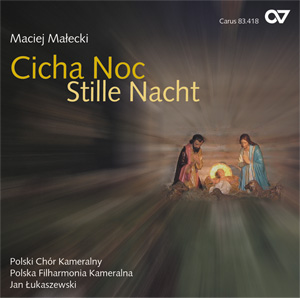
Cicha Noc - Stille Nacht. Polnisches Weihnachtskonzert
Polnisches Weihnachtskonzert 2006
 Ecouter
(14)
Ecouter
(14)
- Aniol pasterzom mówi
- Gdy sie Chrystus rodzi
- Wsród nocnej ciszy
- Lulajze Jezuniu
- W zlobie lezy
- Mizerna, cicha
- Jezus malusienki
- Niemowlatko na slomie
- Hej, w Dzien Narodzenia
- Cicha Noc
- Gdy sliczna Panna
- Medrcy swiata
- Pójdzmy wszystcy do stajenki
- Bóg sie rodzi
Sommaire
-
Compositeur
Maciej Malecki
| 1940
-
L'auteur de l'avant-propos
Maciej Malecki
| 1940
-
Chœur
Polski Chór Kameralny
Polski Chór Kameralny (The Polish Chamber Choir) was founded 30 years ago by Ireneusz £ukaszewski and ever since has been making a name for itself as a top ensemble of international renown. Its declared aim is to work at an instrumental, “orchestral” level which, apart from other skills, requires total control of the vocal instrument. The main interest of the 24 professional musicians lies on unaccompanied music, and especially on romanticism and contemporary music. Hence the countless compositions dedicated to the choir and that wealth of world premiere performances. Besides that, mainly in oratorios and opera, Polski Chór Kameralny regularly cooperates with many important symphonic and chamber orchestras, yet also with e.g. the Academy of Ancient Music, the Neue Düsseldorfer Hofmusik as well as with other specialist Early Music ensembles from all over Europe. A main stay of the choir’s musical work is their regular co-operation with guest conductors from all over the world (Ericson, Gronostay, Bernius, Layton, and many others). Notwithstanding all their serious work, Polski Chór Kameralny enjoys experiments – in 2001, for example, they participated in the world’s first genuine real-time internet concert. Polski Chór Kameralny frequently appears at international festivals, among them the “Warsaw Autumn” and “Vratislavia cantans,” the Ruhr-Festival, the “rendez-vous musique nouvelle,” but also Salzburg, Dresden, Berlin and Tokyo. Its concert tours take it through all of Europe, to the USA and to Japan. In the role of “Official Symposium Choir” it was invited to the Rotterdam “World Symposium on Choral Music“ in 1999. Besides nigh 60 CDs, MCs and videos many of which have won grammophone prizes, Polski Chór Kameralny has recorded profusely for Polish and many European Radio and TV stations. Polski Chór Kameralny provided Poland’s contribution to an EBU Christmas Concert, broadcast live throughout Europe and in Canada. Polski Chór Kameralny conceived and organizes the three-day International Mozart Festival “Mozartiana,” presenting to a wide public Mozart’s music in a diversity of styles. In 2008, Polski Chór Kameralny is hosting the “Musica Sacra” international composers’ competition. Plus d'information sur la personne
-
Orchestre
Polska Filharmonia Kameralna
Polska Filharmonia Kameralna – Sopot (Polish Chamber Philharmonic) was founded in 1982 by conductor Wojciech Rajski. Their cultured play, a combination of vitality, precision, and elegance is praised by critics throughout. PFK has worked with soloists and conductors like Mstislav Rostropovitch, with Christoph Eschenbach, Krystian Zimerman, Natalia Gutman, Sabine and Wolfgang Meyer, Giora Feidman, David Geringas, Claudio Arrau, Tzimon Barto, Gerhard Oppitz, Igor Oistrach, Ivo Pogorelich, Krzysztof Penderecki and Shlomo Mintz and is at home on the renowned concert stages of the world, including the Berlin Philharmonic, Musikhalle Hamburg, Kennedy Center Washington, Musikverein Vienna, Salle Pleyel and Cité de la Musique Paris, Teatro Real de Madrid. PFK has completed tours of Germany, France, Italy, Spain, the USA and Eastern Europe apart from regularly playing at major European festivals like the Montpelier Festival, Schleswig-Holstein Musikfestival, Festspiele Mecklenburg-Vorpommern, Rheingau Musikfestival, Europäisches Musikfest Stuttgart, Prague Spring, Warsaw Autumn, Festival de Strasbourg, Tivoli Music Festival. PFK has more than 50 CDs to its name. The close co-operation between PFK and Polski Chór Kameralny on a great many projects dates back to 1989. Plus d'information sur la personne
-
Chef d'orchestre
Jan Lukaszewski
Jan £ukaszewski has come to be accepted as one of Europe’s most accomplished choral music specialists. He is conductor, artistic director and director general of Polski Chór Kameralny. Much in demand as a guest conductor, he e.g. regularly works with the Polish Radio Choir as well as directing numerous projects both in Poland and abroad. His main artistic interests lie in the fields of romantic and of contemporary music, and, especially in connection with Polski Chór Kameralny he has gained a reputation of being able to make possible the impossible and in a very short time, indeed, preparing musically valid interpretations of even the most complex of works. Hence the number of premier performances directed by him is vast. In Poland, Jan £ukaszewski is regarded as one of the few that propagate the music of such composers as Schönberg, Messiaen, Xenakis, Globokar, Castiglioni, Takemitsu, R. Strauss, Pepping, Tippett, Ives, and Barber. His abundant recordings for Polish Radio and a multitude of other European stations and for Polish and German Television as well as his numerous other recordings reflect the quality of his work. The high artistic level of Polski Chór Kameralny under his direction time and again inspires composers to write works for unaccompanied choir. Jan Lukaszewski’s work has been acknowledged with numerous awards. Plus d'information sur la personne
Critiques
[...] In seinen Chor- und Streicherarrangements wahrt Malecki immer diesen ganz spezifischen slawisch-volkstümlichen Tonfall, betont dabei stets das melodische Potential der Lieder und schafft die Gratwanderung zwischen Kunst und Kitsch mit bewundernswerter Stringenz. Ja, er scheint die angelsächsische Festtagsstimmung eines John Rutter gleichsam ins Polnische zu übersetzen. Dass die wohlig-heimeligen Arrangements nicht ins Banale abgleiten, dafür sorgt nicht zuletzt der Polnische Kammerchor, dessen 24 Berufssänger unter der Leitung des Werkanregers Jan Lukaszewski eine Glanzstunde mustergültigen Chorgesangs bieten. [...]
Sich mild in den Chorklang einfügend, wartet die Polnische Kammerphilharmonie mit einem satten, weichen Streicherklang auf, der den intimen Charakter dieses introspektiven Wartens aufs Christkind im besten Sinne des Wortes unter-‚streicht’. [...]
Erik Daumann
Quelle: klassik.com, 11.12.2008
Les évaluations sur notre site web ne peuvent être effectuées que par des clients disposant d'un compte d'utilisateur enregistré. Il n'est pas vérifié si les produits évalués ont été effectivement achetés.
Questions fréquentes sur l'œuvre
 Il n'y a pas encore de questions et réponses concernant cette œuvre ou vous n'avez pas trouvé la réponse à votre question sur l'œuvre ? Cliquez ici et envoyez votre question spécifique à notre service clients.