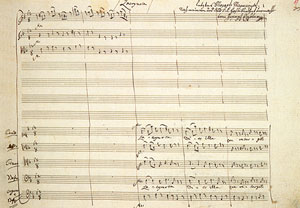
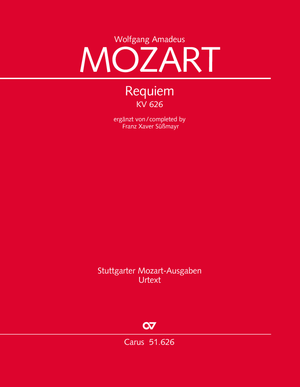
La création du Requiem fait l'objet de nombreuses anecdotes et légendes. Franz Xaver Süßmayr, élève de Mozart, termine l'œuvre inachevée à la mort de ce dernier. Mais d'un point de vue musical, cette composition offre bien plus que des anecdotes : la partition pour chœur de Mozart, à l'apogée de son art, met le choriste au défi avec des passages à l'harmonie exigeante et des fugues exaltantes. Mais si on maîtrise sa partie, malgré l'objet initial de l'œuvre, on peut même éprouver de la joie en chantant…
Il suffit de s'exercer. Partout. A tout moment.
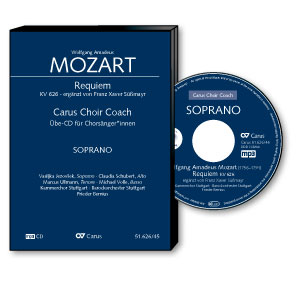
Que ce soit à la maison sur votre tablette ou votre PC ou en déplacement sur votre smartphone : avec carus music, the Choir Coach, vous avez toujours vos œuvres chorales avec vous pour vous entraîner ! Avec l'application chorale de carus music, vous pouvez écouter votre partition ainsi qu'un enregistrement de première qualité sur n'importe quel appareil et vous entraîner facilement à votre propre partie de chœur avec un coach. Avec carus music, la préparation de vos concerts est facile, efficace et amusante à maîtriser !
Découvrir
 Ecouter
(13)
Ecouter
(13)
- Introitus
- Kyrie
- Dies irae
- Rex tremendae
- Confutatis
- Lacrimosa
- Domine Jesu Christe
- Hostias et preces
- Sanctus
- Benedictus
- Agnus Dei
- Lux aeterna
- Cum Sanctis tuis
 S`exercer
-
 carus music, the Choir Coach
Üben mit carus music
carus music, the Choir Coach
Üben mit carus music
-
Aides à l'apprentissage
-
Aides à l'apprentissage voix soprano
- Introitus (Choir Coach)
- Introitus (Choir Coach, Slow mode)
- Kyrie (Choir Coach)
- Kyrie (Choir Coach, Slow mode)
- Dies irae (Choir Coach)
- Dies irae (Choir Coach, Slow mode)
- Rex tremendae (Choir Coach)
- Rex tremendae (Choir Coach, Slow mode)
- Confutatis (Choir Coach)
- Confutatis (Choir Coach, Slow mode)
- Lacrimosa (Choir Coach)
- Lacrimosa (Choir Coach, Slow mode)
- Domine Jesu Christe (Choir Coach)
- Domine Jesu Christe (Choir Coach, Slow mode)
- Hostias et preces (Choir Coach)
- Hostias et preces (Choir Coach, Slow mode)
- Sanctus (Choir Coach)
- Sanctus (Choir Coach, Slow mode)
- Benedictus (Choir Coach)
- Benedictus (Choir Coach, Slow mode)
- Agnus Dei (Choir Coach)
- Agnus Dei (Choir Coach, Slow mode)
- Lux aeterna (Choir Coach)
- Lux aeterna (Choir Coach, Slow mode)
- Cum Sanctis tuis (Choir Coach)
- Cum Sanctis tuis (Choir Coach, Slow mode)
-
Aides à l'apprentissage voix alto
- Introitus (Choir Coach)
- Introitus (Choir Coach, Slow mode)
- Kyrie (Choir Coach)
- Kyrie (Choir Coach, Slow mode)
- Dies irae (Choir Coach)
- Dies irae (Choir Coach, Slow mode)
- Rex tremendae (Choir Coach)
- Rex tremendae (Choir Coach, Slow mode)
- Confutatis (Choir Coach)
- Confutatis (Choir Coach, Slow mode)
- Lacrimosa (Choir Coach)
- Lacrimosa (Choir Coach, Slow mode)
- Domine Jesu Christe (Choir Coach)
- Domine Jesu Christe (Choir Coach, Slow mode)
- Hostias et preces (Choir Coach)
- Hostias et preces (Choir Coach, Slow mode)
- Sanctus (Choir Coach)
- Sanctus (Choir Coach, Slow mode)
- Benedictus (Choir Coach)
- Benedictus (Choir Coach, Slow mode)
- Agnus Dei (Choir Coach)
- Agnus Dei (Choir Coach, Slow mode)
- Lux aeterna (Choir Coach)
- Lux aeterna (Choir Coach, Slow mode)
- Cum Sanctis tuis (Choir Coach)
- Cum Sanctis tuis (Choir Coach, Slow mode)
-
Aides à l'apprentissage voix tenore
- Introitus (Choir Coach)
- Introitus (Choir Coach, Slow mode)
- Kyrie (Choir Coach)
- Kyrie (Choir Coach, Slow mode)
- Dies irae (Choir Coach)
- Dies irae (Choir Coach, Slow mode)
- Rex tremendae (Choir Coach)
- Rex tremendae (Choir Coach, Slow mode)
- Confutatis (Choir Coach)
- Confutatis (Choir Coach, Slow mode)
- Lacrimosa (Choir Coach)
- Lacrimosa (Choir Coach, Slow mode)
- Domine Jesu Christe (Choir Coach)
- Domine Jesu Christe (Choir Coach, Slow mode)
- Hostias et preces (Choir Coach)
- Hostias et preces (Choir Coach, Slow mode)
- Sanctus (Choir Coach)
- Sanctus (Choir Coach, Slow mode)
- Benedictus (Choir Coach)
- Benedictus (Choir Coach, Slow mode)
- Agnus Dei (Choir Coach)
- Agnus Dei (Choir Coach, Slow mode)
- Lux aeterna (Choir Coach)
- Lux aeterna (Choir Coach, Slow mode)
- Cum Sanctis tuis (Choir Coach)
- Cum Sanctis tuis (Choir Coach, Slow mode)
-
Aides à l'apprentissage voix basse
- Introitus (Choir Coach)
- Introitus (Choir Coach, Slow mode)
- Kyrie (Choir Coach)
- Kyrie (Choir Coach, Slow mode)
- Dies irae (Choir Coach)
- Dies irae (Choir Coach, Slow mode)
- Rex tremendae (Choir Coach)
- Rex tremendae (Choir Coach, Slow mode)
- Confutatis (Choir Coach)
- Confutatis (Choir Coach, Slow mode)
- Lacrimosa (Choir Coach)
- Lacrimosa (Choir Coach, Slow mode)
- Domine Jesu Christe (Choir Coach)
- Domine Jesu Christe (Choir Coach, Slow mode)
- Hostias et preces (Choir Coach)
- Hostias et preces (Choir Coach, Slow mode)
- Sanctus (Choir Coach)
- Sanctus (Choir Coach, Slow mode)
- Benedictus (Choir Coach)
- Benedictus (Choir Coach, Slow mode)
- Agnus Dei (Choir Coach)
- Agnus Dei (Choir Coach, Slow mode)
- Lux aeterna (Choir Coach)
- Lux aeterna (Choir Coach, Slow mode)
- Cum Sanctis tuis (Choir Coach)
- Cum Sanctis tuis (Choir Coach, Slow mode)
-
 Compléments
- Acheter des compléments au format téléchargement.
-
 Texte numérique (sans notes), licence d'impression incluse, fichier html, paroles, originalfichier html, paroles, original (Extrait)Introitus 1 Requiem aeternam (Coro)
Requiem aeternam dona eis, domine!
2 Kyrie (Coro)
Et lux perpetua luceat eis.
Te decet hymnus Deus in Sion,
et tibi reddetur votum in Jerusalem:
Exaudi orationem meam,
ad te omnis caro veniet
Dona eis requiem aeternam
et lux perpetua luceat eis.Kyrie eleison,
Sequenz 3 Dies irae (Coro)
Christe eleison.
Kyrie eleison,Dies irae dies illa,
solvet saeclum in favilla:
teste David cum Sibylla.
Quantus tremor est futurus,...
Acheter
Informations complémentaires sur l'œuvre
-
Compositeur
Wolfgang Amadeus Mozart
| 1756-1791Fils du vice-maître de chapelle du prince-archevêque de Salzbourg, Mozart a été constamment entouré de musique sacrée dès sa jeunesse. Au cours de ses voyages, Mozart découvrit la musique sacrée italienne, et plus tard, à Vienne, il étudia les œuvres de Bach et de Haendel. Après son installation à Vienne, il se lance de nouveaux défis avec l'opéra et le concerto pour piano. Il est significatif que la « Messe en ut mineur » KV 427, la plus grande œuvre de musique sacrée des premières années viennoises, reste inachevée. La dernière période de sa vie montre à nouveau une orientation vers la musique sacrée : Mozart postule avec succès pour succéder à Leopold Hoffmann, malade à l'article de la mort, en tant que maître de chapelle à la cathédrale Saint-Étienne, mais il ne peut pas prendre le poste, car il meurt avant Hoffmann. Un joyau comme l'« Ave verum » KV 618 et le Requiem KV 626, resté inachevé, laissent entrevoir ce que Mozart aurait encore pu accomplir en tant que compositeur d'église s'il était parvenu à ce poste à responsabilité. Plus d'information sur la personne
-
Arrangeur
Franz Xaver Süßmayr
| 1766-1803
-
Chœur
Kammerchor Stuttgart
The Kammerchor Stuttgart is regarded as one of the best ensembles of its kind. Over its fifty-year existence, Frieder Bernius has developed the choir into an exceptional ensemble acclaimed by audiences and press alike. This has led to invitations for the choir to perform at all the important European festivals. In Germany the chamber choir performs at festivals and in concert halls in repertoire ranging from the 17th to the 21st century. Frieder Bernius and his ensemble have received numerous accolades for their contribution to new music. The Kammerchor Stuttgart has made over 80 CDs and LPs, numerous of which have been awarded international recording prizes (including the Edison award, Diapason d’or, Gramophone Choice, Classical Internet Award, International Classical Music Award, and German Record Critics’ Award prizes). The International Federation for Choral Music has invited the ensemble to sing at the 1st, 4th and 10th World Symposia on Choral Music in Vienna, Sydney and Seoul. Regular tours of North America and Asia since 1988 and a South America tour reflect the Kammerchor Stuttgart’s international reputation. Since 1984 the top ensemble has also been invited to Israel biennially. Plus d'information sur la personne
-
Orchestre
Barockorchester Stuttgart
The Barockorchester Stuttgart, which was founded by Bernius in 1985, specializes in 18th century music. The musicians are among the leading representatives of historical performance practice and perform exclusively on original instruments. The ensemble dedicates itself to a large extent to the revival of 18th century operas. It has performed at numerous international festivals, among others in Rome, Dresden and Göttingen. Plus d'information sur la personne
-
Chef d'orchestre
Frieder Bernius
| 1947Le travail de Frieder Bernius jouit d’une grande reconnaissance à l’échelle mondiale. Il est très sollicité à l’international, tant comme chef d’orchestre que comme professeur. Ses partenaires artistiques sont principalement le Chœur de chambre de Stuttgart, l’Orchestre baroque de Stuttgart, la Hofkapelle de Stuttgart et la Philharmonie classique de Stuttgart. C’est en 1968, avec la création du Chœur de chambre de Stuttgart, qu’il a posé les bases de sa carrière exceptionnelle, qu’il a rapidement fait de cet ensemble l’un des plus éminents de son genre. Qu’il s’agisse d’œuvres vocales de Monteverdi, Bach, Haendel, Mozart, Beethoven, Fauré et Ligeti, de musiques de théâtre de Mendelssohn ou de symphonies de Haydn, Burgmüller et Schubert, le travail de Frieder Bernius vise toujours un son à la fois fidèle à l’idéal sonore original et d’une personnalité incomparable. Il se consacre aussi bien à la redécouverte d’opéras du XVIIIe siècle qu’aux créations de compositions contemporaines. Il porte un intérêt particulier à l’histoire de la musique du sud-ouest de l’Allemagne. Le travail de Frieder Bernius est largement documenté sur disques et CD sous le label Carus. De nombreux enregistrements ont été récompensés par des prix internationaux. Dans le cadre du Festival choral allemand de Stuttgart, Frieder Bernius s’est vu décerner un CD d’or par les éditions Carus pour son intégrale de la musique vocale sacrée de Felix Mendelssohn Bartholdy. Plus d'information sur la personne
-
Solist - soprano
Vasiljka Jezovsek
-
Solist - alto
Claudia Schubert
Claudia Schubert began studying singing in 1986 at the Hochschule für Musik und Darstellende Kunst in Frankfurt with Elsa Cavelti and participated in master classes with Laura Sarti in London. From 1987 to 1991 she held a scholarship from the Studienstiftung des Deutschen Volkes. Since 1987 she has appeared in many important music centers in Europe, in Israel, Japan, Canada and the USA. At renowned festivals for early music she has collaborated with conductors such as Frieder Bernius, Frans Brüggen, Sir John Eliot Gardiner, Reinhard Goebel, Ton Koopman, Herrmann Max, and Jordi Savall. Her activities have been augmented with guest appearances at the opera houses in Frankfurt, Brussels and Salzburg. Plus d'information sur la personne
-
Solist - ténor
Marcus Ullmann
-
Solist - basse
Michael Volle
Les évaluations sur notre site web ne peuvent être effectuées que par des clients disposant d'un compte d'utilisateur enregistré. Il n'est pas vérifié si les produits évalués ont été effectivement achetés.
Aucune évaluation disponible pour ce produit.
Questions fréquentes sur l'œuvre
 Il n'y a pas encore de questions et réponses concernant cette œuvre ou vous n'avez pas trouvé la réponse à votre question sur l'œuvre ? Cliquez ici et envoyez votre question spécifique à notre service clients.