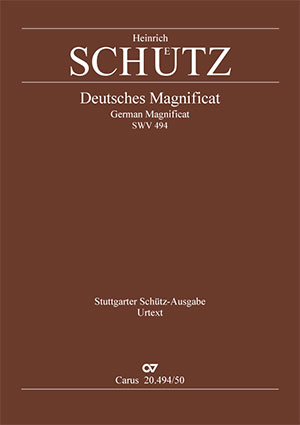
German Magnificat. "Meine Seele erhebt den Herrn"
Magnificat. Extrait de : Psaume 119 du Roi et Prophète David en 11 morceaux (Opus ultimum) SWV 494, 1671
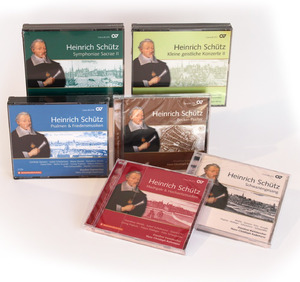
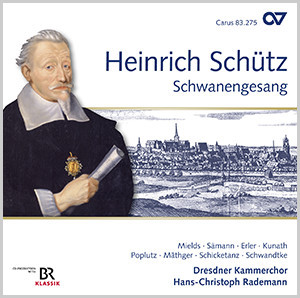
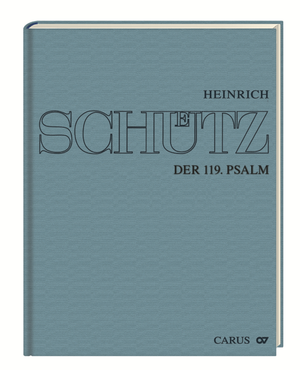
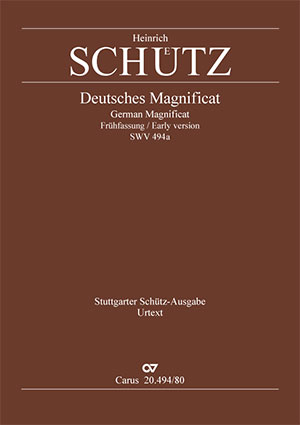
Following Heinrich Spitta’s publication of Heinrich Schütz’s double-choir Deutsches Magnificat in a new edition in 1926, this work has gone on to become one of Schütz’s most popular works. This is due to its successful synthesis of high compositional skill and catchiness. The "tone" of the piece is much shaped by the predominance of triple meter. This gives the piece a rhythmic lightness, but also brings a harmonic straightforwardness with it. Schütz made the Deutsches Magnificat into almost a compendium of his text-based compositions, in which scarcely any opportunity for vivid portrayal of the text passes him by. Schütz included the Deutsches Magnificat and a setting of Psalm 100 as an appendix in the original manuscript of his Opus ultimum, the 119th Psalm ("Schwanengesang"), but two vocal parts from this are now missing. In this edition they have been added by the editor Werner Breig.
Découvrir
 Consulter
 Ecouter
(1)
Ecouter
(1)
- German Magnificat. "Meine Seele erhebt den Herrn"
 Compléments
- Acheter des compléments au format téléchargement.
-
 Texte numérique (sans notes), licence d'impression incluse, fichier html, paroles, traduction en anglaisfichier html, paroles, traduction en anglais (Extrait)
Deutsches Magnificat: Meine Seele erhebt den Herren SWV 494 My soul doth magnify the Lord,
and my spirit hath rejoiced in God my Saviour.
For he hath regarded the low estate of his handmaiden:
for, behold, from henceforth
all generations shall call me blessed.
For he that is mighty hath done to me
great things; and holy is his name.
He hath shewed strength with his arm;
he hath scattered the proud
in the imagination of their hearts.
He hath put down the mighty from their seats,
and exalted them of low degree.
He hath fi lled the hungry with good things;
and the rich he hath sent empty away.
He hath helped his servant Israel,
in remembrance of his mercy;
as he spake to our fathers,
to Abraham, and to his seed for ever.
Lk 1:46-55
...
-
Texte numérique (sans notes), licence d'impression incluse, fichier html, paroles, originalfichier html, paroles, original (Extrait)
Deutsches Magnificat: Meine Seele erhebt den Herren SWV 494 Meine Seele erhebt den Herren,
und mein Geist freuet sich Gottes, meines Heilandes.
Denn er hat die Niedrigkeit seiner Magd angesehen.
Siehe, von nun an
werden mich selig preisen alle Kindeskind,
denn er hat große Ding an mir getan,
der da mächtig ist und des Name heilig ist.
Er übet Gewalt mit seinem Arm
und zerstreuet, die hoffärtig sind
in ihres Herzens Sinn.
Er stößet die Gewaltigen vom Stuhl
und erhöhet die Niedrigen.
Die Hungerigen füllet er mit Gütern
und lässet die Reichen leer.
Er denket der Barmherzigkeit
und hilft seinem Diener Israel auf.
Wie er geredt hat unsern Vätern,
Abraham und seinem Samen ewiglich.
Lk 1,46–55
...
-
Texte numérique (sans notes), licence d'impression incluse, fichier html, Texte introductif, en anglaisfichier html, Texte introductif, en anglais (Extrait)?? Foreword of the Edition Carus 20.494/50
Werner Breig
Translation: Elizabeth RobinsonThe Latin version of the hymn of praise, sung by the Virgin Mary in response to the Archangel Gabriel’s Annunciation in St. Luke’s Gospel that she is to bear the son of God, begins with the word “Magnificat” (Luke 1,46–55: “Magnificat anima mea Dominum”). This ten-verse text has its established place as the canticle at Vespers, the penultimate divine office of the day. As a result the Magnificat became one of the most frequently-set texts in the Bible (for example, there are over
...
-
Texte numérique (sans notes), licence d'impression incluse, fichier html, Texte introductif, en allemandfichier html, Texte introductif, en allemand (Extrait)Gek?rztes Vorwort der Ausgabe Carus 20.494/50
Werner Breig
Mit dem Wort „Magnificat“ beginnt die lateinische Fassung des Lobgesangs, den im Lukas-Evangelium die Jungfrau Maria als Antwort auf die Verkündigung des Erzengels Gabriel anstimmt, sie werde den Sohn Gottes gebären (Lukas 1,46–55: „Magnificat anima mea Dominum“). Dieser aus 10 Versen bestehende Text hat seinen festen Platz als sog. Canticum der Vesper, des vorletzten Stundengebetes des Tages. Dadurch wurde das Magnificat einer der meistvertonten Texte der Bibel (beispielsweise gibt es von Orlando di Lasso über 100 Magnificat-Kompositionen). Auch in der lutherischen Kirche, die die Vesper als liturgische Form beibehalten hat, entstand eine reiche Tradition von Magnificat-Kompositionen, als deren Gipfel das Magnificat von Johann Sebstian Bach (BWV 243) gilt. Dabei trat neben die lateinische Fassung der Vulgata in zunehmenden Maße die Übersetzung Martin Luthers „Meine Seele erhebt den Herrn“.
Heinrich Schütz hat über den Magnificat-Text vier Kompositionen in verschiedenen Besetzungen geschrieben: eine für vierstimmigen Chor (SWV 426), eine für Sopran, zwei Instrumente und Basso continuo (SWV
...
Acheter
Informations complémentaires sur l'œuvre
-
Compositeur
Heinrich Schütz
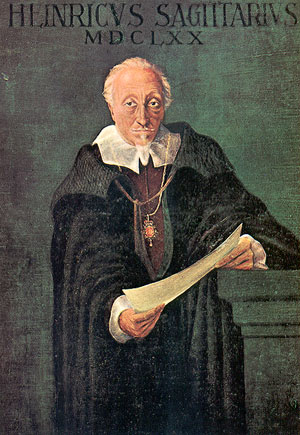
| 1585-1672Heinrich Schütz is regarded as the first German musician of European stature. As a choirboy from 1599 at the court of Landgrave Moritz of Hessen-Kassel, he received a thorough education. In 1608 he began a law degree in Marburg, but broke this off in 1609 in order, with the support of the Landgrave, to study composition with Giovanni Gabrieli, organist at St Mark’s in Venice. In 1613 Schütz returned to Kassel, but two years later was enticed away by Elector Johann Georg I of Saxony to the Dresden court as “Organist und Director der Musica”, where he held the position of Hofkapellmeister (court Kapellmeister) from 1617 until his death. Schütz’s great cycles of vocal works marked the high point of his reputation in Germany and northern Europe. But these represent only part of Schütz’s output; individual works are represented in printed collections with works by other composers, others only survive in manuscript, and much has been lost. The Stuttgart Schütz Edition makes available Schütz’s complete oeuvre, and all works are also published in practical Urtext editions. Plus d'information sur la personne
-
Basse continue réalisée
Paul Horn
| 1922-2016Paul Horn war ein deutscher Kirchenmusiker, Organist, Komponist und Musikwissenschaftler. Er studierte Kirchenmusik und Orgel an der Evangelischen Kirchenmusikschule Esslingen am Neckar bei Hans-Arnold Metzger und Musikwissenschaft, Theologie und Geschichte an der Universität Tübingen. Seine berufliche Laufbahn begann als Kantor an der Evangelischen Michaelskirche in Stuttgart-Degerloch. 1954 wurde er Kantor an der Evangelischen Stadtkirche Ravensburg, eine Position, die er bis zu seiner Pensionierung innehatte. Als Musikwissenschaftler arbeitete Horn bis ins hohe Alter eng mit Carus zusammen. So stammen zahlreiche Carus-Klavierauszüge aus seiner Feder. Plus d'information sur la personne
-
Traducteur
Margaret Schubert
Les évaluations sur notre site web ne peuvent être effectuées que par des clients disposant d'un compte d'utilisateur enregistré. Il n'est pas vérifié si les produits évalués ont été effectivement achetés.
Aucune évaluation disponible pour ce produit.
Questions fréquentes sur l'œuvre
 Il n'y a pas encore de questions et réponses concernant cette œuvre ou vous n'avez pas trouvé la réponse à votre question sur l'œuvre ? Cliquez ici et envoyez votre question spécifique à notre service clients.