Concerto pour flûte en ré majeur
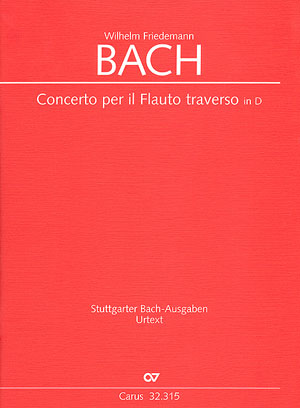
Concerto per il Flauto traverso in D BR-WFB C 15
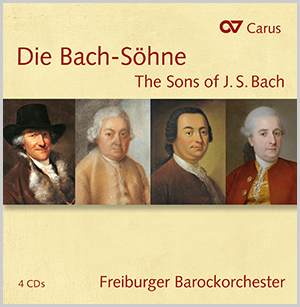
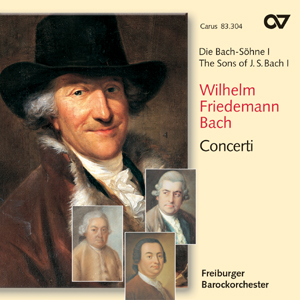
Grâce à cette édition du Concerto en trois mouvements pour flûte traversière, 2 violons, alto et basse continue, le seul concerto pour flûte de Wilhelm Friedemann Bach à nous être parvenu, va pouvoir connaître un public musical plus large. La composition presque continuellement à trois voix et au transparent filigrane dans l’écriture orchestrale porte de manière indubitable les traits artistiques propres au fils aîné de Bach. L’édition critique (d'après la seule source connue en provenance de la bibliothèque de la Sing-Akademie de Berlin) anticipe le volume IV/2 de l’édition complète des œuvres de Wilhelm Friedemann Bach.
Découvrir


 Ecouter
(4)
Ecouter
(4)
- Un poco Allegro
- Un poco Allegro
- Largo
- Vivace
Acheter
Informations complémentaires sur l'œuvre
Sommaire
-
Compositeur
Wilhelm Friedemann Bach
| 1710-1784Wilhelm Friedemann Bach, l'aîné des fils de Johann Sebastian, était connu comme l'un des meilleurs compositeurs de sa génération, mais aussi comme l'un des plus indépendants. Son œuvre témoigne de son ambition de poursuivre l'héritage de son père tout en faisant évoluer le goût musical de ses contemporains. Ses exigences artistiques de haut niveau sont présentes pratiquement dans toutes ses œuvres – des premières pièces pour clavier jusqu'aux sonates et fantaisies tardives, en passant par les cantates de la maturité. Wilhelm Friedemann Bach est l'auteur de pièces pour clavier, de musique de chambre, de concertos et de cantates sacrées. Il entreprit, avec un haut niveau de technique de composition, une synthèse attrayante entre le style complexe du haut-baroque et le style galant expressif. Alors qu'il composa principalement ses œuvres instrumentales à Dresde (1733–1746) et Berlin (1774–1784) , où il était contraint à un style de cour somptueux, ses œuvres vocales appartiennent à la période de Hallens, où il était organiste et directeur de la musique à l'église Saint Marc (1746–1764), et se distinguent par leurs audaces expressives et leur virtuosité. Plus d'information sur la personne
-
Éditeur
Peter Wollny
| 1961
-
Éditeur
Sergej Kudriachov
Critiques
Wilhelm Friedemann Bach: Concerto per il Flauto tTaverso in D BR WFB C 15
Wilhelm Friedemann Bach: Concerto per il Flauto tTaverso in D BR WFB C 15
Three recordings of this concerto have reached us so far, the last (from Carus) proclaiming itself as the first (see p. 21). The work itself has appeared in various catalogues, but was not taken seriously since the source is anonymous, apart from a late, implausible ascription to Quantz. The Quantz thematic catalogue hives it off as QV 5: Anh.6; the W. F. Bach catalogue by Falck (1913) calls it spurious, a judgment with which Peter Wollny agreed in his 1993 Harvard thesis on WFB. There is some objective reason for the ascription: WFB’s hand in the figuring of the continuo part was noticed two centuries ago. But study of the music (plus, a cynical observer might surmise, a desire to exploit the rediscovery of the Sing-Akademie library in Kiev) convinces Wollny, and probably the listener to any of the recordings, that the ascription is at least plausible, perhaps more. This edition is an extract from a future vol. IV / 2 of a projected complete edition of WFB, so editorial commentary is deferred to that. Assuming that parts are available, it is a valuable addition to the flautist’s repertoire; the accompaniment is for strings and harpsichord.
Quelle: Early Music Review April 2003
Les évaluations sur notre site web ne peuvent être effectuées que par des clients disposant d'un compte d'utilisateur enregistré. Il n'est pas vérifié si les produits évalués ont été effectivement achetés.
Aucune évaluation disponible pour ce produit.
Questions fréquentes sur l'œuvre
 Il n'y a pas encore de questions et réponses concernant cette œuvre ou vous n'avez pas trouvé la réponse à votre question sur l'œuvre ? Cliquez ici et envoyez votre question spécifique à notre service clients.