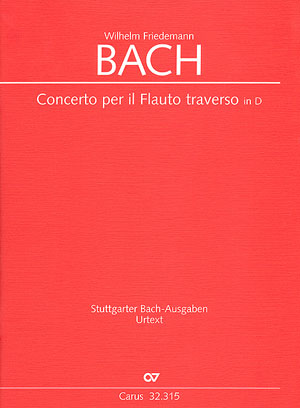
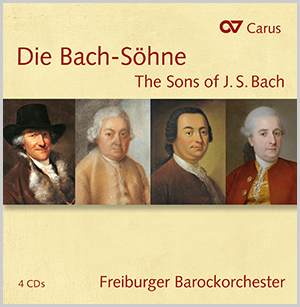
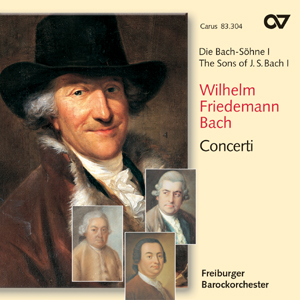
Mit der Erstausgabe dieses 3-sätzigen Konzerts für Querflöte, 2 Violinen, Viola und Basso continuo wird das einzige überlieferte Flötenkonzert Wilhelm Friedemann Bachs einer breiteren musikalischen Öffentlichkeit wieder zugänglich. Die im Orchestersatz durchsichtig-filigrane, fast durchgehend 3-stimmige Komposition trägt unverkennbar die individuellen künstlerischen Züge des ältesten Bach-Sohnes. Die kritische Edition (nach der einzigen bekannten Quelle aus dem Bibliotheksbestand der Berliner Singakademie) bildet einen Vorabdruck aus Band IV/2 der Gesamtausgabe der Werke Wilhelm Friedemann Bachs.
Kennenlernen
 Anschauen

 Anhören
(4)
Anhören
(4)
- Un poco Allegro
- Un poco Allegro
- Largo
- Vivace
Kaufen
Zusatzinformationen zum Werk
Inhaltsverzeichnis
-
Komponist*in
Wilhelm Friedemann Bach
| 1710-1784Wilhelm Friedemann Bach, der älteste Sohn Johann Sebastians, genoss den Ruf, einer der herausragenden, zugleich aber auch eigenwilligsten Komponisten seines Zeitalters zu sein. Sein Werk stellt den ehrgeizigen Versuch dar, das Erbe des Vaters aufzunehmen und dem Geschmack seiner Generation entsprechend weiterzuentwickeln. Hochgesteckte künstlerische Ambitionen sind in nahezu sämtlichen Werken W. F. Bachs zu erkennen – von den frühen Klavierstücken über die Kantaten der mittleren Schaffenszeit bis hin zu den späten Sonaten und Fantasien. Aus Wilhelm Friedemann Bachs Feder stammen Klavier- und Kammermusik, Konzerte und geistliche Kantaten. Auf hohem kompositionstechnischem Niveau unternimmt er eine reizvolle Synthese von hochbarock-komplexem und galant-empfindsamem Stil. Während seine Instrumentalwerke vornehmlich in Dresden (1733–1746) und Berlin (1774–1784) entstanden und einem prachtvollen höfischen Stil verpflichtet sind, gehören die Vokalwerke seiner Wirkungszeit als Organist und Musikdirektor der Hallenser Marktkirche (1746–1764) an und zeichnen sich durch ihre expressive Kühnheit und Virtuosität aus. zur Person
-
Herausgeber*in
Peter Wollny
| 1961
-
Herausgeber*in
Sergej Kudriachov
Rezensionen
Wilhelm Friedemann Bach: Concerto per il Flauto tTaverso in D BR WFB C 15
Wilhelm Friedemann Bach: Concerto per il Flauto tTaverso in D BR WFB C 15
Three recordings of this concerto have reached us so far, the last (from Carus) proclaiming itself as the first (see p. 21). The work itself has appeared in various catalogues, but was not taken seriously since the source is anonymous, apart from a late, implausible ascription to Quantz. The Quantz thematic catalogue hives it off as QV 5: Anh.6; the W. F. Bach catalogue by Falck (1913) calls it spurious, a judgment with which Peter Wollny agreed in his 1993 Harvard thesis on WFB. There is some objective reason for the ascription: WFB’s hand in the figuring of the continuo part was noticed two centuries ago. But study of the music (plus, a cynical observer might surmise, a desire to exploit the rediscovery of the Sing-Akademie library in Kiev) convinces Wollny, and probably the listener to any of the recordings, that the ascription is at least plausible, perhaps more. This edition is an extract from a future vol. IV / 2 of a projected complete edition of WFB, so editorial commentary is deferred to that. Assuming that parts are available, it is a valuable addition to the flautist’s repertoire; the accompaniment is for strings and harpsichord.
Quelle: Early Music Review April 2003
Bewertungen auf unserer Website können nur von Kund*innen mit registriertem Nutzerkonto abgegeben werden. Eine Überprüfung, ob die bewerteten Produkte tatsächlich erworben wurden, findet nicht statt.
Es liegen keine Bewertungen zu diesem Artikel vor.
Häufige Fragen zum Werk
 An dieser Stelle gibt es noch gar keine Fragen und Antworten zum Werk oder Ihre spezifische Frage zum Werk wurde noch nicht beantwortet? Klicken Sie hier und reichen Sie Ihre werkspezifische Frage bei unserem Kundenservice ein!