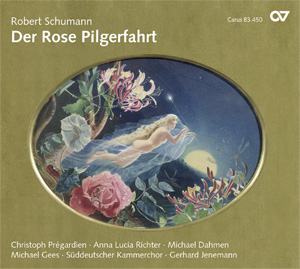
Der Rose Pilgerfahrt
 Anhören
(24)
Anhören
(24)
- Sopran I, II, Alt solo, Frauenchor: Die Frühlingslüfte bringen
- Tenor, Alt: Johannis war gekommen
- Chor der Elfen, Frauenchor: Wir tanzen
- Tenor, Rose, Elfenfürstin, Chor der Elfen: Und wie sie sangen
- Tenor, Rosa: So sangen sie
- Rose, Marthe: Bin ein armes Waisenkind
- Tenor, Rosa, Totengräber: Es war der Rose erster Schmerz!
- Chor, Rosa, Totengräber, Alt: Wie Blätter am Baum
- Tenor, Totengräber, Rosa: Die letzte Scholl’ hinunterrollt
- Rosa, Chor der Elfen: Dank, Herr, dir dort im Sternenland
- Tenor, Rosa, Totengräber: Ins Haus des Totengräbers
- Sopran I, II, Alt: Zwischen grünen Bäumen
- Tenor, Totengräber, Rosa, Müller, Müllerin: Von dem Greis geleitet
- Tenor: Bald hat das neue Töchterlein
- Männerchor: Bist du im Wald gewandelt
- Alt: Im Wald, gelehnt am Stamme
- Sopran, Alt, Max, Rosa: Der Abendschlummer
- Chor: O sel’ge Zeit
- Bass: Wer kommt am Sonntagsmorgen
- Sopran, Alt: Ei Mühle, liebe Mühle
- Tenor, Bariton, Chor, Sopran: Was klingen denn die Hörner
- Chor: Im Hause des Müllers
- Tenor, Rosa: Und wie ein Jahr verronnen ist
- Frauenchor (Engelsstimmen): Röslein!
Inhaltsverzeichnis
-
Komponist*in
Robert Schumann
| 1810-1856Robert Schumann ist noch immer vor allem als Klavier- und Liedkomponist bzw. als Symphoniker präsent. In seinen späteren Schaffensjahren sah er hingegen in der Komposition von Chormusik einen wichtigen Schwerpunkt seiner Arbeit. Hier gilt es auch heute noch einen weitgehend unbekannten Schumann zu entdecken, dessen Chormusik Volkstümlichkeit und künstlerischen Anspruch zugleich meisterhaft verbindet. Carus bietet Schumanns sämtliche Werke für gemischten Chor und für Frauenchor a cappella und mit Klavier. Sie zeigen seine Experimentierfreude, seine Sensibilität in der Auswahl sowie musikalischen Umsetzung der Texte, nicht zuletzt aber sein eigenständiger Chorstil, der besonders auf raffinierte Details in der Gestaltung des Satzes setzt. zur Person
-
Vorwortverfasser*in
Thomas Synofzik
| 1966
-
Ensemble
Süddeutscher Kammerchor
Der Süddeutsche Kammerchor wurde 1973 gegründet. Konzertreisen führten das Vokalensemble bisher durch viele europäische Länder, nach Israel, Kanada und in die USA. Für die nächsten Jahre bestehen Einladungen nach Israel und Hongkong. Neben der Darstellung der großen Oratorien konzentriert sich die Arbeit des Chores auf weniger bekannte Werke aller Epochen aus dem Bereich der A-cappella-Literatur. Der Süddeutsche Kammerchor musiziert in verschiedenen Besetzungsgrößen, die den Erfordernissen der jeweiligen Komposition angepasst werden. In seinem Kern besteht der Chor aus jungen professionellen Sängern, die auch solistisch tätig sind; für größer besetzte Werke treten semi-professionelle Chorsänger und -sängerinnen hinzu. Einladungen zu Festivals und Konzerten im In- und Ausland sowie die Zusammenarbeit mit namhaften Orchestern wie dem Münchner Kammerorchester, Festival Strings Lucerne oder der Jungen Deutschen Philharmonie zeugen von der Qualität des Ensembles. Hierzu zählt auch die Arbeit mit renommierten Originalklang-Orchestern wie dem Freiburger Barockorchester, Drottningholms Baroque Ensemble Stockholm oder Concerto Köln. Mit den deutschen Rundfunkanstalten, u. a. Bayerischer Rundfunk und Hessischer Rundfunk, besteht eine enge Zusammenarbeit. Regelmäßig werden Einspielungen von ausgesuchten Werken für CDs und Rundfunksendungen produziert. zur Person
-
Dirigent*in
Gerhard Jenemann
| 1951Gerhard Jenemann studierte an der Staatlichen Hochschule für Musik Frankfurt/Main. Privatstudien und Kurse in Chor- und Orchesterleitung bei Michael Stephani, Helmuth Rilling, Andreas Weis, Eric Ericson und Thomas Ungar schlossen sich an. Er ist Leiter des Süddeutschen Kammerchores und der Vocalsolisten Frankfurt, einem Ensemble professioneller Konzert- und Opernsänger. Er konzertiert im In- und Ausland. Hierbei arbeitete er mit vielen bekannten Orchestern wie dem Hessischen Staats - orchester Wiesbaden, den Prager Sinfonikern, den Radiosinfonieorchestern aus Prag, Krakau und Budapest, dem Münchner Kammerorchester oder den Festival Strings Lucerne zusammen. Schon seit Jahren beschäftigt sich Gerhard Jenemann intensiv mit der Aufführung vorklassischer Musik und dirigierte hierbei so bekannte Ensembles wie das Freiburger Barockorchester, La Stravaganza Köln, die Cappella Savaria oder Drottningholms Baroqueensemble Stockholm. Seit 1991 ist er Dozent für Chor und Chorleitung am Richard-Strauss-Konservato - rium München. zur Person
-
Sopran-Solo
Anna Lucia Richter
-
Sopran-Solo
Kathrin Arnold
-
Sopran-Solo
Elisabeth Menke
-
Alt-Solo
Elvira Bill
Die Mezzosopranistin Elvira Bill studiert Gesang bei Christoph Prégardien an der Kölner Musikhochschule. Bis zu ihrem Abitur in Mönchengladbach erhielt sie u.a. von Reinhard Becker (Wuppertal) wichtige sängerische Impulse und Anregungen. Ihr Repertoire reicht von alten Meistern bis zur zeitgenössischen Musik. Im Bereich der historischen Aufführungspraxis wird sie zusätzlich vom Countertenor Kai Wessel betreut. Einen Schwerpunkt ihrer solistischen Konzerttätigkeit bildet das Oratorium. Als Solistin sang Elvira Bill unter Leitung von Marcus Creed, Peter Neumann, Robin Gritton, Christopher Hogwood und vielen anderen Dirigenten. Am Theater Krefeld-Mönchengladbach war sie in der Oper Der Riese vom Steinfeld von Friedrich Cerha zu hören. Konzertreisen führten sie in viele Städte Deutschlands, nach Frankreich, Österreich, in die Benelux-Staaten, nach Italien, Portugal, Ungarn, Russland, China und in den Oman. zur Person
-
Alt-Solo
Sibylla Müller
-
Tenor-Solo
Christoph Prégardien
Als einer der herausragenden lyrischen Tenöre unserer Zeit ist Christoph Prégardien ganz besonders als Liedsänger geschätzt. Der Schwerpunkt seiner Arbeit liegt im Fach Lied und Oratorium, sein Repertoire umfasst alle Epochen. Christoph Prégardien und sein Klavierbegleiter Michael Gees erhielten den MIDEM Classical Award 2009 für ihre Aufnahme von Schuberts »Die schöne Müllerin«. zur Person
-
Tenor-Solo
Julian Prégardien
-
Bass-Solo
Michael Dahmen
Der Bariton Michael Dahmen studiert seit 2006 bei Christoph Prégardien an der Hochschule für Musik Köln. Seither tritt er als Opern- und Konzertsänger im In- und Ausland auf, so z.B. in Italien, Frankreich, der Schweiz, in Brasilien und Mexiko. Auf der Opernbühne war er u.a. als Masetto (Don Giovanni) und als Dr. Falke in Strauss’ Die Fledermaus zu sehen. Seine Konzerttätigkeit mit solch namhaften Partnern wie dem Pianisten Michael Gees, dem Gambisten Christophe Coin, den Dirigenten Peter Neumann und Marcus Creed ist im Rundfunk und auf CD dokumentiert und führte den Wagner-Stipendiaten als Gast u.a. zum Internationalen Bachfest Schaffhausen und zum Beethovenfest Bonn. zur Person
-
Bass-Solo
Thomas Schütz
-
Solist*in - Klavier
Michael Gees
Rezensionen
...bei diesem «Kammeroratorium» geht mir immer das Herz auf. Es berührt mich tief und als Zuhörer zerfließe ich förmlich vor Rührung.
Chorzeit, November 2017
[...] The recording is excellent - the sound-stage is believable, with the piano naturally placed.
(Colin Clarke, musicweb-international, März 2011)
[...] bei der hier vorliegenden neuen CD-Einspielung ist mit Michael Gees eine Idealbesetzung zur Stelle. Ein ungemein gewandter und höchst sensibler Aktivposten, der zudem eminent viel Liederfahrung mitbringt. Gleiches gilt natürlich auch für den Tenorlyriker Christoph Prégardien, der ja zusammen mit Gees seit Jahren ein hochkarätiges Liedgespann bildet. [...]
(Johannes Adam, Badische Zeitung, 8.1.2011)
[...] Die andere [Säule] stellt der wundervoll nuanciert und intonationsrein singende Süddeutsche Kammerchor unter der sicheren, sensiblen Leitung von Gerhard Jenemann dar, der die vielen komplexen rhythmischen Variationen der Musik brillant meistert. [...] eine Ehrenrettung Schumanns und seines doch problematischen Werkes verwirklicht. [...]
(pizzicato, Oktober 2010)
[...] Christoph Prégardien lässt als erzählender Tenor keine Wünsche offen: Jedes Wort, jede Phrase ist exakt herausgearbeitet, mit fließenden Legatobögen werden alle Höhen mühelos gemeistert und jede Kantilene mit intensivem Leben erfüllt. Michael Dahmen verleiht dem Totengräber ausdrucksstarkes Profil, seine hohe Baritonstimme ist warm und leuchtend timbriert. Der Süddeutsche Kammerchor (Einstudierung: Gerhard Jenemann) verfügt über ein abwechslungsreiches Potenzial - vom wundervoll schwebenden, sauber intonierten Elfen- und Engelschor über einen frisch vorgetragenen Waldchor, dem mit Schwermut erfüllten Trauergesang bis hin zur fröhlichen Schilderung der Hochzeit. Michael Gees, langjähriger Liedbegleiter von Prégardien, spielt den Klavierpart meisterhaft mit perlenden Läufen und Verzierungen, kraftvollen Akkorden und innig gefühlvollen Passagen.
(G. Schunk, Das Opernglas, 7–8/2010
Grandios deklamiert Christoph Prégardien den Erzähler und Förstersohn. Mit bemerkenswerter Präsenz singt die 1990 geborene Anna Lucia Richter ihre Sopranpartien. Dazu überzeugt Michael Gees mit perlend leichtfüßigem Klavierspiel. Durch die vielfältig angelegten Sätze hindurch animiert Jenemann seinen Kammerchor zu schwungvoll-vitalen Gesängen. Abschließend schwingt sich der Frauenchor zu engelsgleichem Ausdruck empor - ein Höhepunkt zum Weinen. „Sei uns gegrüßt, liebliche Rose!”
(Karsten Blüthgen, Neue Chorzeit, Juli/August 2010)
[...] Wohl dem Chor, der solche Stimmen hat ... [...]
(Reiner Schulte, WDR3, Juli 2010)
Bewertungen auf unserer Website können nur von Kund*innen mit registriertem Nutzerkonto abgegeben werden. Eine Überprüfung, ob die bewerteten Produkte tatsächlich erworben wurden, findet nicht statt.
Häufige Fragen zum Werk
 An dieser Stelle gibt es noch gar keine Fragen und Antworten zum Werk oder Ihre spezifische Frage zum Werk wurde noch nicht beantwortet? Klicken Sie hier und reichen Sie Ihre werkspezifische Frage bei unserem Kundenservice ein!