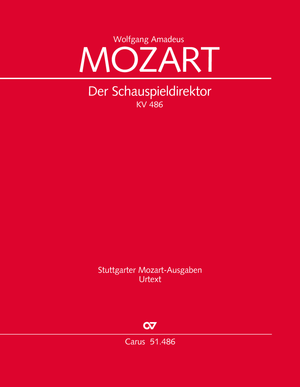
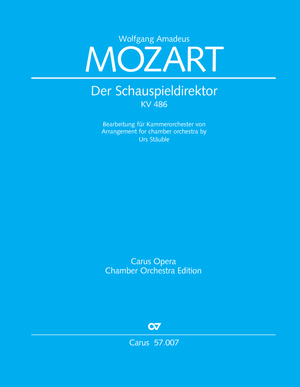
Wolfgang Amadeus Mozart / Urs Stäuble (arr.) Der Schauspieldirektor

Arrangement for chamber orchestra (arr. U. Stäuble) KV 486, 1786

Read and write feedback

Mozart was commissioned by Emperor Joseph II to write the one-act opera Der Schauspieldirektor (The Impresario) to mark a visit to Vienna by the Governor-General of the Netherlands in the spring of 1786. The guests were to be musically entertained with a short German and an Italian comedy at a party arranged at short notice in Schönbrunn. The two composers chosen were Mozart and Salieri, both of whom poke fun at the theatrical conventions of the time. The Schauspieldirektor lampoons the vanity of opera singers and the amateurish nature of many a traveling acting troupe.

This chamber version reduces the original doubled wind section to a quintet of solo flute, oboe, clarinet, bassoon and horn. While trumpets are omitted, the timpani are not, giving the outer movements real momentum through rhythmic impulses. The string parts can be performed by solo instruments. In this way, a performance can be realized with only a few players yet without giving up the differentiated tonal qualities of the original. Ideal for a performance in the opera studio!

The original version of the work is available under Carus 51.486/00.

Original version Arrangement for Chamber Orchestra
Soli SSTB, 6 speaking parts, 2 Fl, 2 Ob, 2 Clt, 2 Fg, 2 Cor, 2 Ctr, Timp, 2 Vl, Va, Vc, Cb
Soli SSTB, 6 speaking parts, Fl, Ob, Clt, Fg, Cor, Timp, 2 Vl, Va, Vc, Cb

Explore
Sheet music preview View
Purchase
Full score, foreword in German and English Carus 57.007/00, ISMN 979-0-007-34180-0 108 pages, paperback
available
82,00 € / copy
Set of parts, complete orchestral parts, for hire Carus 57.007/19 23 x 32 cm, without cover
  • 1 x Set of parts, harmony parts, for hire, flute, oboe, clarinet, bassoon, french horn, timpani (57.007/09)
     
    5 x Individual part, violin 1, for hire (57.007/11)
     
    4 x Individual part, violin 2, for hire (57.007/12)
     
    3 x Individual part, viola, for hire (57.007/13)
     
    3 x Individual part, violoncello, for hire (57.007/14)
     
    2 x Individual part, double bass, for hire (57.007/15)
     
Full score digital (download), pdf file Carus 57.007/00-010-000, ISMN 979-0-007-34181-7 108 pages
available
73,80 € / copy
Set of parts digital (download), zip file, pdf file, complete orchestral parts, for hire Carus 57.007/19-010-000 23 x 32 cm, without cover
  • 1 x Set of parts digital (download), zip file, pdf file, harmony parts, for hire (57.007/09-010-000)
     
    5 x Individual part digital (download), pdf file, violin 1, for hire (57.007/11-010-000)
     
    4 x Individual part digital (download), pdf file, violin 2, for hire (57.007/12-010-000)
     
    3 x Individual part digital (download), pdf file, viola, for hire (57.007/13-010-000)
     
    3 x Individual part digital (download), pdf file, violoncello, for hire (57.007/14-010-000)
     
    2 x Individual part digital (download), pdf file, double bass, for hire (57.007/15-010-000)
     
Director Frank wants to put together a troupe in Salzburg, supported by bass buffo Puf. Various actors and singers are presented, either performing scenes from current theater literature or offering a taste of their vocal skills (Arietta No. 1 and Rondo 2). The promised fees increase with each engagement. In addition, the ladies battle for the role of “first singer” (Trio No. 3). Due to the discord, Frank threatens to call off the whole enterprise. The participants then agree to subordinate their individual interests to art, a sentiment they express in the final song (No. 4): “to give preference to oneself, to rise above others, makes even the greatest artist small.”
  • As the son of the deputy Kapellmeister to the Salzburg Prince-Archbishop, Mozart was constantly surrounded by church music in his youth. On his travels Mozart became familiar with Italian church music, and later in Vienna he studied the works of Bach and Handel. After moving to Vienna he was faced with the new challenges of composing opera and piano concertos, and significantly the “C Minor Mass” KV 427, the greatest sacred work of the first Vienna years, remained unfinished. The last period of his life again shows a change of direction to church music: Mozart successfully applied to succeed the terminally ill Leopold Hoffmann as Kapellmeister at St Stephen's Cathedral, but he was unable to take up the position as he died before Hoffmann. A gem such as the “Ave verum” KV 618 and the incomplete Requiem KV 626 give us an idea of what Mozart might have achieved as a composer of sacred music if he had taken up this important position. Personal details
  • Urs Stäuble studied at the Conservatory of the Music Academy in Basel (organ with Eduard Müller, piano with Klaus Linder) and at the University of Music in Vienna (organ with Michael Radulescu, orchestral conducting with Karl Österreicher, choral conducting with Günther Theuring). In addition to teaching at the Basel Music Academy (1980–2016), he worked as an organist and choir and orchestra conductor in various European countries and Australia. Personal details

Reviews on our website can only be submitted by customers with a registered user account. A check whether the rated products were actually purchased does not take place.

No feedback available for this product.

Frequent questions about this work

How do the string parts in the arrangement for chamber orchestra differ from those in the original version?

The parts for violin I and double bass are completely identical to those in the original version. There is a small deviation in the arietta in bars 23-26 for violin II, while the viola and violoncello show greater differences to the original.
Modern arrangements for smaller ensembles often require single instruments to take on multiple parts from the original version. This would be possible only to a very limited extent with historical instruments. This chamber music version should therefore be performed with modern wind instruments.
A rehearsal scenario (German “Szenarium”) is a scene and role breakdown: it provides a tabular overview of the structure of the opera, showing acts, scenes, musical numbers, etc. and the performers involved at every point. This makes it easy to see immediately who is needed for each scene. A rehearsal scenario is designed to assist with planning rehearsals and creating rehearsal schedules. Rehearsal scenarios can be downloaded free of charge from Carus.
A director’s book (sometimes known as a production or prompt book) contains a record of everything that happens during a theater performance. For example, it documents entrances and exits, cues for set changes, lighting, sound and stage technology, the positions of the characters, costume changes, and placement of props. To provide sufficient space for notes, the vocal score is printed on one page, with the facing page left blank for writing. To ensure maximum writing comfort, Carus offers one version for right-handed users (printed on the left, blank on the right) and one for left-handed users (blank on the left, printed on the right). The content is otherwise identical to the vocal score. The director’s book is available in printed and digital form.
A libretto is the text of an opera containing the complete lyrics with stage directions and scene descriptions. Carus offers libretti for German-language operas with additional English translations. Operas in other languages are published as trilingual libretti. In print and PDF format, the translation is printed in parallel columns, while the HTML version is available separately for each language.
The digital bundle includes the libretto as a PDF (multilingual in columns) and as a separate HTML file for each individual language.
Pencil symbol There are no questions and answers available so far or you were unable to find an answer to your specific question about this work? Then click here and send your specific questions to our Customer Services!