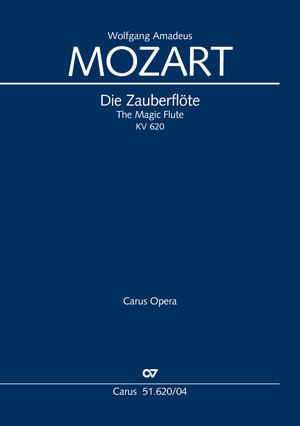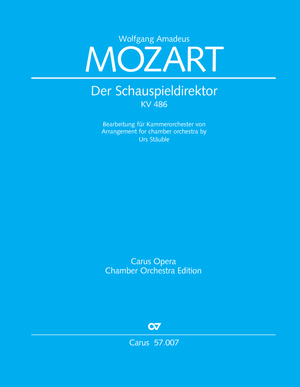
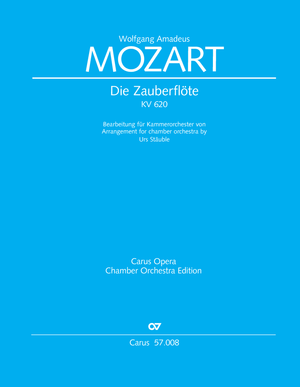
Die Zauberflöte
Bearbeitung für Kammerorchester (arr. U. Stäuble) KV 620, 1791
Sie gehört zu den meistgespielten Opern weltweit: Wolfgang Amadeus Mozarts Die Zauberflöte entstand 1791 für Emanuel Schikaneders Freihaustheater in Wien und verbindet märchenhafte Zauber-Elemente mit freimaurerischem Gedankengut. Mozart entfaltet in seiner letzten Oper sein ganzes kompositorisches Können: von volkstümlichen Melodien in Papagenos Liedern über Paminas innige Arien, der Tiefe und Ruhe in Sarastros Gesang bis zu den virtuosen Koloraturen der Königin der Nacht. So ist die Zauberflöte ernste Oper, munteres Singspiel und aufklärerisches Lehrstück in einem. Kurz: Für alle ist etwas dabei, und wahrscheinlich macht das den Erfolg der Zauberflöte aus.
Die vorliegende Kammerfassung von Urs Stäuble reduziert das Orchester auf ein Kammerensemble, ohne die musikalische Substanz zu beeinträchtigen. Im Gegenteil: Durch die transparente Instrumentierung treten die melodischen Linien und harmonischen Wendungen besonders klar hervor. Die ursprünglichen Posaunenstimmen werden hier von den anderen Bläsern übernommen, Trompete und Pauke sind ad libitum besetzt.
Diese Fassung der Zauberflöte eignet sich besonders für kleinere Ensembles, Hochschulensembles und konzertante Aufführungen mit begrenzten räumlichen Möglichkeiten. Neben der Partitur sind Klavierauszug, Orchesterstimmen und Chorpartitur erhältlich.
| Originalbesetzung | Bearbeitung für Kammerorchester |
| 18 Soli, 4 Sprechrollen, Coro SATTBB, 2 Fl/Pic, 2 Ob, 2 Clt, 2 CdB, 2 Fg, 2 Cor, 2 Tr, 3 Trb, Timp, Str d’a, 2 Vl, Va, Vc, Cb | 18 Soli, 4 Sprechrollen, Coro SATTBB, Fl/Pic, Ob, Clt, Fg, Cor, [Tr, Timp], Str d’a, 2 Vl, Va, Vc, Cb |


Inhaltsverzeichnis
-
Komponist*in
Wolfgang Amadeus Mozart
| 1756-1791Als Sohn des Vizekapellmeisters des Salzburger Fürsterzbischofs war Mozart bereits in seiner Jugend beständig von Kirchenmusik umgeben. Auf seinen Reisen lernte Mozart die Kirchenmusik Italiens kennen, in Wien studierte er später Werke Bachs und Händels. Nach seiner Umsiedlung nach Wien stellen sich mit Oper und Klavierkonzert neue Herausforderungen, bezeichnenderweise bleibt die „c-Moll-Messe“ KV 427, das größte kirchenmusikalische Werk der ersten Wiener Jahre, unvollendet. Die letzte Lebenszeit zeigt wieder eine Hinwendung zur Kirchenmusik: Mozart bewirbt sich mit Erfolg um die Nachfolge des todkranken Leopold Hoffmann als Kapellmeister am Stephansdom, doch kann er die Stelle nicht antreten, da er noch vor Hoffmann stirbt. Ein Kleinod wie das „Ave verum“ KV 618 und das unvollendet gebliebene Requiem KV 626 lassen ahnen, was Mozart als Kirchenkomponist hätte noch leisten können, wäre er in diese verantwortliche Position gelangt. zur Person
-
Textdichter*in
Emanuel Schikaneder
| 1751-1812Emanuel Schikaneder war unter anderem Schauspieler, Sänger, Regisseur und Dichter. Als Schauspieler war er schon seit seinen Zwanzigern in Europa unterwegs. In Salzburg hatte er 1780 erste Erfolge als Textdichter und auch Regisseur. Außerdem machte er dort die Bekanntschaft mit Leopold Mozart und dessen Sohn Wolfgang. In Wien trafen sich Schikaneder und Wolfgang Amadeus Mozart 1789 erneut. 1791 schrieb Schikaneder das Libretto zur Zauberflöte, zu welchem Mozart dann die Musik beisteuerte. Den ersten Papageno spielte Schikaneder dann selbst. zur Person
-
Bearbeiter*in
Urs Stäuble
| 1951Urs Stäuble studierte am Konservatorium der Musik-Akademie in Basel (Orgel bei Eduard Müller, Klavier bei Klaus Linder) und an der Hochschule für Musik in Wien (Orgel bei Michael Radulescu, Orchesterdirigieren bei Karl Österreicher, Chorleitung bei Günther Theuring). Neben seiner Lehrtätigkeit an der Basler Musik-Akademie (1980 – 2016) war er sowohl als Organist als auch als Chor- und Orchesterdirigent in verschiedenen europäischen Ländern und in Australien tätig. zur Person
Bewertungen auf unserer Website können nur von Kund*innen mit registriertem Nutzerkonto abgegeben werden. Eine Überprüfung, ob die bewerteten Produkte tatsächlich erworben wurden, findet nicht statt.
Häufige Fragen zum Werk
Was ist ein Szenarium?
Was ist ein Regiebuch?
Was ist ein Libretto?
Was ist im digitalen Bundle enthalten?
 An dieser Stelle gibt es noch gar keine Fragen und Antworten zum Werk oder Ihre spezifische Frage zum Werk wurde noch nicht beantwortet? Klicken Sie hier und reichen Sie Ihre werkspezifische Frage bei unserem Kundenservice ein!