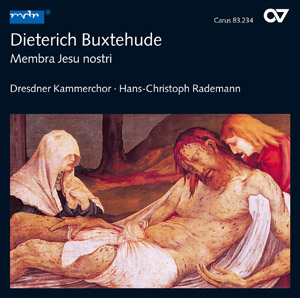
For Passion in 1680 Dieterich Buxtehude composed his largest work in the style of an oratorio, the cantata cycle Membra Jesu nostri, and he dedicated it to his friend, the Swedish Court Music Director, Gustav Düben. In each of the seven separate cantatas which, in principle, follow the scheme “instrumental introduction – choral movement with biblical texts – vocal soli (aria) with a sacred text from the Middle Ages – repetition of the choral movement,” the feet, knees, hands, side, chest, heart and face of the crucified Christ are interpreted allegorically.
The original scoring for strings in No. VI ("Ad Cor") consists of a consort of five gambas. If this group of instruments is not available, then violins I/II can be substituted for gamba I/II and the gamba V parts can be played by the violone (the music for these substitute parts is contained in each respective parts), so that in this case only two gambas (III, IV) are needed.
Explore
 Listen
(25)
Listen
(25)
- I. Ad pedes: Tutti
- I. Ad pedes: Aria
- I. Ad pedes: Tutti
- I. Ad pedes: Tutti
- II. Ad genua: Sonata in tremulo
- II. Ad genua: Tutti
- II. Ad genua: Aria
- II. Ad genua: Tutti
- III. Ad manus: Sonata
- III. Ad manus: Tutti
- III. Ad manus: Aria
- III. Ad manus: Tutti
- IV. Ad latus: Tutti
- IV. Ad latus: Aria
- IV. Ad latus: Tutti
- V. Ad pectus: Voci
- V. Ad pectus: Aria
- V. Ad pectus: Voci
- VI. Ad Cor: Sonata
- VI. Ad Cor: Voci
- VI. Ad Cor: Aria
- VI. Ad Cor: Voci
- VII. Ad faciem: Tutti
- VII. Ad faciem: Aria
- VII. Ad faciem: Voci
 Additional material
- Purchase additional material as a download product.
-
 Digital text (without sheet music) incl. printing licence, html file, singing text, english translationhtml file, singing text, english translation (Sample)
I. To the Feet 1. Sonata 2. Tutti (Coro SSATB) Behold, over the mountains come the feet
3. Aria a) Soprano I Greetings, salvation of the world!
of the bringer of good tidings and herald of peace.
Nahum 2:1
Greetings, dear Jesus!
Upon your Cross I truly desire
to hang! You know the reason,
give me your strength!
b) Soprano II The nails in your feet, the hard blows
and the so severe injuries
I embrace with emotion.
Shuddering at the sight of you,
I think of your wounds. c) Basso...
-
Digital text (without sheet music) incl. printing licence, html file, singing text, german translationhtml file, singing text, german translation (Sample)
I. An die Füße 1. Sonata 2. Tutti (Coro SSATB) Siehe, über die Berge kommen die Füße
3. Aria a) Soprano I Sei gegrüßt, Heil der Welt!
des Freudenboten und Verkünders des Friedens.
Nahum 2,1
Sei gegrüßt, teurer Jesus!
An dein Kreuz will ich wahrhaftig
mich hängen! Du weißt warum,
gib mir deine Kraft!
b) Soprano II Die Nägel in deinen Füßen, die harten Schläge
und die derart schweren Blessuren
umfasse ich mit Ergriffenheit.
Bei deinem Anblick erschauernd,
gedenke ich deiner Wunden.
c) Basso...
-
Digital text (without sheet music) incl. printing licence, html file, singing text, originalhtml file, singing text, original (Sample)
I. Ad pedes 1. Sonata 2. Tutti (Coro SSATB) Ecce super montes pedes
3. Aria a) Soprano I Salve mundi salutare,
evangelizantis et annunciantis pacem.
Nahum 2,1
salve, salve Jesu care!
Cruci tuae me aptare
vellem vere, tu scis quare,
da mihi tui copiam.
b) Soprano II Clavos pedum, plagas duras,
et tam graves impressuras
circumplector cum affectu,
tuo pavens in aspectu,
tuorum memor vulnerum.
c) Basso Dulcis Jesu, pie Deus,
...
-
Digital text (without sheet music) incl. printing licence, html file, Introductory text, frenchhtml file, Introductory text, french (Sample)Texte abrégé du livret du CD Carus 83.234
Michael Wersin
Traduction (abrégée): Sylvie CoquillatLongtemps fut attribué à saint Bernard (vers 1090–1153), l’un des représentants majeurs du culte de la Passion du Moyen-Age, un poème en latin connu sous le titre de Rhytmica Oratio, qui est une méditation sur les membres du Crucifié en sept hymnes : pieds, genoux, mains, côté, poitrine, cœur et visage font l’objet de considérations remplies d’amour fervent et de compassion. En fait, le texte, comme on le suppose aujourd’hui, est plutôt l’œuvre de l’abbé cistercien Arnulf von Löwen (vers 1200–1250) et fut plus tard agrandi à plusieurs reprises.
Dieterich Buxtehude prit sans doute connaissance de la Rhytmica Oratio latine dans une gravure de l’an 1633 parue à Hambourg. Il choisit trois strophes de chacun des sept hymnes consacrés à un membre du corps (membrum) et les place au
...
-
Digital text (without sheet music) incl. printing licence, html file, Introductory text, englishhtml file, Introductory text, english (Sample)Abridged text from the CD Carus 83.234
Michael Wersin
Translation: Peter PalmerSt. Bernard of Clairvaux (ca. 1090–1153) is regarded as one of the chief representatives of the pietism of the Cross in the Middle Ages. For a long time he was thought to be the author of a Latin poem which became known as Rhytmica Oratio. Its seven hymns constitute meditations on the limbs of the crucified Christ. Full of devoted love and ready sympathy, they are addressed to the feet, knees, hands, side, chest, heart, and face. In fact, however, the poem is now believed to traceable to the Cistercian abbot Arnulf von Löwen (ca. 1200–1250). It was later extended several times.
Dieterich Buxtehude probably encountered the Latin Rhytmica Oratio in a printing of 1633 which came out in Hamburg. He selected three verses from each of the seven hymns devoted to
...
-
Digital text (without sheet music) incl. printing licence, html file, Introductory text, germanhtml file, Introductory text, german (Sample)Gekürzter Booklet-Text der CD Carus 83.234
Michael Wersin
Die Meditation über die Wundmale des Heilands Jesus Christus zählt zu den zentralen Elementen spätmittelalterlicher Frömmigkeitspraxis. Der Betende initiiert und kräftigt auf dem Wege der commemoratio seine Bereitschaft zu Buße und Reue, indem er des Leidens Christi am Kreuz gedenkt. Mittels der compassio, des Mit-Erleidens von Folterung und Kreuzigung, entwickelt er ein enges Liebesverhältnis zu Christus, das durchaus auch erotische Züge tragen kann. Durch das Sich-Versenken in Schmerzen und Schmach des Erlösers vergegenwärtigt er sich dessen freiwilligen Opfertod zur Rettung der gefallenen Menschheit und strebt nach conformitas, nach Gleich-Förmigkeit mit Jesus. In Einzelfällen kann es dabei zur unio mystica, zum raptus-artigen Erlebnis des mystischen Einswerdens mit dem Angebeteten, ja sogar zur Ausbildung von Stigmata (so etwa beim
...
Purchase
Additional product information
Contents
-
Composer
Dieterich Buxtehude
| 1637-1707There are few documents concerning Buxtehude’s life. From a contemporary article in Nova literaria Maris Balthici, published soon after his death, we know that he regarded “Denmark as his homeland, from where he came to our region.”Dieterich Buxtehude, to use the spelling of his forename which he used when signing letters, was born about 1637 in Helsingborg, so he was a subject of the King of Denmark. His father, Johannes Buxtehude, was an organist, and taught his son sufficiently for him to become, in 1657 or 1658, an organist in Helsingborg and later in Helsingør. On the 11 April 1668 he was chosen to succeed Franz Tunder as organist at St. Marien in Lübeck, and until his death on 9 May 1707 Buxtehude remained in that position, one of the most important in northern Germany. After his death in 1707 musical experts praised Dieterich Buxtehude particularly for his keyboard music. For example, Johann Mattheson referred to him as a “highly regarded, former Lübeck organist.” That appreciation was based not on printed works, but on manuscript copies of his keyboard compositions, and on his reputation as a virtuoso which he enjoyed throughout Germany. Thus in 1703 Georg Friedrich Händel and Johann Mattheson were in Lübeck, and during the winter of 1705–06 Johann Sebastian Bach also went to Lübeck to study under Buxtehude so as to perfect his technique in composition and organ playing. Together with vocal music and music for keyboard instruments, two publications of his trio sonatas are extant. We know of the “Abendmusiken” in Lübeck from libretti printed for those occasions, but unfortunately the music is lost. That tradition of events similar to concerts was taken over by Buxtehude from his predecessor Franz Tunder. Personal details
Reviews on our website can only be submitted by customers with a registered user account. A check whether the rated products were actually purchased does not take place.
No feedback available for this product.
Frequent questions about this work
 There are no questions and answers available so far or you were unable to find an answer to your specific question about this work? Then click here and send your specific questions to our Customer Services!