Vivaldi, whose red hair inspired the nickname il prete rosso (the red priest), worked as a pastor at the Ospedale della Pietà, a Venice orphanage with an associated music school. Many of his compositions were written for the students at this school, including the Credo, his only authentic independent setting of the creed, which was composed between 1713 and 1717. The piece, which lasts about ten minutes, is written for four-part choir, strings and basso continuo and is divided into four parts: Credo – Et incarnatus – Crucifixus – Et resurrexit, with the two outer movements corresponding closely in terms of motif and style. The Adagio Et incarnatus displays a great deal of chromaticism, while the Crucifixus is characterized by two compositional features: a significant main motif and a continuous sequence of eighth notes with eighth note rests in the bass, which impressively depict the crucifixion and entombment.
Settings of Credo
Since the 14th century, the Credo has been part of the Ordinarium Missae cycle, in which those Mass chants are summarized that always remain the same in terms of text and placement in the service: Kyrie - Gloria - Credo - Sanctus (with Benedictus) - Agnus Dei. Particularly in the settings of the Classical and Romantic periods (e.g. by Mozart, Haydn, Beethoven, Schubert, Gounod, Bruckner and Puccini), the Credo settings are very extensive and musically differentiated due to the sheer volume of text. To this day, the Credo remains an invitation to artistic exploration. This also applies to a number of isolated individual settings of the Credo, for example by Antonio Vivaldi.
Prof. Dr. Stefan Klöckner, a renowned expert in Gregorian chant and liturgy, presents ten settings of the Credo from different eras and styles. Celebrate 1700 years of the Christian creed with us!
-
Antonio Vivaldi: Credo
-
Jan Dismas Zelenka: Missa Gratias agimus tibi
Zelenka, a Bohemian, was one of the most unconventional composers of the High Baroque. He spent most of his life and work in Dresden, where he wrote numerous sacred works for the church of the local court. His Missa Gratias agimus tibi dates from 1730. It is written for an extensive line-up: six vocal soloists, a four-part mixed choir and an orchestra. The Credo, which lasts about seven minutes, is in four movements and presents the text concisely and succinctly. A lively first section is followed by Et incarnatus for a trio of soloists and then the Crucifixus, an extraordinary alto aria in D major (!), reminiscent of Handel's well-known arias in its intimacy. Like many of Zelenka's works, this composition definitely deserves a closer look.
-
Franz Liszt: Missa choralis
After a major personal crisis and a turning point in his life, Liszt wrote this mass in Rome in 1865, at a time when he was focussed on Gregorian church music and preparing to take minor orders. The Missa choralis for four- to six-part choir, soloists and organ ad libitum is one of five mass compositions left by Liszt. It can be seen as a distinctive attempt to do justice to the reform guidelines of the nineteenth century Cecilian movement. The Credo is virtually interwoven with the Gregorian intonation of the Credo I. This motif appears repeatedly in the eight-minute composition, in which the choral parts frequently divide into thirds, giving the choral sound a very orthodox sonority. The Adagio in the middle of the piece begins with the text descendit de caelis; and so the Et incarnatus is quasi extended. The chromatic characteristics of many of the sections can lead to problems of intonation, which probably contributed to the Cecilian view after Liszt’s death that the Missa choralis was actually rather unsuitable for church music reforms.
-
Otto Nicolai: Mass in D major
Nicolai’s Mass, composed in 1832 and revised in 1844-45, is scored for classical orchestra, four vocal soloists and four-part choir. The choral part is not only musically appealing, but also well designed for trained lay choirs. It’s a very colorful realization of the text of the mass and an interesting alternative to other more commonly performed classical and early romantic orchestral masses. The Credo is composed as a single piece but in three sections (Allegro – Andante – Allegro vivace) which match the content. The part writing is very vivid: descendit is marked by musical descent, the rhythmic recitation in Et incarnatus is characterized by a great deal of chromaticism, while the Crucifixus is in unison in the low register. The total performance time is less than 30 minutes, which means the mass can easily be integrated into modern church services.
-
Thomas Gabriel: Missa mundi
Gabriel is one of the most creative composers on the sacred music scene; he’s at home in many musical styles, like jazz and classical sacred music. He wrote his Missa mundi for World Youth Day 2005. The individual parts of the Ordinarium Missae are dedicated to the five continents; the connecting link is the Gregorian Missa mundi, or the Credo I. The Credo is dedicated to Asia and is characterized by the archaic-sounding pentatonic scale. The choir has a dual role. Firstly, it carries the text and forms an effective soundscape with sung vowels; secondly, as a separate parish choir it forms a bridge to the singing congregation, which is involved in individual passages of the Gregorian Credo I. In this manner the composer succeeds in creating a rare connection between different liturgical musical roles.
-
Knut Nystedt: Missa brevis
Nystedt’s four-part a cappella composition from 1985 employs a moderately modern tonal language, which in some passages is characterized by archaic church tonality. The text is mostly presented homophonically and often in pairings (e.g. female voices/male voices). Jesus Christ becoming flesh and living among humans is represented by the voices descending to the lowest possible pitch. This comes across just as vividly as the subsequent Crucifixus in which the male voices sing marcato, imitating the hammer blows of the crucifixion.
-
Jan Janca: Missa de Angelis
With this mass from 1979 Tübingen composer and church musician Jan Janca created the first setting of a Latin mass ordinary in which a four-part mixed choir alternates with unison congregational singing. The work is based on the Gregorian Missa de Angelis (Ordinarium VIII) and the Baroque-Gregorian Credo III, which is in D major here, like the Kyrie and the Gloria – and is therefore set a whole tone higher than the version in the current hymnal, Gotteslob. The choir and congregation are accompanied by the organ, which remains on a single chord during the Et incarnatus in order to highlight the text that is heard above it. The musical language is in the style of classical modernism.
-
Franz von Suppè: Missa Dalmatica
Suppè is better known as an opera and operetta composer, yet he left quite a few works of sacred music. At the age of 16 he wrote a mass in homage to his Dalmatian homeland, which he revised again in 1876 to create the version we know today. This impressive piece was written for three-part male choir (TTB), three soloists (also TTB) and organ. The work is almost fifteen minutes in length, and it displays Suppè’s significant contrapuntal skills alongside his obvious abilities in musical-dramatic expression. The Credo contains several fugato passages, including an extensive final fugue Et vitam venturi saeculi. Amen. Suppè's affinity for the stage is evident in the Et incarnatus and the Crucifixus, where he skillfully employs operatic effects in a major bass aria, although it should be noted that the Mass’s resemblance to musical theater has repeatedly been criticized.
-
Josef Gabriel Rheinberger: Mass in A major
The mass was composed in 1881 for three-part women's choir with organ accompaniment; a short time later Rheinberger orchestrated the work for flutes, strings and organ. The Credo last about five and a half minutes, and in this piece Rheinberger largely avoided more complex compositional techniques. The text is generally sung by all the voices at the same time. The Et incarnatus is striking with its unison voices and colorful, harmonious organ accompaniment. Rheinberger's composition is effective and sonorous, and also not difficult to perform – a rewarding change for all choirs that would like to perform a setting of the Ordinarium Missae by composers other than Mozart and Haydn.
-
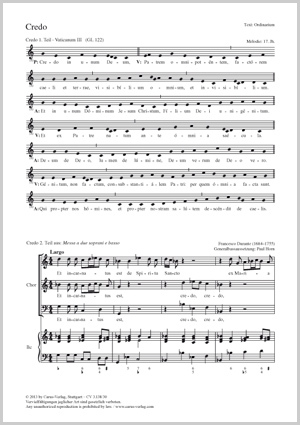
Francesco Durante: Et incarnatus est
This three-part setting of Et incarnatus est (one male and two female voices with basso continuo) is taken from the Messa á tre by the Neapolitan Baroque composer Durante and includes all statements up to passus et sepultus est. At the beginning, the two lower voices reinforce the text with the affirmation of faith, Credo, credo. The change of key from G minor to C minor is particularly appealing, and it distinguishes the interpolation from Credo III, which also dates from the 17th century and gives the impression of a pure C major. The Incarnation, death, and entombment thus take on a different color.