Challenging Choral Works 19th Century

Challenging Choral Works 19th Century

The choral works published by Carus offer a wide variety of styles and levels of difficulty. Each era has its particular requirements: from the clear articulation of Baroque music to the unconventional techniques of contemporary choral works. The challenging compositions from the 19th century presented here demand vocal precision as well as an intensive examination of language and text. Ambitious choirs can develop and expand their musical potential here.

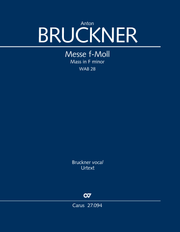
  • Bruckner: Mass in F minor

    Bruckner’s Mass in F minor is regarded as one of the most important choral works of the nineteenth century and poses a significant challenge for choirs. Despite initial controversy at its premiere, the piece ultimately prevailed and it remains a powerful testimony to Bruckner’s visionary thinking. Also available from Carus in the series Great Choral Works in Small Scorings (Carus 27.094/50).
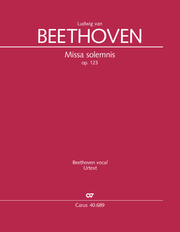
  • Beethoven: Missa solemnis

    Beethoven considered his Missa solemnis to be his greatest work, one that should move people because it came “from the heart”, which is evident from his long and intense engagement with the composition. The work goes far beyond the standard liturgical repertoire and demands a high level of skill from the choir. The Urtext edition by Ernst Herttrich is based on the latest scholarly research and reflects Beethoven’s devotion to the piece. Also available from Carus in the series Great Choral Works in Small Scorings (Carus 40.689/50).

  • Franck: Les Béatitudes

    César Franck (1822–1890), one of the most important French composers and organists of his time, was the composer of Les Béatitudes, a monumental setting of the Sermon on the Mount, which ranks among the great oratorios of the nineteenth century. The Carus edition presents the work for the first time in a scholarly Urtext edition, with practical performance suggestions. Suitable even for ambitious amateur choirs!

  • Lachner: Requiem in F minor

    Franz Lachner’s Requiem in F minor was composed in 1856, one hundred years after the birth of Mozart. It blends classical form, Baroque fugue, and Romantic expressiveness in Lachner’s unique personal style. The work proved to be unsuitable for liturgical use due to its large scale and scoring, but it has gained recognition through secular concert performances.

  • Donizetti: Requiem

    Earworms guaranteed! Gaetano Donizetti composed his Messa di Requiem in 1835 in memory of Vincenzo Bellini, although it remained both unperformed and unpublished during his lifetime. The music has a sacred character throughout, with only occasional hints of the opera composer at its heart.

  • Cherubini: Requiem

    Cherubini’s Requiem in C minor, composed in 1816 for choir and orchestra (without vocal soloists), is among the most important works of the nineteenth century. Beethoven, Schumann and Brahms all admired it for its masterful composition, sophisticated orchestration and sensitive word-setting. We also recommend the recording by the Kammerchor Stuttgart conducted by Frieder Bernius.

  • Franck: The Seven Last Words

    Unlike the works of the same name by Schütz or Haydn, Franck’s setting of The Seven Last Words of Christ combines biblical texts with elements of the Stabat Mater. The first edition is based on the long-lost autograph manuscript, which has been held in the University Library in Liège since 1954.

  • Herzogenberg: The Passion

    Herzogenberg’s Passion is characterized by the participation of the congregation and the prominent use of the organ. Congregational singing and significant organ passages shape the Maundy Thursday and Good Friday sections. Musically and liturgically, the work offers a rewarding opportunity to experience the Passion story anew.

  • Franck: Mass in A major

    César Franck’s orchestral Mass in A major (1861) was composed for liturgical use at St. Clothilde in Paris. It combines symphonic style with rich harmonic color. This Carus edition includes both the original orchestral version and a non-original organ reduction. All versions can be performed with the original three-part (STB) choir or with a four-part setting, in line with modern practice.

  • Ryba: Missa pastoralis

    Ryba’s Missa pastoralis in C major, composed around 1808, is part of a cycle of sacred works for the church year: this is a pastoral mass for Christmas Eve. It makes use of concertante instruments such as the trumpet and the bassoon, which rarely appears as a solo instrument in mass settings, and thus gives the work a distinctive character.

  • Berlioz: L’enfance du Christ

    The central section of this oratorio began as a somewhat whimsical exercise in 1850, which Berlioz jokingly attributed to a fictitious Baroque composer. In 1854 he expanded it into a full triptych for its premiere. The work presents a dramatic retelling of the Nativity story, concentrating on the Flight into Egypt and the visit of the Magi.

  • Elgar: The Dream of Gerontius

    “This is the best of me,” wrote Elgar after the final measure of The Dream of Gerontius. It’s a landmark of late Romantic choral literature, famous for its powerful music and stirring choral scenes, and it’s a compelling alternative to classical Requiem settings. The Carus edition offers the first complete, performance-ready critical edition, with bilingual text and comprehensive performance materials.

  • Bruckner: Mass in E minor

    Anton Bruckner’s solemn Mass in E minor is characterized by its unusual scoring for choir and wind instruments (no strings or organ). The Carus scholarly-critical edition is based on the second version of the work, and for the first time it incorporates parts from the Bruckner archive at St Florian’s Abbey as well as rediscovered choral parts from the Linz Cathedral archives, which allow for more precise editorial decisions.

  • Verdi: Requiem

    A singular masterpiece of sacred music! The Carus edition is the first critical edition with complete performance materials for purchase, based on Verdi’s autograph score. It offers more precise information on articulation, phrasing, and dynamic markings, revealing Verdi’s intentions with carefully added diacritical notations. Thanks to arrangements for chamber orchestra (arr. J. Linckelmann, Carus 27.308/00) and small ensemble (arr. M. Betzner-Brandt, Carus 27.303/50), it is also possible to perform the work on a smaller scale.

  • Mendelssohn: Hora est

    In 1828, inspired by early Italian church music, the nineteen-year-old Mendelssohn composed the sonorous Hora est. Scored for four choirs (SATB), organ and optional basso continuo, the work was originally presented to his sister as a birthday gift and then later performed by Carl Friedrich Zelter’s Singakademie. It is characterized by its majestic, festive mood and the harmonious interplay of the choirs. 

  • Dvorák: Requiem

    Dvorák’s Requiem was composed as a commission for the Birmingham Festival and has been extremely popular ever since Dvorák himself conducted the premiere in 1891. Deeply expressive, it combines religious devotion with dramatic impact and is unified by a chromatic “death motif” that recurs through almost all the movements. The Carus edition follows the autograph manuscript and carefully observes Dvorák’s dynamic instructions as well as additions from the conducting score.

  • Fasch: Mass for 16 Voices

    Carl Friedrich Christian Fasch’s 16-voice Mass is notable for its unusual scoring. Influenced by Italian sacred music in the style of Orazio Benevoli, Fasch made multiple revisions to adapt the piece to the vocal abilities of his ensemble. The work wasn’t published until 1839, some forty years after Fasch’s death, and it has been accorded legendary status ever since.