Great Choral Works for Passiontide

Great Choral Works for Passiontide

Great choral works belong to Passiontide just as Bach's Christmas Oratorio belongs to Advent and Christmas. We have compiled a selection of many great Passion works for you here. Naturally, these are available in the usual Urtext edition and with complete performance material, some also with our practice aid carus music, the Choir Coach. And don't be shy: the works are well suited for amateur choirs. Our difficulty ratings provide an initial guide.

  • Schütz: St. John Passion / The Passion of our Lord and Saviour Jesus Christ

    Schütz concluded his series of Historia settings with his three a cappella Passions: compositions defined by the Gospel texts, featuring an extraordinary degree of craftmanship together with intense, internalized expressiveness. These are works of maturity and experience, which mark the ending of an entire musical era.

    Difficulty level: 1 2 3 4 5
  • Buxtehude: Membra Jesu nostri

    Buxtehude composed his greatest oratorio work, the cantata cycle Membra Jesu nostri, for Passiontide in 1680. In seven individual cantatas the feet, knees, hands, side, breast, heart and face of the crucified Christ are interpreted allegorically. The original string scoring of No. VI calls for five viole da gamba, which can be partially replaced by violins and violone, so that only two viole da gamba are required.

    Difficulty level: 1 2 3 4 5

  • J.S. Bach: St. Matthew Passion

    This practical Urtext edition, edited by Bach expert Klaus Hofmann, reflects the latest Bach scholarship. This work can also be performed by smaller ensembles, thanks to the arrangement for a single orchestra (Carus 31.244/50).

    Difficulty level: 1 2 3 4 5

  • J.S. Bach / Pergolesi / Bartels (arr.): Tilge, Höchster, meine Sünden

    Johann Sebastian Bach adapted Giovanni Battista Pergolesi's famous Stabat Mater for performance at St. Thomas Church in Leipzig. Instead of the traditional liturgical sequence, he used a rhymed version of Psalm 51 as the text. Both Pergolesi's composition and Bach's arrangement (Carus 35.302) were originally scored for only two solo vocal parts (soprano and alto), although some movements clearly invite a choral performance. For this edition Jörn Bartels has created choral versions for verses 3, 5–7, and 10–15, adding male voices based on the basso continuo and Bach's original viola part. Incidentally, Pergolesi's Stabat Mater is also available in a choral version (Carus 97.003).

    Difficulty level: 1 2 3 4 5

  • formerly attributed to R. Keiser / J.S. Johann Sebastian Bach (arr.): St. Mark Passion

    Bach is known to have engaged intensively with this St. Mark Passion: it’s hard to think of another work by any of his contemporaries with which Bach remained quite so involved. There were three documented performances, for each of which Bach produced a version with different changes. Editions of the first (Weimar, Carus 35.304) and third (Leipzig, Carus 35.502) versions are available from Carus.

    Difficulty level: 1 2 3 4 5

  • Scarlatti: St. John Passion

    Scarlatti’s Latin St. John Passion, composed around 1700, adheres strictly to the requirements of Catholic liturgy of his time: apart from 14 extremely brief four-part turbae or crowd choruses, the entire Gospel text is presented in monodic recitation, with strings employed only in a few significant passages. A captivating return to the “old styles.”

    Difficulty level: 1 2 3 4 5

  • Telemann: St Luke Passion

    Among the five surviving St. Luke Passions by Telemann, this 1744 setting stands out for its expressive arias and dramatic crowd choruses. A full-length Passion setting of medium difficulty, it unfolds a power that is immediately gripping.

    Difficulty level: 1 2 3 4 5

  • Händel: Brockes-Passion

    The autograph of Handel's Brockes-Passion, which may have comprised his application for the directorship of the Hamburg Gänsemarkt Opera in 1716, is now lost. The main source for the Carus edition is a copy written in the hand of Johann Sebastian Bach, documenting a musical encounter between two Baroque geniuses who never actually met in person.

    Difficulty level: 1 2 3 4 5

  • Homilius: Passion Cantata

    The Passion Cantata by Homilius depicts the events of the Passion from a very personal perspective: the focus is less on the events themselves and more on the emotions of the observer. This narrative approach is reflected in a very dramatic recitative style, which contrasts charmingly with the expressive choral style and the strongly melodic arias.

    Difficulty level: 1 2 3 4 5

  • Salieri: La Passione di nostro Signore Gesù Cristo

    Salieri's La Passione, which is closely aligned to Italian opera seria, is set to a text by the famous poet Metastasio, who seems to have particularly pleased by the work. In a letter to the 26-year-old composer, Metastasio described it as “the most expressive music of all that has been written to this poem” – a great compliment to the young Salieri!

    Difficulty level: 1 2 3 4 5

  • Mozart: Grabmusik

    The young Mozart probably composed his Grabmusik for Holy Week 1767 for the Adoration of the Holy Sepulcher on Good Friday. The Carus edition includes two original horn parts in the final movement that have never appeared in print before. This makes it possible to perform the Grabmusik in Mozart's original instrumentation.

    Difficulty level: 1 2 3 4 5

  • Mendelssohn Bartholdy: Christus

    Carus has published the first ever critical edition of Mendelssohn's unfinished third oratorio, consisting of two fragments. The first part, Die Geburt Christi, is centered on a four-part choral movement introduced by two short solo sections. Das Leiden Christi, the second part, dives right into the events of the Passion: it depicts the scene of Jesus before Pilate in a rapid, dramatic alternation of evangelist recitatives and crowd choruses. A contemplative choral setting forms the conclusion. Performance materials are available separately for both parts.

    Difficulty level: 1 2 3 4 5

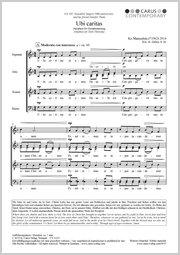
  • Matsushita: Ubi caritas

    The Christian church provides the antiphon Ubi caritas, a particularly heartfelt, conciliatory text, for the moving moment in the liturgy on Maundy Thursday when the priest symbolically washes the feet of several people, recalling Christ's caring, loving gesture at the Last Supper. Matsushita modestly places his composition at the service of this moment and creates a beautiful motet that is as charming as it is rewarding to sing.

    Difficulty level: 1 2 3 4 5

  • Pergolesi / Nicolai, Ritter von Seyfried, Eybler (arr.): Stabat Mater

    Pergolesi's last major composition, his Stabat Mater from 1736, became one of the most popular sacred works of the late Baroque and early Classical periods immediately after the composer's death. Of medium difficulty, the Vienna version offers a rare and enriching gem to any choir eager to discover new repertoire.

    Difficulty level: 1 2 3 4 5

  • Haydn: Stabat Mater

    Composed in 1767, Haydn’s Stabat Mater was the first sacred work he composed after taking up his post with Prince Esterházy in Eisenstadt. It began to circulate in numerous copies soon after its creation and established Haydn's reputation as the leading vocal composer of his time.

    Difficulty level: 1 2 3 4 5

  • Rossini: Stabat Mater

    Rossini's Stabat Mater is one of the masterpieces of the genre. In its ten movements it combines different forms such as aria, duet, quartet and chorus, operatic arioso writing and strict a cappella style. Thanks to an arrangement for chamber orchestra (Carus 70.089/50), the work can also be performed on a smaller scale.

    Difficulty level: 1 2 3 4 5

  • Verdi: Stabat Mater

    Giuseppe Verdi's last work is his Stabat Mater, which he completed at the age of 84 in 1897. A year later it was published together with the slightly earlier Te Deum as part of the collection Quattro pezzi sacri (Carus 27.500). Carus also offers an arrangement for choir and organ (Carus 27.294/45).

    Difficulty level: 1 2 3 4 5

  • Rheinberger: Stabat Mater in g

    Rheinberger’s Stabat Mater is one of his most personal compositions: he wrote it in the summer of 1884 in gratitude for the healing of a hand ailment from which he had suffered for more than ten years. Through sophisticated harmonic twists and turns he succeeds in sensitively transforming the atmosphere of suffering and pain in the face of the cross into hope and redemption. The piece can be accompanied by organ alone, with the optional addition of five string instruments.

    Difficulty level: 1 2 3 4 5

  • J.S. Bach: Easter Oratorio

    Bach composed his Easter Oratorio for April 1 1725, drawing musically in part on his recently written Easter cantata Kommt, gehet und eilt BWV 249.3. Bach then performed the work at least three more times on Easter Sundays, continually refining the composition. The Carus edition offers the final version, but the appendices allow for performances of the earlier version of the work.

    Difficulty level: 1 2 3 4 5

  • J.S. Bach: Christ lay in death's cold prison

    The origins of this cantata remain a mystery. Does its genesis date back to Bach's time in Mühlhausen? And when was it performed in Leipzig? But none of that is of prime importance: thanks to its timeless text and powerful music, this Easter cantata is one of Bach's most beloved vocal works today – and rightly so!

    Difficulty level: 1 2 3 4 5

  • Rheinberger: Osterhymne

    Rheinberger combines two different texts in his Osterhymne: the sequence Victimae paschali and the Offertory for Easter Sunday Terra tremuit. In 1884 the Neue Zeitschrift für Musik was full of praise for the “deeply intimate conception of the musical ideas” and the “mastery of polyphony,” emphasizing in particular the effective contrast between the lyrical Dic nobis Maria and the “earth-shattering entry” of Terra tremuit.

    Difficulty level: 1 2 3 4 5

  • Høybye: Hope. Easter music

    A work of medium difficulty, very suitable for a strong amateur choir. The mixture of a beautiful classical choral sound with rhythmic intensity in jazz-inspired phrases is “typically Høybye.” Each of the eight movements has its own distinct character, yet the work forms a cohesive whole, based on an excellent text by Edward Broadbridge.

    Difficulty level: 1 2 3 4 5