Allegri’s Miserere is one of the most famous a cappella settings of Psalm 51. With two choirs soaring majestically to great heights, the sound is truly spectacular.

From Gregorio Allegri to John Høybye and Ko Matsushita, from the 17th century to contemporary choral music: we’ve put together a selection of motets for Passiontide and Easter, featuring a range of differing styles, levels of difficulty and instrumentation.
Allegri’s Miserere is one of the most famous a cappella settings of Psalm 51. With two choirs soaring majestically to great heights, the sound is truly spectacular.
The five Latin Passion motets from Schütz's Cantiones sacrae op. 4 offer an incomparable blend of theological depth and musical grandeur, presenting the Passion of Christ in Schütz’s own masterly compositional style.
These two celebratory motets take up the joy of the resurrection of Christ, the good shepherd. Lasso captures this triumphant message with elaborate polyphony and radiant harmonies.
Johann Adam Hiller was appointed cantor of St. Thomas' Church in Leipzig in between the publication of the fifth and sixth volumes of four-part motets and arias, of which he was the editor. The sixth volume is therefore entirely geared towards the practice of a cantor, and Hiller takes up the Easter message in the motet Er lebt, der unbezwungene Held (He lives, the unconquered Hero)
The four-part Passiontide motet Woran denkst du, mein Christus, jetzt im Tode is an impressive and deeply moving work that focusses on the final thoughts and feelings of Christ on the cross. It conveys with great poignancy the spiritual and emotional depth of the Passion story.
The title of this motet, Geist, is deliberately ambiguous and encompasses both the Holy Spirit and the general unspecified power that inspires and gives one courage to face life. Høybye begins with Heiliger Geist, Komm zu uns (Holy Spirit, come to us), a German setting of a poem by Danish author Nikolai Grundtvig, and then interweaves two poems by Ingrid Fohlmeister, creating a stylistically diverse motet that reaches beyond the context of Easter and the church.
The intimate antiphon Ubi caritas is a response to the profound emotions of the events of Maundy Thursday. Matsushita employs organum and organ (pedal) point in F major to create an atmospheric motet in which each of the three verses is introduced with an ascending pentatonic motif, ending in a moving Amen.
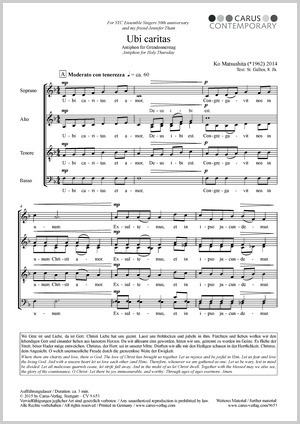
The ruins of Dunkeld Cathedral and the fast-flowing River Tay in Scotland inspire the contemplation of time and eternity. Taking its cue from the tradition of the motet, this colorful musical realization emphasizes contemporary spirituality and opens the senses and the heart in a remarkable way.
In his early years as Kapellmeister Graupner composed the motet Gott will mich auch probieren (GWV 1121/14). Its innovative form and varied structure are striking. This catchy chorale motet, without solo arias or recitatives, is ideal for Easter services due to its compact form.
The Stations of the Cross, a traditional devotional form, has received little musical attention to date. This work offers a new approach in which the choir performs lyrical texts to realize some of the stations, while dancers interpret the “Fall” stations to the accompaniment of a spoken motet.
.jpg "Thomas Gabriel: Der Kreuzweg")
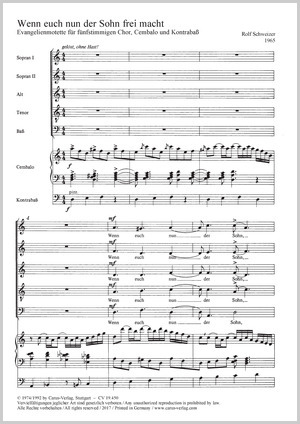
Rolf Schweizer’s Gospel motet Wenn euch der Sohn frei macht for five-part choir, harpsichord and double bass offers a powerful musical exploration of liberation through Christ. Through the striking combination of clear, expressive choral sounds and profound instrumental accompaniment Schweizer convincingly conveys the liberating message of the text.
Das Wort vom Kreuz by Rolf Schweizer is based on 1 Corinthians 1:18-25 and reflects the message of the cross as the wisdom and power of God. This motet combines stunning choral tones with sonorous harmonies in a profound portrayal of divine wisdom and human weakness.
The choral motet Das Blut Jesu Christi by Johann Michael Bach (1648-1694), son of the Arnstadt organist Heinrich Bach, comes from the Altbach Archive (ABA). It begins with a freely composed section, and then a popular chorale melody from Thuringia, Wo soll ich fliehen hin (Where shall I flee, with text by Johann Heermann), is introduced as the cantus firmus in the highest voice.
C. P. E. Bach’s artistry and emotional depth are especially striking in his two impressive motets for three voices (SAB) and basso continuo, Trost der Erlösung and Die Menschenliebe Jesu. The artful coloratura treatment in Trost der Erlösung and the intimate and effective expression in Die Menschenliebe Jesu are particularly memorable.
Jesu, meine Freude (BWV 227) is considered by many choral singers to be Bach's most significant motet and it stands out as an exceptional work due to its unusual length and unique formal structure. The motet has a symmetrical format, presumably the result of a lengthy compositional process.
In his four-part work Homilius uses the chorale So gehst du nun, mein Jesu, hin to convey a deeply heartrending message. The soprano part reflects on the death and atoning sacrifice of Jesus, while the other voices powerfully express accompanying Jesus to his death.
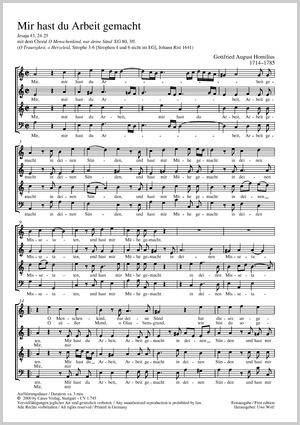
This edition combines two works by Homilius which illuminate different aspects of Christian activity. The four-part choral setting Mir hast du Arbeit gemacht (Isaiah 43:24-25) explores the sinful nature of man and the atoning sacrifice of Christ, while the aria Mein Jesu stirbt expresses deep sadness and the plea that Jesus will not forsake mankind.
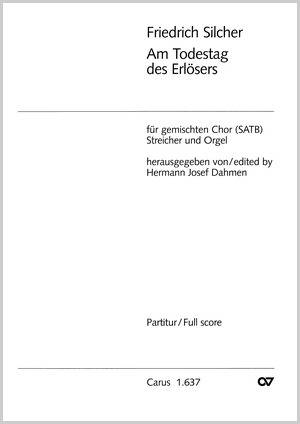
Am Todestag des Erlösers is a solemn, four-part song that focusses on the pivotal importance of Jesus' death and resurrection. The composition begins with a vivid description of Golgotha and concludes with the chorale O Lamm Gottes unschuldig (O innocent Lamb of God).
In O Haupt voll Blut und Wunden, a three-part chorale motet for a cappella mixed choir, Borneveld sets seven verses in a variety of musical arrangements. He chooses a suitable choral realization for each message of the text, creating a motet of profound expressiveness.