
Settings of Mörike
2025 marks the 150th anniversary of the death of the poet Eduard Mörike. Dozens of composers have set his romantic poems to music. To assist you in planning your forthcoming concerts, we’ve compiled a selection of various compositions from the romantic period up to the present day in varying levels of difficulty and for different ensembles (choir and solo singing).
  • Josef Gabriel Rheinberger: Fünf Lieder, op. 31

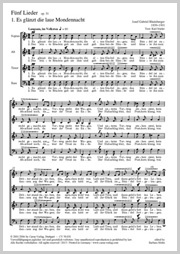
    The Fünf Lieder (Five Songs) by Josef Rheinberger are four-part a cappella choral works, of which nos. 2 to 5 are settings of texts by Eduard Mörike. Rheinberger’s atmospheric music manages to capture Mörike’s romantic lyricism. The content of the songs ranges from the twittering of a swallow outside the window to the mysterious atmosphere of the night and reflections on awakening, hope and mortality.
  • Robert Schumann: Schön-Rohtraut

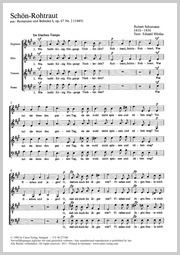
    Schön-Rohtraut is a four-part a cappella choral work by Robert Schumann from his Romanzen und Balladen I, op. 67 from 1849. It tells the story of the mysterious beauty Rohtraut and a young man who longs for her and shares a secret kiss with her. Schumann captures the youthful lightness and tender romance of Mörike’s poem and combines it with a vibrant and harmonious musical style.

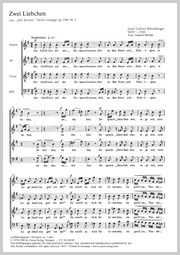
  • Josef Gabriel Rheinberger: Zwei Liebchen, op. 108,5

    Zwei Liebchen by Josef Rheinberger is the fifth song from his collection Am Strome. Sechs Gesänge, op. 108. It’s marked andantino and set in 2/4 time, and it tells the tragic story of a bride and groom who playfully express their affection in a little boat on the Danube, but are then swept away by the river. Rheinberger combines dancing, undulating melodies with expressive harmonies that highlight both the tenderness of the moment and the looming doom of the narrative.

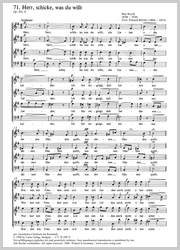
  • Max Bruch: Herr, schicke, was du willt, op. 60,4

    Max Bruch’s Herr, schicke, was du willt [sic] is an a cappella composition for four-part mixed choir, marked andante in 2/4 time, and expressing humility and trust in God's plan. The calm, meditative atmosphere of this work underscores the devotion and inner peace of the text and conveys a heartfelt acceptance of joy and suffering as gifts from God.

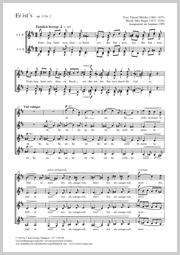
  • Max Reger: Er ist’s, op. 111b,3

    Er ist’s for four-part women’s choir (SSAA) was composed by Max Reger in 1909 to Eduard Mörike’s text. It captures the joyful anticipation of the awakening of spring and reflects Mörike’s poetic description of spring as a vibrant, seductive presence, with the 6/8 time signature creating an elegant lightness. The tender and hopeful moments of spring are brought to musical life by the women's voices.

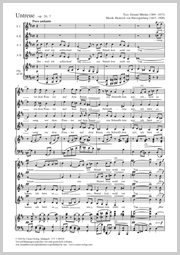
  • Heinrich von Herzogenberg: Untreue op. 26,7

    Heinrich von Herzogenberg’s Untreue (Unfaithfulness) (Op. 26, No. 7) for women’s choir and optional keyboard accompaniment is a melancholy, gentle setting of the text. The work describes the painful discovery of infidelity in a dreamy night atmosphere, with the women's choir reflecting on the loss of love and trust in delicate, almost whispering phrases.

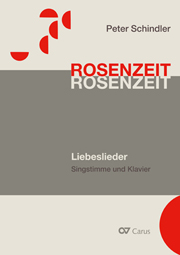
  • Peter Schindler: Rosenzeit. Liederzyklus über die Liebe

    The song cycle Rosenzeit for one singer and piano combines jazz-inspired music with love poems from different eras, including 18 poems by Eduard Mörike. The compositions are suitable for both female and male voices and are characterized by sophisticated piano accompaniments that appeal to both classical pianists and jazz musicians.

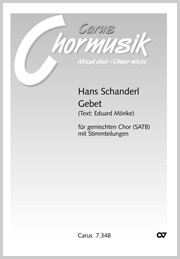
  • Hans Schanderl: Gebet

    Hans Schanderl’s Gebet (Prayer) for mixed choir (SATB) sets Mörike’s text with an expressive interplay between piano and sforzato, depicting the emotional range of love and suffering. The composer uses the dialogue between upper and lower voices to highlight the many nuances of the text.

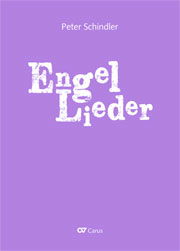
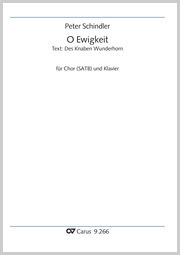
  • Peter Schindler: Engellieder

    Peter Schindler’s Engellieder (Angel Songs) is a song cycle presenting angels in various circumstances. Songs no. 1 (Quiet Angel) and no. 3 (Angelic Song) are settings of texts by Eduard Mörike. All the compositions can be performed by a range of vocal ensembles, from one to four voices with piano accompaniment, which can also be supplemented with strings. They are suitable for choirs of all sizes and can be performed at any time of year, especially at Christmas, as a concert interlude or encore.

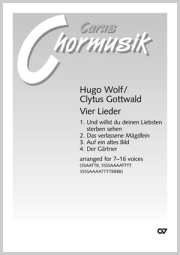
  • Hugo Wolf / Clytus Gottwald: Vier Lieder

    Clytus Gottwald’s arrangements of Hugo Wolf's Vier Lieder (Four Songs), based on texts by Eduard Mörike and an anonymous poet, offer ambitious choirs a chance to perform these sophisticated, masterfully arranged songs for 7 to 16 voices. The choral pieces include the famous opening song from the Italienisches Liederbuch (Und willst du deinen Liebsten sterben sehen), along with three poems by Mörike: Das verlassene Mägdelein, Auf ein altes Bild and Der Gärtner.

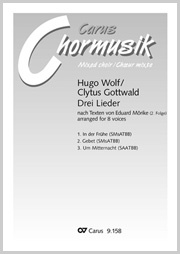
  • Hugo Wolf / Clytus Gottwald: Drei Lieder

    Clytus Gottwald’s arrangements of Hugo Wolf’s three Mörike songs for six-part mixed choir create a unique combination of vivid timbres and delicate harmonies. In der Frühe (In the Morning) recreates in music the pealing of the morning bells; in Gebet (Prayer) chorale motifs are interwoven with an allusion to Isolde’s Liebestod, while Um Mitternacht (At Midnight) creates a dark, dissonant soundscape.


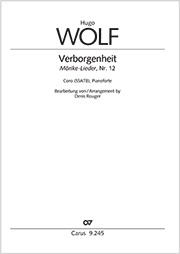
  • Hugo Wolf / Denis Rouger: Verborgenheit

    Hugo Wolf’s Verborgenheit, originally composed for solo voice and piano to a text by Eduard Mörike, has been sensitively arranged for chamber choir by Denis Rouger, respectfully preserving the original work. Rouger uses harmonic and rhythmic structures to integrate each voice individually, combining the expressiveness of the art song with the versatility of an ensemble. The choral version thus opens up new perspectives on the classical work.

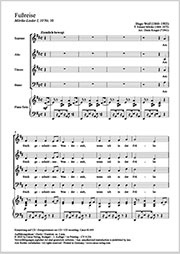
  • Hugo Wolf / Denis Rouger: Fußreise

    Hugo Wolf’s Fußreise (Journey on Foot) to a text by Eduard Mörike initially sounds like a lively hiking song, but soon the tension between earthly suffering and eternal longing becomes tangible. Wolf regarded art as the liberation of the soul from the “wretched piano case” of the body, and this is evident in his intense, metaphysical setting. Denis Rouger has adapted the song for chamber choir.

  • Peter Schindler: Denk es, o Seele! aus: Sonne, Mond und Sterne

    Peter Schindler describes Denk es, o Seele! by Eduard Mörike as a haunting poem that uses the lightness reminiscent of folksongs to highlight the theme of familiarity with death. The meditative and melancholy sounds of Schindler’s musical setting merge with jazz-inspired harmonies, yet with the text always remaining in the foreground. The central message “Think about it, soul!” is powerfully emphasized by rhythmic repetition, leaving a lasting impression.

  • Peter Schindler: Um Mitternacht

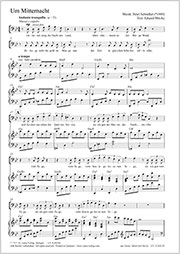
    Peter Schindler’s setting of Mörike’s Um Mitternacht (At Midnight) shapes the poem as a calm lullaby that personifies the night as a mother. The steady pulsation and gentle accompaniment create an earthy, life-affirming atmosphere and allow the poem’s metaphors to drift by like a movie. The music also appeals to traditional choirs familiar with chanson, pop or jazz sounds.

  • Vic Nees: Zwei Chorlieder

    These Two Choruses contrast two different moods: Hölderlin's Hälfte des Lebens (Half of Life) seems nostalgic and despairing, while Mörike’s Fußreise (Journey on Foot) radiates energy and joie de vivre. These contrasts are reflected musically in tempo, rhythm and tonality, although the pieces can also be performed independently of each other. The intonation requires a level of musical experience, especially in the chromatic-enharmonic passages.