Requiem Highlights

Requiem Settings for Every Choir

Carus-Verlag offers a wide range of Requiem settings suitable for choirs of all kinds. Below we've compiled the highlights from our program: popular classics by Mozart, Brahms, Faure, and Verdi, as well as lesser-known works by Biber, Lachner, and Jommelli. Have fun discovering! We of course offer all editions with complete performance material. Practice aids for choral singers are also available for many of the works.

  • Dvorák: Requiem

    Created as a commissioned work for the traditional music festival in Birmingham, Dvorák's Requiem was conducted by the composer in 1891. Dvorák created a full-length concert work that divides the liturgical Requiem text into two large musical blocks. The first part, up to the “Lacrimosa”, is characterized by sombre timbres and dramatic intensifications - here the focus is on grief, fear and the Last Judgement. In the second part, from the “Offertorium” onwards, the atmosphere lightens and Dvorák incorporates musical elements from his Czech homeland. The choir is at the center of the composition and - with one exception - is involved in all 13 parts. Dvorák largely dispenses with monumental choral fugues and instead relies on lyrical, folksong-like turns of phrase and a personal tonal language.

  • Ives: Requiem

    Ives' Requiem was commissioned by Magdalen College in Oxford in 2008 and was premiered under the direction of the composer. The music is tonal and accessible, yet rich in color and characterized by diverse influences. The Requiem is given a special timbre by the recurring use of small Tibetan hand cymbals, which run  through the entire work like a fine thread. Ives' aim was to create a piece for liturgical use that would be appealing and easily feasible for many choirs.

  • Hoybye: Light Shines in the Darkness

    John Hoybye's Requiem surprises with its unusual scoring for solo viola and mixed choir. The composition is based on the motto “Lux in tenebris lucet” (Light shines in the darkness) and is based on an english text by Edward Broadbridge. Hoybye supplements the text with Latin passages from the requiem mass and turns it into a modern requiem. The music moves between melancholy sounds and rousing rhythms, enriched by contemporary elements such as samba, clusters and chanting.

  • Mozart: Requiem

    Surrounded by legends and stories: besides the better known version of Mozart's Requiem by Süßmayr, we also recommend the versions by Howard Arman and Robert Levin.

  • Verdi: Messa da Requiem

    The Carus edition of Verdi's Requiem is the first critical edition with complete performance materia available for purchase. This dramatic masterpiece, which is full of extremes, is also available in two very exciting arrangements: 1. with horn, double bass, marimba, timpani, and piano, 2. with chamber orchestra.

  • Lachner: Requiem in F minor

    Lachner's Requiem was written for Mozart's 100th birthday. It is a unique work, but his veneration for Mozart is clearly noticeable. The double fugue in the "Kyrie" is very reminiscent of the Mozart model, as is the "Dies Irae", which breathes the spirit of the Mozart Requiem. Yet Lachner retains his independence with his Romantic tonal language. The "Recordare" is particularly beautiful, in which the clarinet and viola create a wonderfully soft sound. Opinions differ on the "Sanctus"; many composers set the angels' hymn to music with a radiant tutti. In Lachner's work, the "Holy, Holy, Holy" begins with a warm 8-part choral movement accompanied by the low-pitched orchestra. The music develops slowly to a radiant use of brass, like a curtain opening to reveal a vast, light-filled space behind it.

  • Brahms: Ein deutsches Requiem

    The choir stands at the center of Brahms' interdenominational Ein Deutsches Requiem (A German Requiem). Smaller choirs and choirs with limited space or financial resources can also perform the popular work in a version for chamber orchestra.

  • Fauré: Requiem

    Gabriel Fauré owes his worldwide fame not least to his Requiem op. 48, his only larger-scale work among his sacred compositions. Already popular with the public during his lifetime, its success continues to this day.

  • Gounod: Requiem in C major

    Gounod's compact Requiem is full of surprises. It is like a colorful mosaic and encourages one to listen again and again. The very beginning is unusual. The French composer uses a falling chromatic line starting from a single note, known in the Baroque as "passus duriusculus – the hard way" an expression of suffering. The "Dies irae," which sounds like a detective story, is another example of a skillful use of the text. Particularly interesting and beautiful is the "Rex tremendae", which immediately changes into a gentle "Salva me" to pass into a wonderfully light soprano solo, followed by the choir and a touching lyrical violin solo.

  • Saint-Saëns: Messe de Requiem

    Amazingly "oblique" is how one would characterize the beginning of Camille Saint-Saën's Requiem. It takes a while until its initial uncertainty dissolves and a harmonic center seems to be consolidated. But the choral entry with its slowly alternating chromatic lines immediately unsettles again. The "Dies irae" – not set to music, but is rather an outcry – seems to emerge from hell. The "Rex tremendae" is also unusual. Here Saint-Saëns foregrounds its trembling uncertainty, while the harmonic basis is difficult to grasp. Only in the "Sanctus" do the the choir of angels dispell all uncertainty by shining forth in full force, followed by a warm "Benedictus" (interestingly sung by the choir!). And immediately the "weird", intangible harmonies from the beginning are heard again in the "Agnus Dei", which ends on a single note.

  • Biber: Requiem in F minor

    It is no surprise that Biber's Requiem with its six-part string section offers a wonderfully full sound – the composer was also a well-known violin virtuoso. The work is rewarding and varied: homophonic and polyphonic sections alternate, often outshone by the brilliance of the violins. To name just two of its many highlights: the "Quantus tremor" in a harmonically "spicy" sequence with quasi-trembling violins, and the daring transverse position right at the beginning of the "Sanctus", which really gets you sitting up and paying attention! (For those with restricted budgets who still want to perform this great work, see also the version for organ).

  • Bruckner: Requiem in D minor

    Composed under simple conditions, Bruckner's Requiem in D minor is still accessible to many choirs today. Bruckner wrote it at the age of 24, still completely committed to the Viennese Classicism that was omnipresent in Austrian churches at the time. Despite drawing upon these models, he succeeded in giving the Requiem a character of its own. The work foreshadows how Bruckner's style would develop. Bruckner performed it several times and, in his old age, subjected it to a thorough revision.

  • Bossi: Missa pro defunctis

    The word "archaic" often comes to mind when listening to Bossi's music. Rather than sounding like it was written at the turn of the 20th century, his music breathes the spirit of Renaissance composers like Desprez or Palestrina. His Missa pro defunctis has the potential to transport you to a large Romanesque church with great acoustics. Anyone who feels at home in this world will be capable of performing this work, especially since the organ can be used to support the choir.

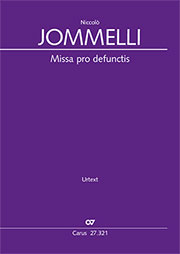
  • Jommelli: Missa pro defunctis

    Let us hope that the afterlife can be as beautiful as the beginning of Jommelli's Missa pro defunctis, whose tranquility nothing can dull! Despite its commemoration of the dead, Jommelli conveys a fundamentally benign atmosphere, while remaining true to the seriousness of its subject. The diversity of the text is reflected in a mosaic of sections, especially when mixed with monophonic Gregorian sections. The lovely "Pie Jesu" in the "Dies irae" sequence should be singled out, as its music seems to defy gravity.

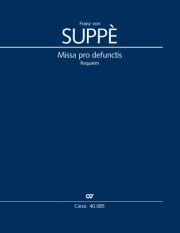
  • Suppè: Missa pro defunctis

    Mozart's Requiem influenced many subsequent composers. Indeed, one can hear this model again and again in Suppé's Missa pro defunctis: in the archaic fugue of the "Kyrie", in the bass solo of the "Tuba mirum", in the contrasting parts of "Rex Tremendae – Salva me". But Suppé always remains true to himself and his style, creating a virtual sacral stage in which many emotional facets of the Requiem text come to life. Be it in the seething fire of the low strings and the desperate crying out of the choir in the "Dies irae", in the beautiful lament of the "Lacrimosa", or in the sunrise of the "Sanctus" (is there the suggestions of Humperdinck's Hansel and Gretel in the beginning string tremolo when the angels descend?). In each number, Suppé proves how skillfully he can capture different emotional states in his music.