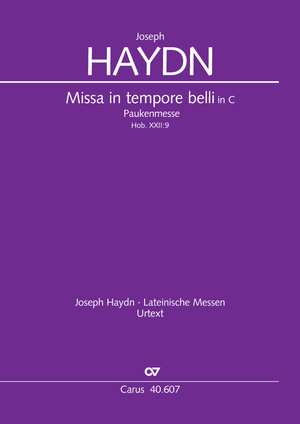
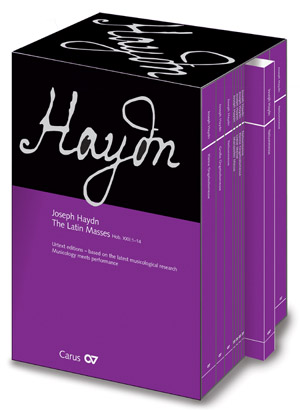
The Missa in tempore belli by Joseph Haydn is an interesting work in several respecst. Firstly this setting of the Mass provides pointers to the situation of Austrian church music as it had been affected by imperial decrees. Secondly the political situation, with the imminent invasion of Austria by Napoleon's troops, had reached a crisis point which is reflected in the description of this composition as a “Mass in time of war”. Last but not least, this work is the first of the group of six settings of the Latin Mass which, together with the oratorios The Creation and The Seasons, form the body of Haydn's last period vocal works, and which unquestionably belong among his supreme creative achievements.
Explore
 Additional material
- Purchase additional material as a download product.
-
 Digital text (without sheet music) incl. printing licence, html file, singing text, originalhtml file, singing text, original (Sample)Kyrie 1 Kyrie (Soli SATB, Coro)
Kyrie eleison.
Gloria 2 Gloria in excelsis Deo (Coro)
Christe eleison.
Kyrie eleisonGloria in excelsis Deo.
3 Qui tollis (Solo B, Coro)
Et in terra pax hominibus bonae voluntatis.
Laudamus te, benedicimus te, adoramus te, glorificamus te.
Gratias agimus tibi propter magnam gloriam tuam.
Domine Deus, Rex coelestis, Deus Pater omnipotens.
Domine Fili unigenite, Jesu Christe.
Domine Deus, Agnus Dei, Filius Patris.Qui tollis peccata mundi, miserere nobis.
4 Quoniam tu solus Sanctus (Solo S, Coro)
Qui tollis peccata mundi, suscipe deprecationem nostram.
Qui sedes ad dexteram Patris. Miserere nobis.Quoniam tu solus Sanctus, tu solus Dominus,
...
-
Digital text (without sheet music) incl. printing licence, html file, Introductory text, englishhtml file, Introductory text, english (Sample)Abridged Foreword of the Edition Carus 40.607
Wolfgang Hochstein
Translation: John CoombsThe Missa in tempore belli by Joseph Haydn (Hob. XXII:9) is an interesting work in several respects. Firstly this setting of the Mass provides pointers to the situation of Austrian church music as it had been affected by imperial decrees. Secondly the political situation, with the imminent invasion of Austria by Napoleon's troops, had reached a crisis point which is reflected in the description of this composition as a "Mass in time of war" (in German-speaking countries this work is generally known as the "Paukenmesse" - Timpani Mass). Last but not least, this work is the first of the group of six settings of the Latin Mass which, together with the oratorios The Creation and The Seasons, form the body of Haydn's last period vocal works, and which unquestionably belong among his supreme creative achievements.
Between 1782 and 1785 the Austrian Emperor Joseph II had issued a series of decrees concerning the nation's religious life and the ordering of church services. These decrees had the intention, among others, of removing superficial pomp from the liturgy, and reducing it to what was considered essential. Those decrees,
...
-
Digital text (without sheet music) incl. printing licence, html file, Introductory text, germanhtml file, Introductory text, german (Sample)Vorwort der Ausgabe Carus 40.607
Wolfgang Hochstein
Die Missa in tempore belli von Joseph Haydn (Hob. XXII:9) ist ein in mehrfacher Hinsicht interessantes Werk. Zum einen lässt diese Messvertonung einige Rückschlüsse auf die Situation der österreichischen Kirchenmusik unter dem Einfluss der damaligen Gesetzgebung zu. Außerdem hat die politische Lage mit der bevorstehenden Invasion Österreichs durch die Truppen unter Napoleon jenen Niederschlag gefunden, der sich schon in der Bezeichnung der Komposition als „Messe in Kriegszeit" offenbart (im deutschen Sprachraum ist das Werk vor allem unter dem Namen „Paukenmesse" bekannt). Nicht zuletzt aber steht die Komposition am Beginn jener Gruppe von sechs lateinischen Messvertonungen, die zusammen mit den Oratorien Die Schöpfung und Die Jahreszeiten das vokale Spätwerk Haydns bilden und die unbestritten zu seinen kompositorischen Spitzenleistungen zählen.
Zwischen 1782 und 1785 hatte der österreichische Kaiser Joseph II. eine Reihe von Vorschriften für das kirchliche Leben und zur Gestaltung des Gottesdienstes erlassen. Diese von aufgeklärtem Gedankengut getragenen „Josephinischen Reformen" sollten
...
Purchase
Additional product information
-
Composer
Joseph Haydn
| 1732-1809As Kapellmeister to Prince Esterházy, Haydn composed numerous instrumental works and various operas, as well as making important contributions to the genre of church music, including fourteen Latin masses, of which only twelve are authentic or complete; these are complemented by motets and offertories, two important Te Deum settings, two Salve Reginas, a Stabat Mater, and the different versions of the Sieben Worte des Erlösers am Kreuze. The masses were composed continually between 1749 and 1802, except for the years 1783–1795, and therefore constitute the genre with which Haydn was occupied over the longest period of time. The six (authentic or complete) masses composed before 1782 are stylistically very different, and as well as short Missae breves there are more extended masses with rich orchestral scoring; by contrast the six so-called late masses, written from 1796 onwards, form a comparatively homogeneous group of more extensive works scored for large forces. With his two great oratorios Die Schöpfung (The Creation) (1798) and Die Jahreszeiten (The Seasons) (1801) Haydn established the tradition of the German oratorio for middle-class music making. Personal details
Reviews on our website can only be submitted by customers with a registered user account. A check whether the rated products were actually purchased does not take place.
No feedback available for this product.
Frequent questions about this work
 There are no questions and answers available so far or you were unable to find an answer to your specific question about this work? Then click here and send your specific questions to our Customer Services!