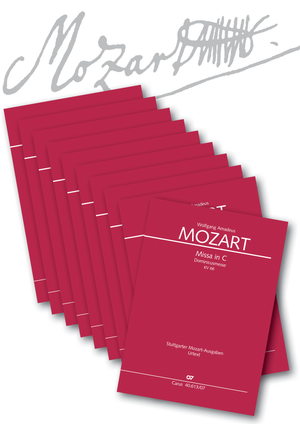
Mozart’s Missa in C K. 317, erroneously dubbed the “Coronation Mass,” is among the most popular and most often performed works in this genre. The autograph of the Mass, which in many respects is very enlightening, was regarded as having been lost following the end of World War II, but was discovered at the end of the 1970s, it is preserved among the musical treasures contained in the Biblioteka Jagiellonska in Kraków. Ulrich Leisinger, the editor, prepared the edition based upon what is, without a doubt, the only authentic source, although additionally in the Critical Report he has also consulted an early copy of the Mass (by Fügerl), since such later copies often help to clarify questions concerning historical performance practice.
Explore
 Listen
(6)
Listen
(6)
- Kyrie
- Gloria
- Credo
- Sanctus
- Benedictus
- Agnus Dei
 Practise
-
 carus music, the Choir Coach
Üben mit carus music
carus music, the Choir Coach
Üben mit carus music
-
Practice aids
-
Practice aids voice part soprano
- Kyrie (Choir Coach)
- Kyrie (Choir Coach, Slow mode)
-
Practice aids voice part alto
- Kyrie (Choir Coach)
- Kyrie (Choir Coach, Slow mode)
-
Practice aids voice part tenore
- Kyrie (Choir Coach)
- Kyrie (Choir Coach, Slow mode)
-
Practice aids voice part basso
- Kyrie (Choir Coach)
- Kyrie (Choir Coach, Slow mode)
-
 Additional material
- Purchase additional material as a download product.
-
 Digital text (without sheet music) incl. printing licence, html file, singing text, originalhtml file, singing text, original (Sample)Kyrie (ST, Coro)
Kyrie eleison.
Gloria (SATB, Coro)
Christe eleison.
Kyrie eleison.Gloria in excelsis Deo.
Et in terra pax hominibus bonae voluntatis.
Laudamus te. Benedicimus te. Adoramus te. Glorificamus te.
Gratias agimus tibi propter magnam gloriam tuam.
Domine Deus, Rex coelestis, Deus Pater omnipotens.
Domine Fili unigenite, Jesu Christe.
Domine Deus, Agnus Dei, Filius Patris.
Qui tollis peccata mundi, miserere nobis,
suscipe deprecationem nostram.
Qui sedes ad dexteram Patris, miserere nobis.
Quoniam tu solus Sanctus.
Tu solus Dominus.
Tu solus Altissimus, Jesu Christe.
Cum Sancto Spiritu, in gloria Dei Patris....
-
Digital text (without sheet music) incl. printing licence, html file, Introductory text, englishhtml file, Introductory text, english (Sample)Abridged Foreword of the Edition Carus 40.618
Ulrich Leisinger
Translation: John CoombsThe name “Coronation Mass” by which the Missa in C major KV 317 of Wolfgang Amadeus Mozart is generally known, is historically misleading (Mozart did not compose it for a coronation, and so far as is known at present it was never performed at one during his lifetime), but the name says a great deal about the role of this work in the increasing appreciation of Mozart’s church music by succeeding generations. Mozart himself regarded this as one of the most important among his settings of the Mass. […] The date, the full scoring of the work, and its dimensions – substantially greater that those of the Missae breves written about the middle of the 1770s – suggest that this work was probably intended for performance at Easter 1779 (Easter Sunday that year was on the 6th April).
In accordance with the instructions given by Archbishop Colloredo, the Prince-Bishop of Salzburg, all the movements of this work are laid out concisely. Elaborate contrapuntal sections, such as fugues to conclude the Gloria and Credo, are avoided. As in other masses, Mozart did not compose the Agnus Dei in the original key, to which
...
-
Digital text (without sheet music) incl. printing licence, html file, Introductory text, germanhtml file, Introductory text, german (Sample)Gekürztes Vorwort der Ausgabe Carus 40.618
Ulrich Leisinger
In den Jahrzehnten nach Mozarts Tod, in denen sich seine Werke rasch verbreiteten, ein Werkverzeichnis zur eindeutigen Identifizierung einer bestimmten Komposition aber fehlte, haben sich viele Beinamen eingebürgert, die zum größeren Teil bis heute lebendig geblieben sind. Wenn die Missa in C KV 317 unter der Bezeichnung „Krönungsmesse“ allgemein bekannt ist, so ist dieser Ehrentitel zwar historisch irreführend (Mozart selbst hat sie nämlich weder für eine Krönung geschrieben, noch nach derzeitigem Kenntnisstand bei einer solchen aufgeführt), doch besagt er viel über die Rolle, die dieser Messe in der Rezeptionsgeschichte der Kirchenmusik Wolfgang Amadeus Mozarts zukommt. In der Wertschätzung des Komponisten, des ausgehenden 18. Jahrhunderts und weiten Teilen des 19. Jahrhunderts zählt sie zu seinen bedeutendsten Messkompositionen. Mozarts selbst hat sie sich vom Vater aus Salzburg nach München, später nach Wien nachschicken lassen; um 1790 verlieh er Partitur und Originalstimmen an seinen Freund Anton Stoll, der sie als Regenschori in Baden bei Wien aufgeführt hat. […] Neben der Missa solemnis in C KV 337 gehört sie damit seit gut zwei
...
Purchase
Additional product information
Contents

-
Composer
Wolfgang Amadeus Mozart
| 1756-1791As the son of the deputy Kapellmeister to the Salzburg Prince-Archbishop, Mozart was constantly surrounded by church music in his youth. On his travels Mozart became familiar with Italian church music, and later in Vienna he studied the works of Bach and Handel. After moving to Vienna he was faced with the new challenges of composing opera and piano concertos, and significantly the “C Minor Mass” KV 427, the greatest sacred work of the first Vienna years, remained unfinished. The last period of his life again shows a change of direction to church music: Mozart successfully applied to succeed the terminally ill Leopold Hoffmann as Kapellmeister at St Stephen's Cathedral, but he was unable to take up the position as he died before Hoffmann. A gem such as the “Ave verum” KV 618 and the incomplete Requiem KV 626 give us an idea of what Mozart might have achieved as a composer of sacred music if he had taken up this important position. Personal details
Reviews on our website can only be submitted by customers with a registered user account. A check whether the rated products were actually purchased does not take place.
No feedback available for this product.
Frequent questions about this work
 There are no questions and answers available so far or you were unable to find an answer to your specific question about this work? Then click here and send your specific questions to our Customer Services!