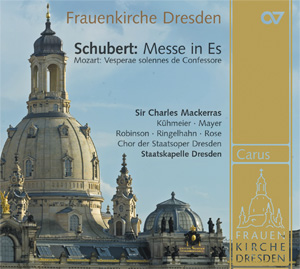
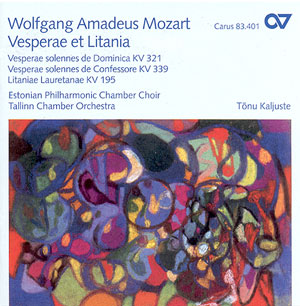
It was during Mozart’s last years at Salzburg, 1779 and 1780, that he composed the two sets of Vespers, K. 321 and K. 339. The music ot these Vespers gives no indication of Mozart’s many grounds for annoyance at that time. With supreme concentration he devoted himself to his task, and the penultimate movement of the Vespers K. 339, “Laudate Dominum” (Psalm 116) inspired him to create an exquisite melody which is part of the undying heritage of classical music.
The critical editon of the Vesperae solennes de Confessore K. 339, edited by Wolfgang Horn, is the first edition since the publication of the “old” Complete Edition from 1880 to be based on Mozart’s autograph score. The score was thought to have been lost after the second world war but it is again accessible through the Biblioteka Jagiellonska in Kraków.
Explore
 Listen
(6)
Listen
(6)
- Laudate Dominum
- Dixit Dominus
- Confitebor tibi
- Beatus vir
- Laudate pueri
- Magnificat anima mea
 Practise
-
 carus music, the Choir Coach
Üben mit carus music
carus music, the Choir Coach
Üben mit carus music
-
Practice aids
-
Practice aids voice part soprano
- Dixit Dominus (Choir Coach)
- Confitebor tibi (Choir Coach)
- Beatus vir (Choir Coach)
- Laudate pueri (Choir Coach)
- Magnificat anima mea (Choir Coach)
- Kyrie (Choir Coach)
- Dixit Dominus (Choir Coach, Slow mode)
- Confitebor tibi (Choir Coach, Slow mode)
- Beatus vir (Choir Coach, Slow mode)
- Laudate pueri (Choir Coach, Slow mode)
- Magnificat anima mea (Choir Coach, Slow mode)
- Kyrie (Choir Coach, Slow mode)
-
Practice aids voice part alto
- Dixit Dominus (Choir Coach)
- Confitebor tibi (Choir Coach)
- Beatus vir (Choir Coach)
- Laudate pueri (Choir Coach)
- Magnificat anima mea (Choir Coach)
- Kyrie (Choir Coach)
- Dixit Dominus (Choir Coach, Slow mode)
- Confitebor tibi (Choir Coach, Slow mode)
- Beatus vir (Choir Coach, Slow mode)
- Laudate pueri (Choir Coach, Slow mode)
- Magnificat anima mea (Choir Coach, Slow mode)
- Kyrie (Choir Coach, Slow mode)
-
Practice aids voice part tenore
- Dixit Dominus (Choir Coach)
- Confitebor tibi (Choir Coach)
- Beatus vir (Choir Coach)
- Laudate pueri (Choir Coach)
- Magnificat anima mea (Choir Coach)
- Kyrie (Choir Coach)
- Dixit Dominus (Choir Coach, Slow mode)
- Confitebor tibi (Choir Coach, Slow mode)
- Beatus vir (Choir Coach, Slow mode)
- Laudate pueri (Choir Coach, Slow mode)
- Magnificat anima mea (Choir Coach, Slow mode)
- Kyrie (Choir Coach, Slow mode)
-
Practice aids voice part basso
- Confitebor tibi (Choir Coach)
- Beatus vir (Choir Coach)
- Laudate pueri (Choir Coach)
- Magnificat anima mea (Choir Coach)
- Kyrie (Choir Coach)
- Dixit Dominus (Choir Coach, Slow mode)
- Confitebor tibi (Choir Coach, Slow mode)
- Beatus vir (Choir Coach, Slow mode)
- Laudate pueri (Choir Coach, Slow mode)
- Magnificat anima mea (Choir Coach, Slow mode)
- Kyrie (Choir Coach, Slow mode)
-
 Additional material
- Purchase additional material as a download product.
-
 Digital text (without sheet music) incl. printing licence, html file, singing text, english translationhtml file, singing text, english translation (Sample)1. Dixit Dominus (Soli SATB e Coro SATB)
The Lord said to my Lord:
sit thou at my right hand,
until I make thine enemies thy footstool.
The Lord will send forth the sceptre of thy power out of Sion:
rule thou in the midst of thine enemies.
With thee is the principality in the day of thy strength in the brightness of the saints:
from the womb before the morning star
I begot thee.
The Lord hath sworn, and He will not repent:
Thou art a priest for ever
according to the order of Melchisedech.
The Lord at thy right hand hath broken kings in the day of His wrath.
He shall judge among nations,
He shall fill ruins:
He shall crush the heads in the land of many.
He shall drink of the torrent in the way:...
-
Digital text (without sheet music) incl. printing licence, html file, singing text, german translationhtml file, singing text, german translation (Sample)1. Dixit Dominus (Soli SATB e Coro SATB)
Der Herr sprach zu meinem Herrn:
Setze dich zu meiner Rechten,
bis ich deine Feinde
zum Schemel deiner Füße lege.
Der Herr wird das Zepter deiner Macht ausstrecken aus Zion:
Herrsche mitten unter deinen Feinden!
Wenn du dein Heer aufbietest,
wird dir dein Volk willig folgen in heiligem Schmuck.
Deine Kinder werden dir geboren wie der Tau aus der Morgenröte.
Der Herr hat geschworen, und es wird ihn nicht gereuen:
Du bist ein Priester ewiglich
nach der Weise Melchisedeks.
Der Herr zu deiner Rechten wird zerschmettern die Könige am Tage seines Zorns.
Er wird richten unter den Heiden, wird viele erschlagen,
wird Häupter zerschmettern über große Lande.
Er wird trinken vom Bach auf dem Wege,...
-
Digital text (without sheet music) incl. printing licence, html file, singing text, originalhtml file, singing text, original (Sample)1. Dixit Dominus (Soli SATB e Coro SATB)
Dixit Dominus Domino meo:
Sede a dextris meis:
Donec ponam inimicos tuos,
scabellum pedum tuorum.
Virgam virtutis tuae emittet Dominus ex Sion:
dominare in medio inimicorum tuorum.
Tecum principium in die virtutis tuae
in splendoribus sanctorum:
ex utero ante luciferum genui te.
Juravit Dominus, et non poenitebit eum:
Tu es sacerdos in aeternum
secundum ordinem Melchisedech. Dominus a dextris tuis,
confregit in die irae suae reges.
Judicabit in nationibus, implebit ruinas:
conquasabit capita in terra multorum.
De torrente in via bibet:
propterea exaltabit caput.
Psalm 109...
Purchase
Additional product information
Contents

-
Composer
Wolfgang Amadeus Mozart
| 1756-1791As the son of the deputy Kapellmeister to the Salzburg Prince-Archbishop, Mozart was constantly surrounded by church music in his youth. On his travels Mozart became familiar with Italian church music, and later in Vienna he studied the works of Bach and Handel. After moving to Vienna he was faced with the new challenges of composing opera and piano concertos, and significantly the “C Minor Mass” KV 427, the greatest sacred work of the first Vienna years, remained unfinished. The last period of his life again shows a change of direction to church music: Mozart successfully applied to succeed the terminally ill Leopold Hoffmann as Kapellmeister at St Stephen's Cathedral, but he was unable to take up the position as he died before Hoffmann. A gem such as the “Ave verum” KV 618 and the incomplete Requiem KV 626 give us an idea of what Mozart might have achieved as a composer of sacred music if he had taken up this important position. Personal details
Reviews on our website can only be submitted by customers with a registered user account. A check whether the rated products were actually purchased does not take place.
No feedback available for this product.
Frequent questions about this work
 There are no questions and answers available so far or you were unable to find an answer to your specific question about this work? Then click here and send your specific questions to our Customer Services!