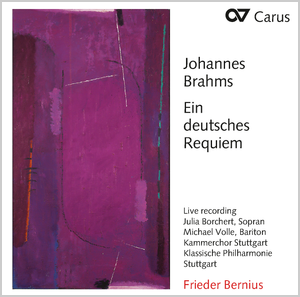
Since its first complete performance in 1869 in Leipzig, Brahms’s German Requiem is, without question, one of the key works in the history of the oratorio. The reputation of the work is based not only on its unusually concentrated musical structure, but also on the original conception of the text: Brahms assembled important passages from both the Old and New Testaments in Luther’s translation so that thoughts on sorrow and consolation would obviously refer to one another. In contrast to many other oratorios of the 19th century Brahms places the choir, the voice of the community, in the center of this interdenominational celebration of the dead.
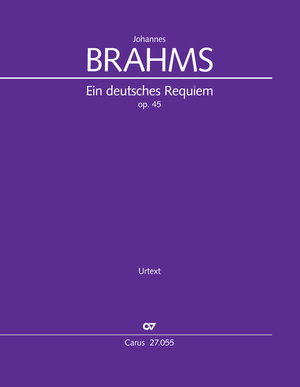
The source-critical edition is based on the first published edition of the score, which Brahms authorized.
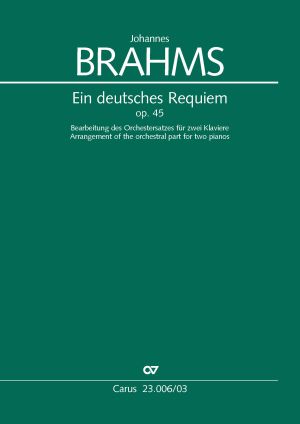
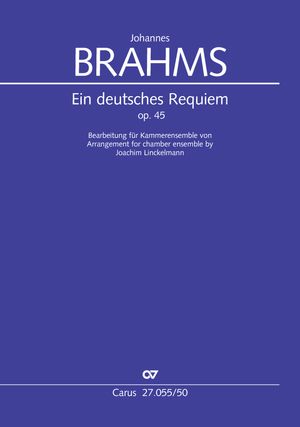
Thanks to an arrangement by J. Linckelmann (Carus 27.055/50), it is possible to perform the work in smaller settings. Also available is an arrangement of the orchestral movement for two pianos (Carus 23.006/03).
Explore
 View
View


 Listen
(7)
Listen
(7)
 Practise
-
-
Practice aids
-
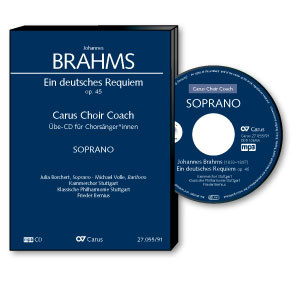
Practice aids voice part soprano
- Selig, sind, die da Leid tragen (Choir Coach)
- Selig, sind, die da Leid tragen (Choir Coach, Slow mode)
- Denn alles Fleisch es ist wie Gras (Choir Coach)
- Denn alles Fleisch es ist wie Gras (Choir Coach, Slow mode)
- Herr, lehre mich (Choir Coach)
- Herr, lehre mich (Choir Coach, Slow mode)
- Wie lieblich sind deine Wohnungen (Choir Coach)
- Wie lieblich sind deine Wohnungen (Choir Coach, Slow mode)
- Ihr habt nur Traurigkeit (Choir Coach)
- Ihr habt nur Traurigkeit (Choir Coach, Slow mode)
- Denn wir haben hier keine bleibende Statt (Choir Coach)
- Denn wir haben hier keine bleibende Statt (Choir Coach, Slow mode)
- Selig sind die Toten (Choir Coach)
- Selig sind die Toten (Choir Coach, Slow mode)
-
Practice aids voice part alto
- Selig, sind, die da Leid tragen (Choir Coach)
- Selig, sind, die da Leid tragen (Choir Coach, Slow mode)
- Denn alles Fleisch es ist wie Gras (Choir Coach)
- Denn alles Fleisch es ist wie Gras (Choir Coach, Slow mode)
- Herr, lehre mich (Choir Coach)
- Herr, lehre mich (Choir Coach, Slow mode)
- Wie lieblich sind deine Wohnungen (Choir Coach)
- Wie lieblich sind deine Wohnungen (Choir Coach, Slow mode)
- Ihr habt nur Traurigkeit (Choir Coach)
- Ihr habt nur Traurigkeit (Choir Coach, Slow mode)
- Denn wir haben hier keine bleibende Statt (Choir Coach)
- Denn wir haben hier keine bleibende Statt (Choir Coach, Slow mode)
- Selig sind die Toten (Choir Coach)
- Selig sind die Toten (Choir Coach, Slow mode)
-
Practice aids voice part tenore
- Selig, sind, die da Leid tragen (Choir Coach)
- Selig, sind, die da Leid tragen (Choir Coach, Slow mode)
- Denn alles Fleisch es ist wie Gras (Choir Coach)
- Denn alles Fleisch es ist wie Gras (Choir Coach, Slow mode)
- Herr, lehre mich (Choir Coach)
- Herr, lehre mich (Choir Coach, Slow mode)
- Wie lieblich sind deine Wohnungen (Choir Coach)
- Wie lieblich sind deine Wohnungen (Choir Coach, Slow mode)
- Ihr habt nur Traurigkeit (Choir Coach)
- Ihr habt nur Traurigkeit (Choir Coach, Slow mode)
- Denn wir haben hier keine bleibende Statt (Choir Coach)
- Denn wir haben hier keine bleibende Statt (Choir Coach, Slow mode)
- Selig sind die Toten (Choir Coach)
- Selig sind die Toten (Choir Coach, Slow mode)
-
Practice aids voice part basso
- Selig, sind, die da Leid tragen (Choir Coach)
- Selig, sind, die da Leid tragen (Choir Coach, Slow mode)
- Denn alles Fleisch es ist wie Gras (Choir Coach)
- Denn alles Fleisch es ist wie Gras (Choir Coach, Slow mode)
- Herr, lehre mich (Choir Coach)
- Herr, lehre mich (Choir Coach, Slow mode)
- Wie lieblich sind deine Wohnungen (Choir Coach)
- Wie lieblich sind deine Wohnungen (Choir Coach, Slow mode)
- Ihr habt nur Traurigkeit (Choir Coach)
- Ihr habt nur Traurigkeit (Choir Coach, Slow mode)
- Denn wir haben hier keine bleibende Statt (Choir Coach)
- Denn wir haben hier keine bleibende Statt (Choir Coach, Slow mode)
- Selig sind die Toten (Choir Coach)
- Selig sind die Toten (Choir Coach, Slow mode)
-

 Additional material
- Purchase additional material as a download product.
-
 Digital text (without sheet music) incl. printing licence, html file, singing text, originalhtml file, singing text, original (Sample)I Selig sind die da Leid tragen (Coro)
Selig sind, die da Leid tragen,
II Denn alles Fleisch es ist wie Gras (Coro)
denn sie sollen getröstet werden.
(Matthäus 5, 4)
Die Tränen säen, werden mit Freuden ernten.
Sie gehen hin und weinen und tragen edlen Samen,
und kommen mit Freuden und bringen ihre Gaben.
(1. Petrus 1, 24)
Denn alles Fleisch, es ist wie Gras
und alle Herrlichkeit des Menschen wie des Grases Blumen.
Das Gras ist verdorret und die Blume abgefallen.
(1. Petrus, 1, 24)So seid nun geduldig, lieben Brüder,
bis auf die Zukunft des Herrn.
Siehe, ein Ackermann wartet
auf die köstliche Frucht der Erde
und ist geduldig darüber,
bis er empfahe
den Morgenregen
und Abendregen.
So seid geduldig.
(Jakobus 5, 7)Denn alles Fleisch es ist wie Gras
und alle Herrlichkeit des Menschen wie des Grases Blumen.
Das Gras ist verdorret und die Blume abgefallen.
Aber des Herrn Wort bleibet in Ewigkeit.
(1. Petrus 1, 24+25)
Die Erlöseten des Herrn werden wiederkommen,
und gen Zion kommen...
-
Digital text (without sheet music) incl. printing licence, html file, Introductory text, englishhtml file, Introductory text, english (Sample)Abridged Foreword of the Edition Carus 27.055
Günter Graulich
Translation: Peter PalmerTogether with the Passions of J. S. Bach and the Requiem by W. A. Mozart, Johannes Brahms’s Ein deutsches Requiem (A German Requiem) occupies a preeminent place in the choral works of the concert repertoire. Brahms’s contemporaries laid particular emphasis on three things: the undogmatic, ultimately ecumenical choice of biblical texts, the balance and consistency in the design, and the masterly ease with which the composer succeeded in combining historical techniques and harmonies new for the period into a convincing unity.
The choice of texts is of a completely new kind. The traditional Latin requiem text is a prayer for the deceased in light of the imminent Last Judgement. Those biblical passages which Brahms selected, on the other hand, emphasize that it is not the dead but the bereaved who are in need of peace and consolation. It is true that Brahms alludes to the Last Judgement, for the line “For the trumpet shall sound” from the First Epistle to the Corinthians clearly recalls the “Tuba mirum spargens sonum“ of the liturgical text. But immediately the hope is expressed
...
-
Digital text (without sheet music) incl. printing licence, html file, Introductory text, germanhtml file, Introductory text, german (Sample)Gekürztes Vorwort der Ausgabe Carus 27.055
Günter Graulich
Unter den Chorwerken des Konzertrepertoires nimmt Ein deutsches Requiem von Johannes Brahms mit den Passionen von Johann Sebastian Bach und dem Requiem von Wolfgang Amadeus Mozart einen führenden Platz ein. Brahms’ Zeitgenossen hoben drei Dinge besonders hervor: die undogmatische, letztlich überkonfessionelle Auswahl der Textstellen, die Ausgewogenheit und Geschlossenheit der Werkanlage und die Souveränität, mit der es der Komponist verstanden hatte, historische Satztechniken und damals neue Harmonien zu einer überzeugenden Einheit zu verbinden.
Gänzlich neuartig ist die Textwahl: Der traditionelle lateinische Requiemtext ist ein Gebet für den Verstorbenen angesichts des drohenden Jüngsten Gerichts. Die von Brahms gewählten Bibelstellen betonen hingegen, dass nicht die Toten, sondern die Hinterbliebenen der Ruhe und des Trostes bedürfen. Brahms spielt zwar auf das Jüngste Gericht an: Der Vers „Denn es wird die Posaune schallen“ aus dem ersten Korintherbrief erinnert deutlich an das „Tuba mirum spargens sonum“ des liturgischen Textes. Es wird aber sofort die Hoffnung ausgesprochen, dass
...
Purchase
Additional product information
Contents

-
Composer
Johannes Brahms
| 1833-1897Johannes Brahms' study of musical tradition was of crucial importance to his output: he combined church modes, canonic technique, Baroque style and diction, Bach's counterpoint and Beethoven's thematic-motivic work with the harmonic and expressive achievements of Romanticism to form his own distinctive style. In this respect his choral songs and vocal quartets (e.g. the “Liebeslieder Waltzes” and “New Liebeslieder Waltzes”), often to folk song texts, in which a musical microcosm unfolds, are examplary. His “Deutsches Requiem”, available from Carus in several different versions, constitutes one of the most fascinating confessions of faith in the history of music. Personal details
-
Editor
Günter Graulich
| 1926The publisher, church musician and teacher Günter Graulich is one of the major personalities in German publishing of the post-war period. With his wife Waltraud he founded Carus-Verlag Stuttgart in 1972, which he built up from a 2-person family firm to a medium-sized business with around 60 employees. A trained church musician and Kantor for many years at the Matthäuskirche Stuttgart, he also directed the Motettenchor Stuttgart for 50 years. With his choir he made LP and CD recordings, and undertook numerous concert tours to other European countries and America. Personal details
Reviews
They have mostly to do with the instrumentation. Graulich is of the opinion (based on annotations by Brahms himself in scores used by several different conductors) that the ad libitum contrabassoon is intended to play rather more than is often the case in modern performances. And for the organ, also an ad libitum instrument in this work, Graulich includes a much more detailed realization than most editions offer. … Graulich’s edition, scrupulous in so many ways, nevertheless retains the mute marking. But then I suppose that is part of the fascination with an ongoing study of these works - there are always more layers of the onion waiting to be peeled away.
The Music Times, March/April 2018
... Dieses grandiose Werk gehört sicher zu den Top 10 der musica sacra mit enormem Tiefgang.
Singende Kirche Heft 3, 2008
... Mit der sorgsamen Edition von Günter Graulich liegt nunmehr eine ausgezeichnete Grundlage für Aufführung und Studium des Deutschen Requiems vor.
Barbara Stühlmeyer, Musica Sacra, 2/2010
Reviews on our website can only be submitted by customers with a registered user account. A check whether the rated products were actually purchased does not take place.
No feedback available for this product.
Frequent questions about this work
 There are no questions and answers available so far or you were unable to find an answer to your specific question about this work? Then click here and send your specific questions to our Customer Services!