
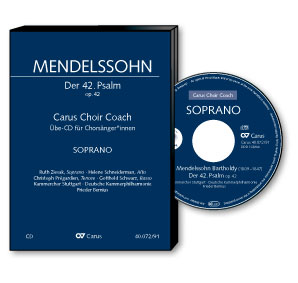
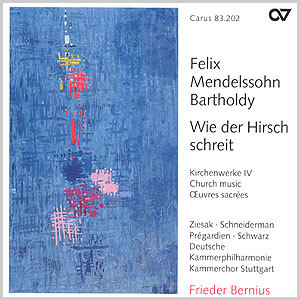
In 1837 Robert Schumann judged Mendelssohn’s Psalm 42 Wie der Hirsch schreit (Like as the hart) as the “highest standard which has been achieved amongst recent church music”. This work is truly a favorite of many choirs, however, the final chorus contains a few tricky problem passages: in particular, the wonderful quintet requires perfect intonation from the four male voices to provide a secure basis over which the bell-like clarity of the solo soprano floats ...
Simply practice. Anytime. Everywhere.
Whether at home on your tablet or PC or on the road on your smartphone: with carus music, the Choir Coach, you always have your choral works with you to practice! With the carus music choir app, you can listen to your score together with a first-class recording on any device and easily practice your own choir part with a coach. With carus music, your concert preparation is easy, efficient and fun to master!
Performers: Ruth Ziesak (soprano), Jan Kobow, Christoph Prégardien (tenore), Gotthold Schwarz, Adolph Seidel (basso) – Kammerchor Stuttgart, Deutsche Kammerphilharmonie Bremen – Frieder Bernius
Explore
 Listen
(7)
Listen
(7)
- Coro: Wie der Hirsch schreit
- Recitativo, Aria: Meine Tränen
- Aria: Meine Seele dürstet
- Coro: Was betrübst du dich
- Recitativo: Mein Gott, betrübt ist meine Seele
- Quintetto: Der Herr hat des Tages
- Schlußchor: Was betrübst du dich, meine Seele
 Practise
-
-
Practice aids
-
Practice aids voice part soprano
- Coro: Wie der Hirsch schreit (Choir Coach)
- Coro: Wie der Hirsch schreit (Choir Coach, Slow mode)
- Aria: Meine Seele dürstet (Choir Coach)
- Aria: Meine Seele dürstet (Choir Coach, Slow mode)
- Coro: Was betrübst du dich (Choir Coach)
- Coro: Was betrübst du dich (Choir Coach, Slow mode)
- Schlußchor: Was betrübst du dich, meine Seele (Choir Coach)
- Schlußchor: Was betrübst du dich, meine Seele (Choir Coach, Slow mode)
-
Practice aids voice part alto
- Coro: Wie der Hirsch schreit (Choir Coach)
- Coro: Wie der Hirsch schreit (Choir Coach, Slow mode)
- Aria: Meine Seele dürstet (Choir Coach)
- Aria: Meine Seele dürstet (Choir Coach, Slow mode)
- Coro: Was betrübst du dich (Choir Coach)
- Coro: Was betrübst du dich (Choir Coach, Slow mode)
- Schlußchor: Was betrübst du dich, meine Seele (Choir Coach)
- Schlußchor: Was betrübst du dich, meine Seele (Choir Coach, Slow mode)
-
Practice aids voice part tenore
- Coro: Wie der Hirsch schreit (Choir Coach)
- Coro: Wie der Hirsch schreit (Choir Coach, Slow mode)
- Coro: Was betrübst du dich (Choir Coach)
- Coro: Was betrübst du dich (Choir Coach, Slow mode)
- Quintetto: Der Herr hat des Tages (Choir Coach, Tenore 1)
- Quintetto: Der Herr hat des Tages (Choir Coach, Slow mode, Tenore 1)
- Quintetto: Der Herr hat des Tages (Choir Coach, Tenore 2)
- Quintetto: Der Herr hat des Tages (Choir Coach, Slow mode, Tenore 2)
- Schlußchor: Was betrübst du dich, meine Seele (Choir Coach)
- Schlußchor: Was betrübst du dich, meine Seele (Choir Coach, Slow mode)
-
Practice aids voice part basso
- Coro: Wie der Hirsch schreit (Choir Coach)
- Coro: Wie der Hirsch schreit (Choir Coach, Slow mode)
- Coro: Was betrübst du dich (Choir Coach)
- Coro: Was betrübst du dich (Choir Coach, Slow mode)
- Quintetto: Der Herr hat des Tages (Choir Coach, Basso 1)
- Quintetto: Der Herr hat des Tages (Choir Coach, Slow mode, Basso 1)
- Quintetto: Der Herr hat des Tages (Choir Coach, Basso 2)
- Quintetto: Der Herr hat des Tages (Choir Coach, Slow mode, Basso 2)
- Schlußchor: Was betrübst du dich, meine Seele (Choir Coach)
- Schlußchor: Was betrübst du dich, meine Seele (Choir Coach, Slow mode)
-

 Additional material
- Purchase additional material as a download product.
-
 Digital text (without sheet music) incl. printing licence, html file, singing text, english translationhtml file, singing text, english translation (Sample)
1. Coro (SATB) As the hart longs for streams of water,
O God, so my spirit longs for thee.2. Aria (Solo S) For my spirit thrists after God,
my God, the Lord of all living.
O when shall I come before him,
so that mine own eyes may see him?3. Recitativo (Solo S) And my tears have been all my food both day and night,
Allegro assai (Solo S e Coro) For I would have gone out gladly with the people
while they daily come and ask me: Where is now your God?
These things I now remember,
as I pour out my heart in prayer to him.
and with them would go up to God’s own temple
with rejoicing and thanksgiving,
with all the people on the feast day....
-
Digital text (without sheet music) incl. printing licence, html file, singing text, originalhtml file, singing text, original (Sample)
1. Coro (SATB) Wie der Hirsch schreit nach frischem Wasser,
so schreit meine Seele, Gott, zu dir.2. Aria (Solo S) Meine Seele dürstet nach Gott,
nach dem lebendigen Gotte.
Wann werde ich dahin kommen,
dass ich Gottes Angesicht schaue?3. Recitativo (Solo S) Meine Tränen sind meine Speise Tag und Nacht,
Allegro assai (Solo S e Coro) Denn ich wollte gern hingehen mit dem Haufen
weil man täglich zu mir saget: Wo ist nun dein Gott?
Wenn ich dess’ inne werde,
so schütte ich mein Herz aus bei mir selbst.
und mit ihnen wallen zum Hause Gottes,
mit Frohlocken und mit Danken
unter dem Haufen, die da feiern.4. Coro (SATB) Was betrübst du dich, meine Seele,
...
-
Digital text (without sheet music) incl. printing licence, html file, Introductory text, frenchhtml file, Introductory text, french (Sample)Texte du livret du CD Carus 83.202
Thomas Schmidt-Beste
Traduction (abrégé) : Jean Paul MénièreLa musique spirituelle pour chœurs occupe une place importante dans la production de Felix Mendelssohn Bartholdy (1809–1847). Le catalogue de ses œuvres ne compte pas moins de 67 compositions, publiées ou non, qui vont de très simples et brèves pièces pour chœurs jusqu’aux deux oratorios monumenteaux Paulus et Elias. Il est facile de comprendre cet aspect de la production du compositeur lorsqu’on jette un bref regard sur sa biographie : Après l’abandon de la religion juive et la conversion de la famille Mendelssohn au christianisme en 1816 (d’abord les enfants, les parents en suivent 1822) le compositeur grandit dans le milieu culturel et musical de Berlin, fortement imprégné par le protestantisme. Son professeur, Carl Friedrich Zelter, jouait, en outre, en tant que directeur de la Singakademie, Berlin, à laquelle appartint également le jeune
...
-
Digital text (without sheet music) incl. printing licence, html file, Introductory text, englishhtml file, Introductory text, english (Sample)Text from the CD Carus 83.202
Thomas Schmidt-Beste
Translation (abridged): John CoombsSacred choral music occupies an important place among the works of Felix Mendelssohn Bartholdy (1809–1847); the catalogue of his sacred compositions includes no fewer than 67 published and unpublished works, ranging from brief and straightforward choruses to the two monumental oratorios St. Paul and Elijah. A glance at the biography of the composer makes this understandable: following conversion to Christianity of the originally Jewish Mendelssohn family (the children were converted in 1816 and the parents in 1822) the composer grew up in the Protestant-influenced musical culture of Berlin. His teacher Carl Friedrich Zelter, as director of the Berlin Singakademie (to which the young Mendelssohn belonged), was one of the leading figures in the movement of that period whose aim was to breathe new life into the “classical” art of the old
...
-
Digital text (without sheet music) incl. printing licence, html file, Introductory text, germanhtml file, Introductory text, german (Sample)Booklet-Text der CD Carus 83.202
Thomas Schmidt-Beste
Im Schaffen Felix Mendelssohn Bartholdys (1809–1847) nimmt die geistliche Chormusik einen großen Stellenwert ein – das Werkverzeichnis führt nicht weniger als 67 veröffentlichte und unveröffentlichte Werke auf, die von kurzen, ganz einfachen Chorsätzen bis zu den beiden monumentalen Oratorien Paulus und Elias reichen. Ein Blick auf die Biographie des Komponisten macht dies verständlich: Nach dem Übertritt der ursprünglich jüdischen Familie Mendelssohn zum Christentum – im Jahr 1816 erst der Kinder und 1822 dann der Eltern – wuchs der Komponist in der protestantisch geprägten Musikkultur Berlins auf; sein Lehrer Carl Friedrich Zelter war zudem als Leiter der Berliner Singakademie (deren Mitglied auch der junge Mendelssohn war) eine der treibenden Kräfte im Bestreben, die „klassische“ Kunst der alten Meister der Kirchenmusik in der Praxis zu neuem Leben zu erwecken. An erster Stelle standen hier die Werke
...
Purchase
Additional product information
Contents


-
Composer
Felix Mendelssohn Bartholdy
| 1809-1847
Reviews on our website can only be submitted by customers with a registered user account. A check whether the rated products were actually purchased does not take place.
No feedback available for this product.
Frequent questions about this work
 There are no questions and answers available so far or you were unable to find an answer to your specific question about this work? Then click here and send your specific questions to our Customer Services!