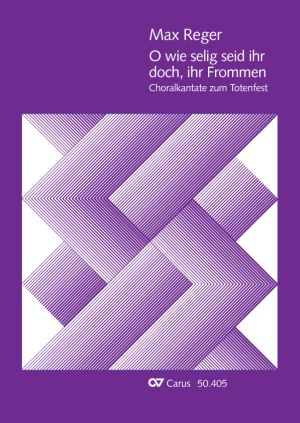
The choral cantatas are Reger's most personal and most substantial contribution to one of the principal categories of Protestant church music, and they are only major works in this field by one of the foremost composers of his time. This is true despite the fact that Reger himself does not appear to have considered the cantatas to figure among his principal compositions, as he gave them no opus numbers. In contrast to the three other chorale cantatas of Reger which exist in a definitive form, there is no record of the place or date of the first performance of "O wie selig", or indeed of any performance of it during the composer's lifetime.



Purchase
Additional product information
-
Composer
Max Reger
| 1873-1916Born in Brand, Bavaria, in 1873, Reger studied music in Munich and Wiesbaden with Hugo Riemann. From 1905 on he worked at the Academy in Munich as a teacher for organ and composition. He moved in 1907 to Leipzig to become the music director of the university until 1908 and professor of composition at the conservatory until his early death in 1916. Personal details
-
Melody composed by
Johann Crüger
| 1598-1662sorbischstämmiger Komponist bekannter Kirchenlieder; 40 Jahre Kantor an der St. Nikolai-Kirche in Berlin Personal details
-
Editor
Günther Massenkeil
| 1926-2014
-
Songwriter / Librettist
Jacob Baumgarten
-
Songwriter / Librettist
Simon Dach
-
Translator
Jean Lunn
Reviews
Max Reger, O wie selig seid ihr doch, ihr Frommen
Max Reger, O wie selig seid ihr doch, ihr Frommen
Die Choralkantaten sind Regers wichtiger Beitrag zu einer Kerngattung der protestantischen Kirchenmusik. Dass Reger diesen insgesamt vier vollständigen und einer im Manuskript überlieferten Choralkantaten keine Opuszahl zugewiesen hat, muss nicht bedeuten, dass er diese gering schätzte. Der Carus-Verlag bringt sämtliche Choralkantaten in einer kritischen Ausgabe heraus. Die Choralkantaten sind Zeugnisse eines großen Komponisten von manchmal berückender Schönheit.
Quelle: Musica Sacra 6/1992, S. 525
Reviews on our website can only be submitted by customers with a registered user account. A check whether the rated products were actually purchased does not take place.
No feedback available for this product.
Frequent questions about this work
 There are no questions and answers available so far or you were unable to find an answer to your specific question about this work? Then click here and send your specific questions to our Customer Services!