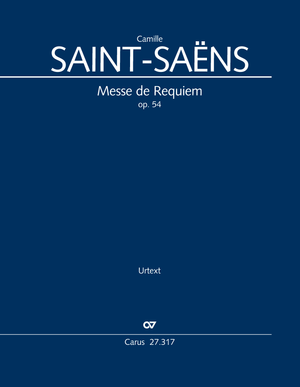
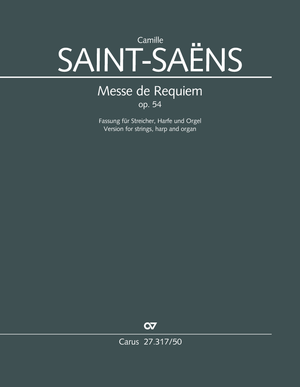
Messe de Requiem
Bearbeitung für Streicher, Harfe und Orgel (arr. K. Rothaupt) op. 54, 1878/2020
Die farbige und original sehr opulent instrumentierte Messe de Requiem op. 54 von Saint-Saëns liegt hier in einer geschickt reduzierten Fassung vor, sodass auch kleinere Chöre, oder Chöre mit begrenzten finanziellen oder räumlichen Möglichkeiten, dieses attraktive Werk mit geringerem instrumentalen Einsatz aufführen können.
Die originale, große Besetzung – vierfache Bläserbesetzung und vier Harfen – dürfte ein Grund dafür gewesen sein, dass sich das ausdrucksstarke wie farbenreiche Werk weniger verbreitete als Saint-Saëns' weltweit beliebtes Oratorio de Noël (Carus 40.455). Neben der Originalfassung, deren Material so eingerichtet wurde, dass das Werk alternativ auch mit 11 statt 20 Bläsern aufführbar ist, bietet Carus hier eine Fassung ganz ohne Bläser, nur für Streicher, ein bis zwei Harfen und Orgel an. Sie basiert auf einer entsprechenden Bearbeitung, die 1927 bei Durand erschienen ist, und wurde von Klaus Rothaupt neu eingerichtet. Die Orgel übernimmt Teile der ursprünglichen Bläserpartien; dabei erleichtern Registrierungsangaben die Einstudierung. Vokal- und Streicherstimmen bleiben unverändert gegenüber der Originalkomposition, daher können der Klavierauszug und die Chorpartitur der Originalfassung auch für diese Fassung verwendet werden. Eine klangvolle, individuelle Totenmesse, die zweifellos zu den bedeutendsten Werken des Komponisten zu zählen ist.
- Großes Requiem auch für kleinere Chöre aufführbar
- Fassung ohne Bläser, reduziert auf Streicher, ein bis zwei Harfen und Orgel
- Klavierauszüge und Chorpartituren der Originalfassung können verwendet werden.
| Originalversion | Bearbeitung für Streicher, Harfe und Orgel |
| Soli SATB, Coro SATB, 4 Fl, 2 Ob, 2 Eh, 4 Fg, 4 Cor, 4 Trb, 4 Arpa, Grand Orgue, Orgue d’accompagnement, 2 Vl, Va, Vc, Cb (reduzierte Fassung: 2 Fl, 2 Ob, 2 Eh, 2 Fg, 2 Cor, Trb, 2 Arpa, Org, 2 Vl, Va, Vc, Cb) | Soli SATB, Coro SATB, 2 (1) Arpa, 2 Vl, Va, Vc, Cb, Org |




-
Komponist*in
Camille Saint-Saëns
| 1835-1921Camille Saint-Saëns war ein wahres Multitalent. Er war Pianist, Dirigent, Organist, Musikwissenschaftler, Musikpädagoge und Komponist und erlangte vor allem durch den Karneval der Tiere und die Oper Samson et Dalila Bekanntheit.
Seine Sinfonie A-Dur komponierte er mit 15 und wurde bereits mit 16 an der Universität in Paris aufgenommen. Klavier, Orgel und Komposition studierte Saint-Saëns am Pariser Konservatorium und wurde 1852 Organist von Saint-Séverin in Paris. Im selben Jahr lernte er auch Franz Liszt kennen, welcher folgend einen Einfluss auf Saint-Saëns kompositorisches Schaffen ausübte. Ein Jahr später feierte er dann als Komponist sein musikalisches Debüt. Die Oper Samson et Dalila, die 1877 in Weimar uraufgeführt wurde, brachte ihm einen bis heute anhaltenden Erfolg an den Opernhäusern. Sein Weihnachtsoratorium Oratorio de Noël, das beim Carus-Verlag erhältlich ist, ist wohl das bekannteste seiner geistlichen Werke. zur Person
-
Bearbeiter*in
Klaus Rothaupt
Rezensionen
... Über weite Strecken ist es [das Stück] ] originell und ideenreich, von vielen unerwarteten Klangvorstellungen durchsetzt, die dem Text zahlreiche neue Überlegungen abgewinnen…
Gustav Danzinger, Chor aktuell, 01/2021
... Wenn man sich auf das Experiment einlassen möchte, liegt mit der vorliegenden Ausgabe ein durchdachtes Konzept vor, das auf Umsetzung harrt.
Württembergische Blätter für Kirchenmusik, 06/2021
Bewertungen auf unserer Website können nur von Kund*innen mit registriertem Nutzerkonto abgegeben werden. Eine Überprüfung, ob die bewerteten Produkte tatsächlich erworben wurden, findet nicht statt.
Häufige Fragen zum Werk
Die Fassung wird als Bearbeitung für Streicher, Harfe und Orgel angepriesen, die Besetzungsangabe lautet aber "2 (1) Arpa". Wieviele Harfen brauche ich denn nun?
Wer ist der Bearbeiter der Fassung von 1927?
Kann ich den "normalen" Klavierauszug /03 bzw. die Chorpartitur /05 für die große Fassung auch zum Singen der vorgestellten Fassung nutzen?
Können die Streicherstimmen der Originalfassung (Carus 27.317/00) auch für die Bearbeitung verwendet werden?
 An dieser Stelle gibt es noch gar keine Fragen und Antworten zum Werk oder Ihre spezifische Frage zum Werk wurde noch nicht beantwortet? Klicken Sie hier und reichen Sie Ihre werkspezifische Frage bei unserem Kundenservice ein!