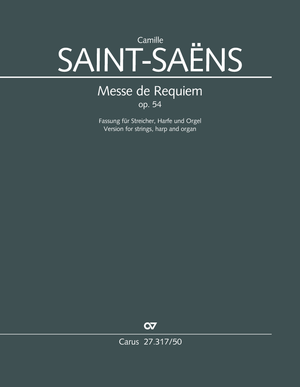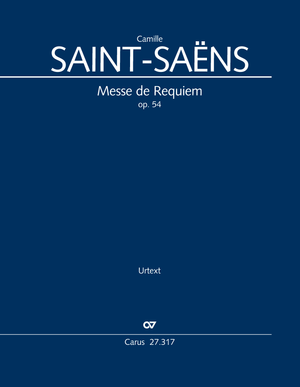
Messe de Requiem
op. 54, 1878
During his most productive period as an opera composer, Camille Saint-Saëns also wrote sacred works, among which his Oratorio de Noël has enjoyed great worldwide popularity. The colorful and opulently orchestrated Messe de Requiem was composed in 1878 in Bern. The composer dedicated it to his patron, Albert Libon. We have published this edition both with its larger orchestral forces and to enable perfomances of the Requiem in slightly reduced scoring (without losing the special characteristics of the work), in a version with a smaller orchestra consisting of 11 winds, two harps, organ and string instruments. The full score reproduces the Urtext of the Requiem with its original scoring, whereas the performance material is presented and conceived so to enable it to be performed either in the original orchestration or the version with reduced forces.
Thanks to an arrangement for strings, harp and organ by K. Rothaupt (Carus 27.317/50), it is possible to perform the work in smaller settings.
 View
View


 Additional material
- Purchase additional material as a download product.
-
 Digital text (without sheet music) incl. printing licence, html file, singing text, english translationhtml file, singing text, english translation (Sample)
1. Requiem – Kyrie Lord, grant them eternal rest,
and let the perpetual light shine upon them.
Thou shalt have praise in Zion, oh God,
and homage shall be paid to thee in Jerusalem.
All flesh shall come before thee.
Lord, have mercy upon us.
Christ, have mercy upon us.
Lord, have mercy upon us.2. Dies irae This day, this day of wrath
shall consume the world in ashes,
as foretold David and the Sibyl.
What trembling there shall be
when the judge shall come
to weigh everything strictly.
The trumpet, scattering its awful sound
...
-
Digital text (without sheet music) incl. printing licence, html file, singing text, german translationhtml file, singing text, german translation (Sample)
1. Requiem – Kyrie Gib ihnen die ewige Ruhe, Herr,
und das ewige Licht leuchte ihnen.
Dir gebührt ein Lobgesang, Gott, in Zion,
und dir erfülle man sein Gelübde in Jerusalem.
Zu dir komme alles Fleisch.
Herr, erbarme dich.
Christus, erbarme dich.
Herr, erbarme dich.2. Dies irae Tag der Rache, Tag der Sünden
wird das Weltall sich entzünden,
wie Sibyll und David künden.
Welch ein Graus wird sein und Zagen,
wenn der Richter kommt mit Fragen,
streng zu prüfen alle Klagen.
Laut wird die Posaune klingen,
...
-
Digital text (without sheet music) incl. printing licence, html file, singing text, originalhtml file, singing text, original (Sample)
1. Requiem – Kyrie Requiem aeternam dona eis Domine:
et lux perpetua luceat eis.
Te decet hymnus Deus in Sion,
et tibi reddetur votum in Jerusalem:
ad te omnis caro veniet.
Kyrie eleison.
Christe eleison.
Kyrie eleison.2. Dies irae Dies irae, dies illa,
solvet saeclum in favilla,
teste David cum Sibylla.
Quantus tremor est futurus,
quando judex est venturus,
cuncta stricte discussurus.
Tuba mirum spargens sonum
...
-
Digital text (without sheet music) incl. printing licence, html file, Introductory text, englishhtml file, Introductory text, english (Sample)Abridged foreword of the edition Carus 27.317
Dieter Zeh
Camille Saint-Saëns was born on October 9, 1835 in Paris. He grew up in a family that fostered the boy’s talents. In 1848 he began lessons with the leading teachers at the Paris Conservatoire: Camille Stamaty (piano), François Benoist (organ), and Jacques Fromental Halévy (composition). At the age of only eighteen, Saint-Saëns was appointed to the post of organist at the Église Saint-Merri, where his compositions included the Messe op. 4, and he held the same position at the Église de la Madeleine from 1858 to 1877. After France’s defeat in the war with Germany in 1870–71, Saint-Saëns became the champion of an Ars gallica and one of the founders of the Société Nationale de Musique, which also sought to promote contemporary French (and particularly symphonic) music at an institutional level. Saint-Saëns’ compositional phase lasting until just after the turn of the century, with many concert tours and convalescent trips, was characterized by a focus on opera. By 1900 he was universally considered one of the most important French composers of his generation. The final period of his life, during which he was limited by illness, was overshadowed
...
-
Digital text (without sheet music) incl. printing licence, html file, Introductory text, germanhtml file, Introductory text, german (Sample)Gekürztes Vorwort der Ausgabe Carus 27.317
Dieter Zeh
Camille Saint-Saëns wurde am 9. Oktober 1835 in Paris geboren. Das familiäre Umfeld förderte die Begabungen des Jungen. Ab 1848 erhielt er Unterricht von den bedeutendsten Repräsentanten des Conservatoire de Paris, Camille Stamaty (Klavier), François Benoist (Orgel) und Jacques Fromental Halévy (Komposition). Bereits mit 18 Jahren bekleidete Saint-Saëns das Amt des Organisten an der Église Saint-Merri, wo u. a. die Messe op. 4 entstand, und von 1858 bis 1877 wirkte er in gleicher Eigenschaft an der Église de la Madeleine. Nach der Niederlage Frankreichs im Krieg mit Deutschland 1870/71 wurde Saint-Saëns zum Fürsprecher einer Ars gallica und Mitbegründer der Société Nationale de Musique, die auch institutionell die Förderung zeitgenössischer französischer Musik, vor allem der Sinfonik, sichern wollte. Die Phase bis kurz nach der Jahrhundertwende, mit zahlreichen Tourneen und Erholungsaufenthalten, war kompositorisch bei Saint-Saëns vor allem von der Hinwendung zur Oper bestimmt. Um 1900 gehörte er zu den unbestritten wichtigsten französischen Komponisten seiner Generation. Sein letzter, von krankheitsbedingten Einschränkungen geprägter
...
-
Composer
Camille Saint-Saëns
| 1835-1921Camille Saint-Saëns was a true multi-talent. He was a pianist, conductor, organist, musicologist, music teacher and composer and became famous above all for the Carnival of the Animals and the opera Samson et Dalila.
He composed his Symphony in A major at the age of 15 and was accepted to the University of Paris at the age of 16. Saint-Saëns studied piano, organ and composition at the Paris Conservatoire and became organist of Saint-Séverin in Paris in 1852. In the same year, he also met Franz Liszt, who subsequently exerted an influence on Saint-Saëns' compositional work. A year later, he celebrated his musical debut as a composer. The opera Samson et Dalila, which premiered in Weimar in 1877, brought him lasting success in opera houses to this day. His Christmas oratorio Oratorio de Noël, which is available from Carus-Verlag, is probably the best-known of his sacred works. Personal details
-
Editor
Fritz Näf
| 1943Fritz Näf studied solo singing at the Musikhochschule in Zurich and Freiburg/Breisgau and attended master courses given by Jenny Tourel and Ernst Haefliger. As a tenor he appeared in concerts in many parts of Europe, while continuing his studies as a choral and orchestral conductor. Between 1976 and 1986 he taught solo and ensemble singing at the Schola Cantorum Basiliensis, where he founded the Basle Madrigalists in 1978. Between 1986 and 2000 first he was director of the Winterthur Music School and Conservatory, and subsequently rector of the newly established Hochschule for Music and Theater in Zurich. Since December 2000 Fritz Näf has been full-time artistic director of the Swiss Chamber Choir (founded in 1997) and the Basle Madrigalists. He also continues to appear as a guest conductor with various choirs and orchestras. Personal details
Reviews
Ein interessantes Werk, das fernab jeglicher Äußerlichkeit unter die Haut gehen kann!
Gottesdienst und Kirchenmusik, Mai/Juni 2022
... Da ist es für die Praxis geradezu verführerisch, dass der Carus-Verlag den Schweizer Dirigenten Fritz Näf eine reduzierte Fassung hat erstellen lassen: So ist es auch in bescheideneren Verhältnissen zu realisieren, ...
Musica Sacra, 6/2019
... Die Überschaubarkeit und der größtenteils homophone Chorsatz sollten auch die Einstudierung des mittelschweren Werks zu einer gut lösbaren Aufgabe machen.
Ulrich Barthel, Chorzeit, 02/2021
Reviews on our website can only be submitted by customers with a registered user account. A check whether the rated products were actually purchased does not take place.
Frequent questions about this work
Do I need special parts for the reduced orchestral version?
Do we really need 4 or 2 harps?
Do I really need two organs?
 There are no questions and answers available so far or you were unable to find an answer to your specific question about this work? Then click here and send your specific questions to our Customer Services!