Alexander's Feast
Ode. Version of the first performance and version of 1751 HWV 75, 1736/1751
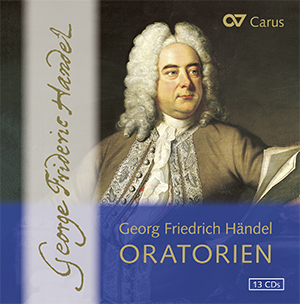
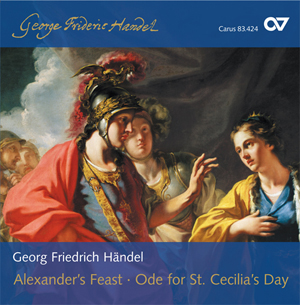
Handel opened the oratorio season at Covent Garden Theatre in early 1736 with Alexander’s Feast. This magnificent composition afforded him an unparallelled opportunity to showcase his musical artistry, which few of his other oratorios could match. The text, which illustrates the power of music using the example of the ancient hero Alexander the Great, is based on Alexander's Feast, or, The Power of Musick, the ode by John Dryden which was widely known in England at the time. Alexander's Feast became one of Handel's most popular works and, alongside Acis and Galatea and Messiah, his most frequently performed oratorio during his lifetime.
For the first time the present Carus edition is based consistently on Handel’s conducting score, which he used for his own performances of the oratorio, thus not only eliminating timeworn errors, but also offering clarity concerning the choruses, the arias and recitatives, actually performed in Handel’s concerts, as well as their sequence of performance. The new Carus edition offers two performance versions: the version of the premiere in 1736, as well as a revised version from 1751. Furthermore, the inclusion of the Concerto for Harp HWV 294 (CV 55.294) is also possible; Handel composed this work especially for Alexander's Feast (as an illustration of Timotheus, the ancient poet who played the lyre). For this purpose the edition contains the appropriate alternatives for the sequence of the movements.
Explore
 Listen
(28)
Listen
(28)
- Recitative (Tenore): The praise of Bacchus
- Arioso (Soprano): Softly sweet, in Lydian measures
- Chorus: The many rend the skies
- Ouverture
- Recitative (Tenore): ‘Twas at the royal feast
- Air (Tenore) and Chorus: Happy, happy, happy pair!
- Recitative (Tenore): Timotheus plac’d on high
- Accompagnato (Soprano): The song began from Jove
- Chorus: The list’ning crowd admire the lofty sound
- Air (Soprano): With ravish’d ears
- Air (Basso): Bacchus, ever fair – Chorus: Bacchus’ blessings are a treasure
- Recitative (Tenore): Sooth’d with the sound
- Accompagnato (Soprano): He chose a mournful muse
- Air (Soprano): He sung Darius great and good
- Accompagnato (Soprano): With downcast looks the joyless victor sate
- Chorus: Behold Darius, great and good
- Recitative (Tenore): The mighty master smil’d to see
- Air (Soprano): War, he sung, is toil and trouble
- Chorus: The many rend the skies
- Air (Soprano): The Prince, unable to conceal his pain
- Accompagnato (Tenore): Now strike the golden lyre; Chorus: Break his bands of sleep; Accompagnato (Tenore): Hark! hark! – the horrid sound
- Air (Basso): Revenge, Timotheus cries
- Accompagnato (Tenore): Give the vengeance due
- Air (Tenore): The princes applaud with a furious joy
- Air (Soprano): Thais led the way; Chorus: The princes applaud with a furious joy
- Accompagnato (Tenore): Thus long ago; Chorus: At last divine Cecilia came
- Recitative (Tenore, Basso): Let old Timotheus yield the prize
- Chorus: Let old Timotheus yield the prize
 Additional material
- Purchase additional material as a download product.
-
 Digital text (without sheet music) incl. printing licence, html file, singing text, german translationhtml file, singing text, german translation (Sample)
Erster Teil
1. Ouvertüre
2. Rezitativ (Tenore) Es war beim Königsfest, als Persien gewonnen war
durch Philipps kriegerischen Sohn.
In erhabener Pracht
saß der göttergleiche Held
auf seinem Herrscherthron,
umringt von seiner tapfern Feldherrn Schar,
die Ros’ und Myrten froh bekränzt,
wie sie durch ihren Sieg verdient.
Zur Seite ihm die liebliche Thais saß
geschmückt wie eine Braut des Morgenlandes,
in jugendlichem Glanz und stolzer Freude.3. Arie (Tenore) und Chor Glücklich, glücklich, glücklich Paar!
Allein der Tapfere verdient die Schöne.4. Rezitativ (Tenore) Timotheus, der erhöht
unter den Sängern sitzt
...
-
Digital text (without sheet music) incl. printing licence, html file, singing text, originalhtml file, singing text, original (Sample)
First Part
1. Ouverture
2. Recitative (Tenore) ’Twas at the royal feast, for Persia won
by Philip’s warlike son.
Aloft in awful state
the god-like hero sate
on his imperial throne;
his valiant peers were plac’d around,
their brows with roses and with myrtles bound.
So should desert in arms be crown’d.
The lovely Thais by his side
sate like a blooming Eastern bride,
in flow’r of youth, and beauty’s pride.3. Air (Tenore) and Chorus Happy, happy, happy pair!
None but the brave deserves the fair.4. Recitative (Tenore) Timotheus plac’d on high,
amid the tuneful quire,
...
Purchase
Additional product information
Contents

-
Composer
Georg Friedrich Händel
| 1685-1759George Frideric Handel put his exceptionally versatile compositional abilities to the test at an early age. After moving to London in 1712, where he was appointed Composer of Musick for His Majesty’s Chapel Royal in 1723, he wrote numerous masterpieces for the royal court as well as his major opere serie. For many years he enjoyed triumphant successes with his operas, which were sung by outstanding performers, with serenades, and later also with oratorios such as Saul and Israel in Egypt. Over the years Handel’s reputation grew far beyond the city where he worked; some of his choral works, particularly Messiah, have enjoyed a performance tradition which remains unbroken to this day, and are sung by choirs throughout the world. Personal details
Reviews on our website can only be submitted by customers with a registered user account. A check whether the rated products were actually purchased does not take place.
No feedback available for this product.
Frequent questions about this work
 There are no questions and answers available so far or you were unable to find an answer to your specific question about this work? Then click here and send your specific questions to our Customer Services!