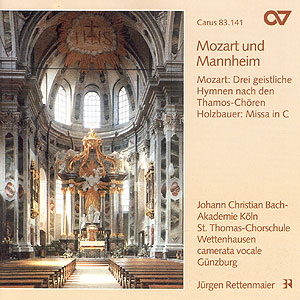
Church music from the famous Mannheim School: Ignaz Holzbauer (1711–1783) composed this festive “Missa in C” for the renowned Mannheim Court Orchestra. The Mass is one of the composer’s most significant church works and a prime example of Holzbauer’s symphonic church style. In doing so, he made nearly full use of the possibilities offered by the orchestra: the large ensemble is rather unusual, as is the use of clarinets, which are first documented in the Mannheim court orchestra as late as 1758. The setting of the Ordinary movements is characterized by the innovative Mannheim orchestral language and attests to Holzbauer’s affinity for stage music. For example, in the “Cruzifixus,” the composer’s talent for dramatic music is evident through stark contrasts and suspenseful harmonies. Vocal parts are integrated into the symphonic fabric both structurally and sonically.
Published in the series “Music of the Mannheim Court Orchestra.”
Purchase
Additional product information
-
Composer
Ignaz Holzbauer
| 1711-1783Ignaz Holzbauer, born in Vienna in 1711, began his musical career as a self-taught musician. After traveling to Italy and spending years as music director at the Burgtheater in Vienna alongside renowned figures such as Galuppi and Gluck, he moved to Stuttgart in 1751 to serve as chief conductor, where he enjoyed great success with his stage works. Shortly thereafter, he was appointed Kapellmeister of the legendary Mannheim Court Orchestra, a position he held until his death on April 7, 1783. His innovative symphonic church style is based on a deep understanding of contemporary musical trends, combined with a love of experimentation and a distinct talent for dramatic music. Mozart, too, appreciated this “fine church style” and “fine arrangement of the vocal parts.” Holzbauer shaped the “Mannheim style” and, with it, an entire generation of composers and musicians. Personal details
Reviews on our website can only be submitted by customers with a registered user account. A check whether the rated products were actually purchased does not take place.
No feedback available for this product.
Frequent questions about this work
 There are no questions and answers available so far or you were unable to find an answer to your specific question about this work? Then click here and send your specific questions to our Customer Services!