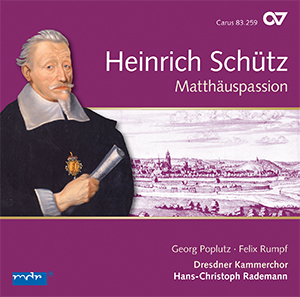
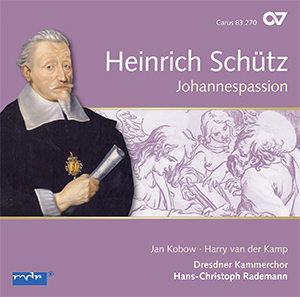
St. John Passion / The Passion of our Lord and Saviour Jesus Christ
Historia des Leidens und Sterbens unsers Herrn und Heilandes Jesus Christi nach dem Evangelisten St. Johannem SWV 481, 1666
With his three purely a cappella Passions, Schütz closes his series of historical settings: text-oriented compositions that are both technically demanding and intensely expressive. These are works of maturity, which bring an entire musical period to a close. With the Stuttgarter Schütz Edition, Carus-Verlag offers the trilogy of Schütz’s Passions in critical editions with detailed information about their composition, transmission, and performance practice.
Explore
 View
View
 Listen
(8)
Listen
(8)
- Introitus
- Gefangennahme Jesu (aus Vol. 13: Johannespassion)
- Jesus vor Hannas und Kaiphas, Verleugnung des Petrus
- Jesus vor Pilatus (aus Vol. 13: Johannespassion)
- Geißelung und Verspottung
- Jesu Verurteilung
- Kreuzigung und Tod
- Beschluss
 Additional material
- Purchase additional material as a download product.
-
 Digital text (without sheet music) incl. printing licence, html file, singing text, english translationhtml file, singing text, english translation (Sample)
Introitus The Passion of our Lord and Saviour Jesus Christ, as we find it written in Holy Scripture in the Gospel of Saint John.
Jesus is taken prisoner Evangelist:
When Jesus had spoken these words, he went forth with his disciples over the brook Cedron, where was a garden, into the which he entered, and his disciples. And Judas also, which betrayed him, knew the place: for Jesus oft times resorted thither with his disciples. Judas then, having received a band of men and officers from the chief priests and Pharisees, cometh thither with lanterns and torches and weapons. Jesus therefore, knowing all things that should come upon him, went forth, and said unto them:
Jesus:
Whom seek ye?
Evangelist:
They answered him:
The Jews:
Jesus of Nazareth.
Evangelist:
Jesus saith unto them:
...
-
Digital text (without sheet music) incl. printing licence, html file, singing text, originalhtml file, singing text, original (Sample)??
Introitus Das Leiden unsers Herren Jesu Christi, wie uns das beschreibet der heilige Evangeliste Johannes.
Gefangennahme Jesu Evangelist: Da Jesus solches geredet hatte, ging er hinaus mit seinen J?ngern ?ber den Bach Kidron; da war ein Garte, darein ging Jesus und seine J?nger. Judas aber, der ihn verriet, wusste den Ort auch; denn Jesus versammlete sich oft daselbst mit seinen J?ngern. Da nun Judas zu sich genommen hatte die Schare und der Hohenpriester und Pharis?er Diener, k?mmt er dahin mit Fackeln, Lampen und mit Waffen. Da nun Jesus wusste alles, was ihm begegnen sollte, ging
...
Purchase
Additional product information
Contents
-
Composer
Heinrich Schütz
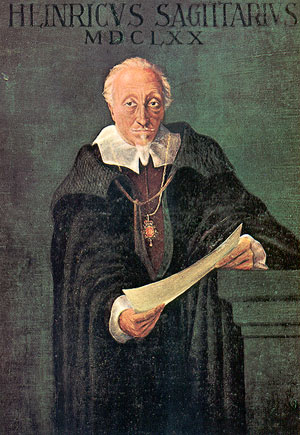
| 1585-1672Heinrich Schütz is regarded as the first German musician of European stature. As a choirboy from 1599 at the court of Landgrave Moritz of Hessen-Kassel, he received a thorough education. In 1608 he began a law degree in Marburg, but broke this off in 1609 in order, with the support of the Landgrave, to study composition with Giovanni Gabrieli, organist at St Mark’s in Venice. In 1613 Schütz returned to Kassel, but two years later was enticed away by Elector Johann Georg I of Saxony to the Dresden court as “Organist und Director der Musica”, where he held the position of Hofkapellmeister (court Kapellmeister) from 1617 until his death. Schütz’s great cycles of vocal works marked the high point of his reputation in Germany and northern Europe. But these represent only part of Schütz’s output; individual works are represented in printed collections with works by other composers, others only survive in manuscript, and much has been lost. The Stuttgart Schütz Edition makes available Schütz’s complete oeuvre, and all works are also published in practical Urtext editions. Personal details
-
Editor
Günter Graulich
| 1926The publisher, church musician and teacher Günter Graulich is one of the major personalities in German publishing of the post-war period. With his wife Waltraud he founded Carus-Verlag Stuttgart in 1972, which he built up from a 2-person family firm to a medium-sized business with around 60 employees. A trained church musician and Kantor for many years at the Matthäuskirche Stuttgart, he also directed the Motettenchor Stuttgart for 50 years. With his choir he made LP and CD recordings, and undertook numerous concert tours to other European countries and America. Personal details
-
Translator
Derek McCulloch
Reviews on our website can only be submitted by customers with a registered user account. A check whether the rated products were actually purchased does not take place.
No feedback available for this product.
Frequent questions about this work
 There are no questions and answers available so far or you were unable to find an answer to your specific question about this work? Then click here and send your specific questions to our Customer Services!