Stabat Mater
op. 58, 1876/1877
Antonín Dvorák’s impressive Stabat Mater for soloists, chorus and orchestra is probably the best-known of the composer’s sacred works. Some painful experiences – in 1875 his first daughter died, and in 1877 he lost two other children in quick succession – may have led to Dvorák’s preoccupation with the suffering of the Mother of God, who stands weeping beneath the cross of her son.
The music enters into the different moods of the liturgical texts with great sensitivity. Nine movements in slow to moderate tempi serve as a kind of Passion meditation, before the ecstasy of a vision of the resurrection wins the upper hand at the end of the tenth movement.
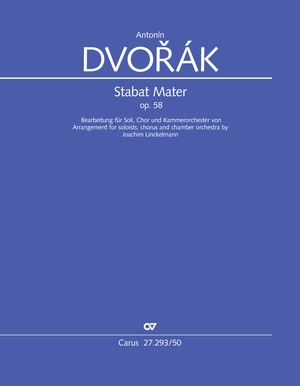
Thanks to the arrangement for chamber orchestra (arr. J. Linckelmann / Carus 27.293/50) it is possible to perform the work in smaller settings.


-
Composer
Antonín Dvorák
| 1841-1904Antonín Dvorák (1841-1904), next to Smetana and Janacek the most important exponent of specifically Czech music, now ranks (also in general) as one of the most popular composers of the nineteenth century. The son of a butcher-innkeeper in the Bohemian town of Nelahozeves (Mühlhausen) near Kralup, he first became known in his homeland for his patriotic hymn The Heirs of the White Mountain for chorus and orchestra, op.30, that he wrote in 1872. His road out into the world was opened by a commission consisting of Johannes Brahms, Eduard Hanslick and Johann von Herbeck, that selected him for an Austrian government stipend.
Brahms, who was seven years the elder, took a friendly interest in his younger colleague whose eminent talent he had recognized and had come to admire. (Brahms: "That fellow has more ideas than all of us together. Every other composer could cull main themes from what he throws away.") Brahms recommended Dvorák to his Berlin publisher, Simrock, who later became Dvorák's chief publisher though he was obstinate and at first quite difficult.
International fame came to Dvorák as a composer and – beginning in 1884 – as conductor of his own works mainly through his sensational successes in England (he went there for lengthy sojourns a total of nine times) and in the United States (two long visits spent in teaching and composing). His success was sparked chiefly by a sacred work, his Stabat Mater that was written in 1876 (Carus 27.293/03). Right until his late period, church music was never missing from the list of his important compositions: the symphonic poems, the operas (among them Rusalka), the symphonies, the string quartets and other chamber music works, the oratorio St. Ludmila - and the Slavonic Dances op.46 and op.72. To the Stabat Mater op.58 (1876/77) mentioned above, he added the 149th Psalm op.79 (1879/87), the Requiem op.89 (1890) (Carus 27.323) and the Te Deum op.103 (1892) (Carus 27.189).
Personal details
Reviews on our website can only be submitted by customers with a registered user account. A check whether the rated products were actually purchased does not take place.
Frequent questions about this work
 There are no questions and answers available so far or you were unable to find an answer to your specific question about this work? Then click here and send your specific questions to our Customer Services!