

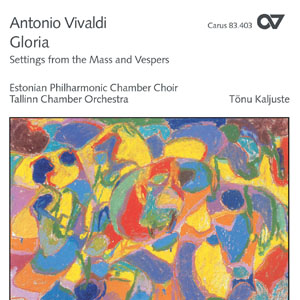
Gloria - Messsätze und Vespern (Kaljuste)
 Listen
(26)
Listen
(26)
- Kyrie eleison
- Christe eleison
- Kyrie eleison
- Gloria in excelsis Deo
- Et in terra pax
- Laudamus te
- Propter magnam
- Domine Deus
- Domine Fili unigenite
- Domine Deus, Agnus Dei
- Qui tollis peccata mundi
- Qui sedes ad dexteram Patris
- Quoniam tu solus sanctus
- Cum Sancto Spiritu
- Credo in unum Deum
- Et incarnatus est
- Crucifixus
- Et resurrexit
- Magnificat (Coro)
- Et exsultavit (Soli SAT, Coro)
- Et misericordia (Coro)
- Esurientes (Soli SS)
- Deposuit potentes (Coro)
- Suscepit Israel (Coro)
- Sicut locutus est (Coro SAB)
- Gloria patri (Coro)
 Additional material
-
 Digital text (without sheet music) incl. printing licence, html file, singing text, english translationhtml file, singing text, english translation (Sample)1. Gloria in excelsis (Coro
Glory be to God on high
2. Et in terra pax (Coro)and on earth peace to men of good will.
3. Laudamus te (Duetto Soprano I.II)We praise Thee;
4. Gratias agimus tibi (Coro)
we bless Thee;
we adore Thee;
we glorify Thee.We give Thee thanks
5. Propter magnam gloriam tuam (Coro)for Thy great glory.
6. Domine Deus (Aria Soprano)Lord God, heavenly King, God the almighty Father.
7. Domine Fili unigenite (Coro)O Lord, the only-begotten Son,
...
-
Digital text (without sheet music) incl. printing licence, html file, singing text, german translationhtml file, singing text, german translation (Sample)1. Gloria in excelsis (Coro)
Ehre sei Gott in der Höhe
2. Et in terra pax (Coro)und Friede auf Erden den Menschen, die guten Willens sind.
3. Laudamus te (Duetto Soprano I.II)Wir loben Dich,
4. Gratias agimus tibi (Coro)
wir preisen Dich,
wir beten Dich an,
wir rühmen Dich.Wir danken Dir,
5. Propter magnam gloriam tuam (Coro)denn groß ist Deine Herrlichkeit.
6. Domine Deus (Aria Soprano)Herr und Gott, König des Himmels, Gott, allmächtiger Vater.
7. Domine Fili unigenite (Coro)Herr Jesus Christus,
...
-
Digital text (without sheet music) incl. printing licence, html file, singing text, originalhtml file, singing text, original (Sample)1. Gloria in excelsis Deo (Coro)
Gloria in excelsis Deo.
2. Et in terra pax (Coro)Et in terra pax hominibus bonae voluntatis.
3. Laudamus te (Duetto Soprano I.II)Laudamus te, benedicimus te, adoramus te, glorificamus te.
4. Gratias agimus tibi (Coro)Gratias agimus tibi
5. Propter magnam gloriam tuam (Coro)propter magnam gloriam tuam.
6. Domine Deus (Aria, Soprano)Domine Deus, Rex coelestis,
7. Domine Fili unigenite (Coro)
Deus Pater omnipotens.Domine Fili unigenite, Jesu Christe.
8. Domine Deus, Agnus Dei (Alto e Coro)...
-
Digital text (without sheet music) incl. printing licence, html file, Introductory text, englishhtml file, Introductory text, english (Sample)Text from the CD Carus 83.325
Karl Heller
Translation (abridged): John CoombsThe Gloria in D major has, more than any other work, established Vivaldi’s reputation as a composer of church music. In the compositional design of this work Vivaldi followed the same basic conception which is known from Bach’s B minor Mass: it is arranged in a large number of individual movements, some of which are for chorus, while others are solo arias or duets. This is the basis of the socalled “cantata” or “number” Mass, which enabled the composer to focus on central thoughts of the text. Thus the twelve movements profit from a great diversity of character, while at the same spanning a considerable stylistic range.
The heart of the composition is the chorus “Et in terra pax.” Among the unusual features of this masterly piece is the fact that the musical events proceed on two levels which motivically are distinct from each other: the orchestra plays wide intervals,
...
-
Digital text (without sheet music) incl. printing licence, html file, Introductory text, germanhtml file, Introductory text, german (Sample)Booklet-Text der CD Carus 83.325
Karl Heller
Die Wiederbelebung der Musik Antonio Vivaldis im 20. Jahrhundert ging einher mit der Neuentdeckung bisher völlig unbekannter Schaffensbereiche des Komponisten. Für die stärksten Überraschungen sorgte dabei ein großer Bestand an geistlicher Vokalmusik, dessen Repertoire von der groß angelegten Mess- und Vesperkomposition bis zum biblischen Oratorium und zur Solomotette reicht. Die ersten Wiederaufführungen solcher Werke, darunter das Gloria RV 589 und das Credo RV 591, während einer Vivaldi-Woche in Siena 1939 wurden geradezu als Sensation empfunden. Sie ließen deutlich werden, dass der Komponist gerade auf diesem Sektor Werke höchsten künstlerischen Ranges geschaffen hat.
Wie kaum ein zweites Werk hat das Gloria D-Dur RV 589 dazu beigetragen, den Ruf Vivaldis als Kirchenkomponist zu begründen. Seit es 1941 als erstes der kirchenmusikalischen Werke des Komponisten durch Druck veröffentlicht wurde, erfreut es sich der besonderen Gunst der Musizierenden und der Hörer. Die Gründe dafür mögen vielfältiger Natur sein, liegen aber gewiss primär bei der Kraft und dem Reichtum der musikalischen Erfindung und Ausdrucksgebung.
Vivaldi folgt in der kompositorischen
...
-
Digital text (without sheet music) incl. printing licence, html file, singing text, english translationhtml file, singing text, english translation (Sample)1. Magnificat (Tutti)
My soul doth magnify
2. Et exultavit (Aria Soprano 1, Soprano 2, Tenore e Coro)
the Lord.And my spirit hath rejoiced
3. Et misericordia eius (Tutti)
in God my Saviour.
For he hath regarded the low
estate of his handmaiden: for,
behold, from henceforth shall
call me blessed all generations.
For he that is mighty
hath done great things;
and holy is his name.And his mercy is on them
4. Fecit potentiam (Tutti)
that fear him
from generation to generation.He hath showed strength
with his arm;...
-
Digital text (without sheet music) incl. printing licence, html file, singing text, german translationhtml file, singing text, german translation (Sample)1. Magnificat (Tutti)
Meine Seele erhebt
2. (Et exultavit (Aria Soprano 1, Soprano 2, Tenore e Coro)
den Herrn,und mein Geist freuet sich
3. Et misericordia eius (Tutti)
Gottes, meines Heilands.
Denn er hat die Niedrigkeit
seiner Magd angesehen.
Siehe, von nun an werden mich
selig preisen alle Kindeskinder.
Denn er hat große Dinge an mir getan,
der da mächtig ist
und des Name heilig ist.Und seine Barmherzigkeit
4. Fecit potentiam (Tutti)
währet immer für und für
bei denen, die ihn fürchten.Er übet Gewalt
mit seinem Arm...
-
Digital text (without sheet music) incl. printing licence, html file, singing text, originalhtml file, singing text, original (Sample)1. Magnificat (Tutti)
Magnificat anima mea Dominum.
2. Et exultavit (Aria Soprano 1, Soprano 2, Tenore e Coro)Et exsultavit spiritus meus
3. Et misericordia eius (Tutti)
in Deo salutari meo.
Quia respexit humilitatem
ancillae suae,
ecce enim ex hoc beatam me
dicent omnes generationes.
Quia fecit mihi magna
qui potens est,
et sanctum nomen eius.Et misericordia
4. Fecit potentiam (Tutti)
a progenie in progenies
timentibus eum.Fecit potentiam
in bracchio suo,...
-
Digital text (without sheet music) incl. printing licence, html file, Introductory text, englishhtml file, Introductory text, english (Sample)Text from the CD Carus 83.325
Karl Heller
Translation (abridged): John CoombsThe Magnificat in G minor belongs liturgically in the service of Vespers. Vivaldi set this song of praise to Mary only once. The first version was written for the Ospedale della Pietà between 1713 and 1717 (RV 610b), but the work was revised at least twice. The version RV 610, differs from the original version only in points of detail. The characteristic features of this work include a clear sense of compositional terseness. Despite the particular charm of such a piece as the duet “Esurientes,” it is generally agreed that the greatest effect is created by the choral movements. This is true of the opening “Magnificat” with its extravagant gestures, concise plasticity in the unisono of the “Deposuit potentes de sede,” and above all of the “Et misericordia,” which is distinguished by its close counterpoint and expressive harmonic tension. The words at that point are set to music whose
...
-
Digital text (without sheet music) incl. printing licence, html file, Introductory text, germanhtml file, Introductory text, german (Sample)Booklet-Text der CD Carus 83.325
Karl Heller
Die Wiederbelebung der Musik Antonio Vivaldis im 20. Jahrhundert ging einher mit der Neuentdeckung bisher völlig unbekannter Schaffensbereiche des Komponisten. Für die stärksten Überraschungen sorgte dabei ein großer Bestand an geistlicher Vokalmusik, dessen Repertoire von der groß angelegten Mess- und Vesperkomposition bis zum biblischen Oratorium und zur Solomotette reicht. Die ersten Wiederaufführungen solcher Werke, darunter das Gloria RV 589 und das Credo RV 591, während einer Vivaldi-Woche in Siena 1939 wurden geradezu als Sensation empfunden. Sie ließen deutlich werden, dass der Komponist gerade auf diesem Sektor Werke höchsten künstlerischen Ranges geschaffen hat.
Zu den Sätzen des Messordinariums tritt mit dem Magnificat g-Moll eine Komposition, die ihrer liturgischen Stellung nach dem Vespergottesdienst – als dessen Schlussstück – zugehört. Vivaldi hat diesen Lobgesang der Maria (Luk 1,46–55) nur ein einziges Mal vertont, die zwischen 1713 und 1717 entstandene Erstfassung (RV 610b) allerdings wenigstens zweimal umgearbeitet, das letzte Mal 1739 zu einer Fassung, die fünf neu komponierte Soloarien für Sängerinnen des Ospedale della Pietà
...
-
Digital text (without sheet music) incl. printing licence, html file, singing text, english translationhtml file, singing text, english translation (Sample)1. Credo in unum Deum
I believe in one God,
the Father almighty,
Maker of heaven and earth
and of all things visible
and invisible.
And in one Lord
Jesus Christ,
the only-begotten Son of God,
begotten of his Father
before all ages.
God of God,
light of light,
true God of true God,
begotten, not made,
being of one substance with the Father,
by whom all things were made.
Who for us men
and for our salvation
came down from heaven....
-
Digital text (without sheet music) incl. printing licence, html file, singing text, german translationhtml file, singing text, german translation (Sample)1. Credo in unum Deum
Ich glaube an einen Gott,
den allmächtigen Vater,
der alles geschaffen hat,
Himmel und Erde, die sichtbare
und die unsichtbare Welt.
Und an den einen Herrn
Jesus Christus,
Gottes eingeborenen Sohn,
aus dem Vater geboren
vor aller Zeit:
Gott von Gott,
Licht vom Licht,
wahrer Gott vom wahren Gott,
gezeugt, nicht geschaffen,
eines Wesens mit dem Vater;
durch ihn ist alles geschaffen.
Für uns Menschen
und zu unserem Heil
ist er vom Himmel gekommen....
-
Digital text (without sheet music) incl. printing licence, html file, singing text, originalhtml file, singing text, original (Sample)1. Credo in unum Deum
Credo in unum Deum,
Patrem omnipotentem,
factorem coeli et terrae,
visibilium omnium, et invisibilium.
Et in unum Dominum Jesum Christum,
Filium Dei unigenitum.
Et ex Patre natum ante omnia saecula.
Deum de Deo, lumen de lumine, Deum verum de Deo vero.
Genitum, non factum, consubstantialem Patri:
per quem omnia facta sunt.
Qui propter nos homines, et propter nostram salutem
descendit de coelis....
-
Digital text (without sheet music) incl. printing licence, html file, Introductory text, englishhtml file, Introductory text, english (Sample)Text from the CD Carus 83.325
Karl Heller
Translation (abridged): John CoombsThe Credo RV 591 shows in wide stretches a continuous, uninterrupted setting of the words. Thus, the duration of the composition of this textually lengthy section of the Mass is only about a third as long as the Gloria RV 589. Vivaldi achieved this by forcing the large blocks of text of the Credo into a unified musical mould. In so doing, the principle of musical duality is again confirmed: The basic, characteristic idea, whose in sistent rhythm is emphasized by rapid repeated notes, is entrusted to the orchestra, while the cho rus declaim the words in block chords. This treatment of the chorus is only abandoned in the final section of the work: The words “Et vitam venturi saeculi. Amen” are set as a short fugue, but at the same time they remain surrounded by the unifying flow of the instruments.
The only sections with music uniquely their own
...
-
Digital text (without sheet music) incl. printing licence, html file, Introductory text, germanhtml file, Introductory text, german (Sample)Booklet-Text der CD Carus 83.325
Karl Heller
Die Wiederbelebung der Musik Antonio Vivaldis im 20. Jahrhundert ging einher mit der Neuentdeckung bisher völlig unbekannter Schaffensbereiche des Komponisten. Für die stärksten Überraschungen sorgte dabei ein großer Bestand an geistlicher Vokalmusik, dessen Repertoire von der groß angelegten Mess- und Vesperkomposition bis zum biblischen Oratorium und zur Solomotette reicht. Die ersten Wiederaufführungen solcher Werke, darunter das Credo RV 591, während einer Vivaldi-Woche in Siena 1939 wurden geradezu als Sensation empfunden. Sie ließen deutlich werden, dass der Komponist gerade auf diesem Sektor Werke höchsten künstlerischen Ranges geschaffen hat.
Einer starken Aufsplitterung des Textes in Einzelsätze (wie beispielsweise im GloriaRV 589) steht im Credo RV 591 auf weite Strecken eine durchgehende Vertonung des Textes gegenüber.
...
-
Digital text (without sheet music) incl. printing licence, html file, singing text, english translationhtml file, singing text, english translation (Sample)
1. Kyrie eleison Lord, have mercy on us.
2. Christe eleison Christ, have mercy on us.
3. Kyrie eleison (Coro I and Coro II) Lord, have mercy on us.
...
-
Digital text (without sheet music) incl. printing licence, html file, singing text, german translationhtml file, singing text, german translation (Sample)
1. Kyrie eleison Herr, erbarme dich unser.
2. Christe eleison Christus, erbarme dich unser.
3. Kyrie eleison (Coro I und Coro II) Herr, erbarme dich unser.
...
-
Digital text (without sheet music) incl. printing licence, html file, singing text, originalhtml file, singing text, original (Sample)
1. Kyrie eleison Kyrie eleison.
2. Christe eleison Christe eleison.
3. Kyrie eleison (Coro I und Coro II) Kyrie eleison.
...
-
Digital text (without sheet music) incl. printing licence, html file, Introductory text, englishhtml file, Introductory text, english (Sample)Text from the CD Carus 83.325
Karl Heller
Vivaldi’s setting of the Kyrie follows the common practice of assigning the outer sections (“Kyrie eleison”) to the choir and using solo singers in the “Christe eleison”. Only the inner movement uses double choir throughout; in the opening movement the two choirs often sing together, as they do throughout the final movement – an Allegro double fugue with a short Adagio introduction. This double fugue draws upon a model borrowed by Vivaldi from a work of another composer. This practice is probably also true for the harmonically striking opening section of the work, a series of tensely modulating chords which give the first “Kyrie” appeal such a great expressive power. In fashioning this “labyrinthine” sequence of chords Vivaldi also probably followed the model of an other composer, and the use of this sequence is not unique to this Kyrie: we encounter it again in the opening chorus of the Magnificat and at “Et incarnatus est” in the Credo. This harmonic progression always helps the composer to create a very special aura.
Translation (abridged): John Coombs...
-
Digital text (without sheet music) incl. printing licence, html file, Introductory text, germanhtml file, Introductory text, german (Sample)Booklet-Text der CD Carus 83.325
Karl Heller (2003)
Die Wiederbelebung der Musik Antonio Vivaldis im 20. Jahrhundert ging einher mit der Neuentdeckung bisher völlig unbekannter Schaffensbereiche des Komponisten. Für die stärksten Überraschungen sorgte dabei ein großer Bestand an geistlicher Vokalmusik, dessen Repertoire von der groß angelegten Mess- und Vesperkomposition bis zum biblischen Oratorium und zur Solomotette reicht. Die ersten Wiederaufführungen solcher Werke, darunter das Gloria RV 589 und das Credo RV 591, während einer Vivaldi-Woche in Siena 1939 wurden geradezu als Sensation empfunden. Sie ließen deutlich werden, dass der Komponist gerade auf diesem Sektor Werke höchsten künstlerischen Ranges geschaffen hat.
Vivaldis Vertonung des Kyrie folgt der weithin geübten Praxis, die beiden rahmenden Textglieder (»Kyrie eleison«) für Chor, das »Christe eleison«
...
Contents


-
Composer
Antonio Vivaldi
| 1678-1741Antonio (Lucio) Vivaldi was an Italian composer and violinist of the Baroque period.
It is assumed that his father, who was a musician himself, was responsible for Vivaldi's musical education. However, he began his professional career as a priest, which earned him the nickname Il prete rosso (the red-haired priest).
From 1703, Vivaldi worked intermittently as a violin teacher and composer at the Ospedale della Pietà, an orphanage for girls in Venice, until shortly before his death. Initially, he also worked there as a priest, but relinquished this role after three years. He wrote numerous chamber music works and concertos for his pupils at the Pietà. The famous Four Seasons are particularly well-known and often performed today. Vivaldi also composed sacred and secular vocal music and was an opera composer and director.
Of over 800 works known today, only 135 were published during Vivaldi's lifetime. After his death, Vivaldi's compositions were initially largely forgotten. Many of his works were rediscovered and published, particularly in the 20th century. Among them is the Gloria in D RV 589, the very first sheet music edition published by Carus-Verlag.
Personal details
-
Preface writer
Karl Heller
-
Ensemble
Estonian Philharmonic Chamber Choir
-
Ensemble
Tallinn Chamber Orchestra
-
Conductor
Tonu Kaljuste
For twenty years Tõnu Kaljuste (conductor) was artistic director and principal conductor of the Estonian Philharmonic Chamber Choir, which he founded in 1981, and the Tallinn Chamber Orchestra. Kaljuste has also been chief conductor of the Swedish Radio Choir and the Netherlands Chamber Choir. He has directed international choral seminars and workshops for several years and has worked as a guest conductor with leading orchestras and choirs throughout Europe, Australia and America. As well as immersing himself in the music of the great northern and eastern European moderns, such as Schnittke, Kurtag, Penderecki, Rautavaara and Kancheli, he has a deep affinity with the composers of his native Estonia, including Pärt, Tüür, Tormis and Eller. He has established an international reputation with his wide-ranging repertoire from opera, via the traditional symphonic repertoire to contemporary music. His numerous recordings have won many awards and have been nominated for Grammy awards. In 1999 he received the Cannes Classical Award in the category “Best 20th Century Choral Music” for his recording of Alfred Schnittke’s Psalms of Repentance. In 2004 he was awarded first prize by the Estonian State Foundation “Kultuurkapital.” The same year he became artistic director of the Nargen Festival, an annual, three-month long musical event on the coast of Estonia. He is a member of the Royal Swedish Academy of Music. Personal details
-
Soloist - soprano
Kaia Urb
-
Soloist - soprano
Vilve Hepner
-
Soloist - alto
Anna Zander
-
Soloist - tenor
Mati Turi
Reviews
Antonio Vivaldi: Gloria
Antonio Vivaldi: Gloria. Settings for the Mass and Vespers
Perhaps you’ve heard Vivaldi’s unrelentingly popular Gloria just about ten too many times and wonder why no one focuses on the composer’s dozens of other vocal and choral works. Well, here is a recording that not only may restore your enthusiasm for the Gloria (which really is a fine if insanely over-done piece) but also acknowledges a few other sacred items in the Vivaldi catalog that justly deserve attention. The first movement of the Kyrie RV 587 for double choir and two orchestras sounds more like Mozart of the Requiem than a creation from nearly 70 years earlier, and its opening, wildly meandering, richly scored chord progression seems as if it never will settle on a home key (which eventually turns out to be G minor). The Credo RV 591 won’t leave anyone napping when confronted with its furiously rushing opening and closing expositions--and this often-interminable section of the mass passes pleasantly and painlessly with same remarkably varied and sensitively scored Et incarnatus est and Crucifixus passages. While Vivaldi’s only setting of the Magnificat may not have the enduring impact and ingeniously resourceful economy of Bach’s better-known D major version, it’s full of terrific and memorable music--including a Dirty unison Deposuit potentes and irresistibly catchy Sicut locutus est-- that bears far more respect than today’s choruses acknowledge.
The big work, the Gloria, makes a grand impression here, largely because--and please forgive the cliché--this outstanding choir and orchestra perform it with the kind of enthusiasm and energy and commitment that you expect from the first performance of a brand new piece. As one who swore off this work years ago, I was surprised to discover an immediate, reaffirming appreciation in this fresh, vital, well- paced rendition (generally more brisk than Harnoncourt’s dramatic and lively reading--my other favorite Gloria). The singing throughout couldn’t be more accomplished, the detail of every line more clearlv defined, or the purity of the voices more uniform and delightful to the ear. Conductor Tonu Kaljuste seems to have been guided by an aim toward clarity and simplicity--no big dramatic effects, no overwhelming instrumental, choral, or solo vocal forces to obscure the music’s inherent, unpretentious beauty or to complicate its rather straightforward forms. The sound is ideal, perfectly complementing music, voices, and instruments.
David Vernier
Quelle: Classsics Today
Antonio Vivaldi: Gloria
Nach einer ersten Carus-CD mit doppelchörigen Psalmen findet das Vivaldi-Projekt aus Tallinn seine schlüssige Fortsetzung mit dem Kyrie „in due cori” RV 587, dem einzigen aus der Feder des „prete rosso”, das uns erhalten blieb. Tonu Kaljuste setzt es an den Beginn einer imaginären Messe, die noch das Gloria RV 589 und das Credo RV 591 umschließt. Die andere, Vivaldis zweite Gloria-Vertonung RV 588, klammert er aus (oder spart er auf), aber damit wäre der schmale Werkbestand ohnehin bereits erschöpft. Die wenigen zweifelsfrei überlieferten Beiträge des venezianischen Komponisten zum Ordinarium missae sind gering an Zahl, musikalisch freilich „ein weites Feld”.
Die estnischen Musiker nähern sich diesen Kompositionen wahrhaft andächtig, sie wählen die Weise der Betrachtung, der Kontemplation, die selbst der spannungsreichsten Harmonik eine tiefe innere Ruhe verleiht, eine leuchtende Schönheit, eine weise Gelassenheit. Hinsichtlich technischer Meisterschaft, Virtuosität und Präzision lassen sie keine Wünsche noch des verwöhntesten Hörers offen. Chor und Orchester müssen den Vergleich mit der westlichen Prominenz nicht scheuen, im Gegenteil: ihr Wissen um die Musik scheint tiefer gegründet, durchgeistigter, geheimnisvoller, ein eigenes Zeitmaß lenkt Gedanken und Atemzüge. Nennen wir es Spiritualität, Versenkung oder wie auch immer – eine Erfahrung jedenfalls, die sich bei John Eliot Gardiners brillanter Einspielung des Gloria (Philips, 2001) keineswegs aufdrängt. Gleichwohl ließen sich gegen Kaljustes Vivaldi-Andacht auch Einwände vorbringen: Sollte diese Musik nicht zuweilen und andeutungsweise von Klage, Skepsis, den Erschütterungen des Glaubens sprechen? Im Magnificat RV 610, das die CD ergänzt und beschließt, wird sogar das „Et misericordia”, das Herzstück des Canticum, zum Zeugnis weltentrückter Abgeklärtheit. Welche Anspannung und Zerrissenheit dieser Satz birgt, enthüllt dagegen eine Aufnahme des Tafelmusik Chamber Choir (Hyperion, 1987), der mit ausgefeilter Deklamation eine beklemmende Atmosphäre zwischen Hoffen und Bangen erzeugt. Tonu Kaljuste aber erkundet eine andere als die psychologische oder dramatische Wahrheit, er umkreist die verlorene Mitte, meidet alles Phantastische und Exzentrische (in auffallendem Gegensatz zur vorherrschenden Vivaldi-Interpretation der vergangenen Jahre).
Vielleicht würde der estnische Dirigent mit dem Lyriker Walter Neumann übereinstimmen, der in einem Gedicht über Vivaldi bekannte: „Schöne Musik. / Du bewahrst ein Erinnern / an das ungeschiedene Sein, / heiter und leuchtend.”
Wolfgang Stähr
Quelle: Klassik heute, 09.02.04
Reviews on our website can only be submitted by customers with a registered user account. A check whether the rated products were actually purchased does not take place.
Frequent questions about this work
 There are no questions and answers available so far or you were unable to find an answer to your specific question about this work? Then click here and send your specific questions to our Customer Services!