

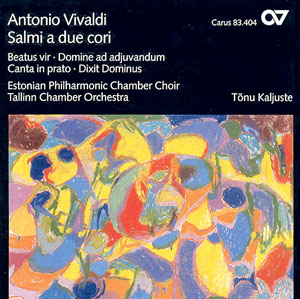
Salmi a due cori (Kaljuste)
 Listen
(25)
Listen
(25)
- Beatus vir
- Potens in terra
- Gloria et divitiae
- Exortum est in tenebris
- Jucundus homo
- In memoriam aeterna
- Paratum cor ejus
- Peccator videbit
- Gloria patri
- Domine ad adjuvandum
- Gloria patri
- Sicut erat in principo
- Canta in prato
- Sacra fulgescit nobis
- Avenae bistinctae
- Dixit Dominus
- Donec ponam
- Virgam virtutis
- Tecum principum
- Juravit Dominus
- Dominus a dextris tuis
- Judicabit in nationibus
- De torrente in via
- Gloria patri
- Sicut erat in principio
 Additional material
-
 Digital text (without sheet music) incl. printing licence, html file, singing text, originalhtml file, singing text, original (Sample)
1. Chor (SATB/SATB) Domine ad adjuvandum me festina.
Psalm 69 (70): 1b2. Arie (Soprano) Gloria Patri, et Filio,
et Spiritui Sancto.3. Chor (SATB/SATB) Sicut erat in principio, et nunc, et semper,
et in saecula saeculorum. Amen....
-
Digital text (without sheet music) incl. printing licence, html file, singing text, english translationhtml file, singing text, english translation (Sample)
1. Chorus (SATB/SATB) O Lord, make haste to help me.
Psalms 69 (70): 1b2. Aria (Soprano) Glory be to the Father, and to the Son,
and to the Holy Spirit.3. Chorus (SATB/SATB) As it was in the beginning, is now, and ever shall be,
world without end. Amen....
-
Digital text (without sheet music) incl. printing licence, html file, singing text, german translationhtml file, singing text, german translation (Sample)
1. Chor (SATB/SATB) Herr, eile mir zu helfen!
Psalm 69 (70): 1b2. Arie (Soprano) Ehre sei dem Vater und dem Sohn
und auch dem Heiligen Geiste.3. Chor (SATB/SATB) Wie es war im Anfang, jetzt und immerdar
und von Ewigkeit zu Ewigkeit. Amen....
-
Digital text (without sheet music) incl. printing licence, html file, singing text, originalhtml file, singing text, original (Sample)
1. Aria Canta in prato, ride in fonte,
Filomena laeta in monte,
nox respondeat exsultando.
Et nox illa sit amoena,
nox laetitiae, nec tua poena
gaudia turbet deplorando.2. Recitativo Sacra fulgescit nobis
digna communi gaudio optata dies.
Gaude, beate Pater,
coelesti gloria tua.
Vos fideles, plaudite et exsultate,
et si plaudent in coelo amoeni chori,
gaudeat et omnis vivens
et semper plaudendo sacro honori.3. Aria Avenae bistinctae
sinceri fervida
...
-
Digital text (without sheet music) incl. printing licence, html file, singing text, english translationhtml file, singing text, english translation (Sample)
1. Aria Sing in the meadows, laugh in the fountains;
O my spirit, sing on the mountains;
Let the night join in exultation.
May the night be full of gladness;
night of light, may no shade of sadness
cloud our joy with lamentation.2. Recitativo Now in its holy splendour
shines the great day of happiness so long awaited.
Therefore, O blessed Father,
proclaim thy heavenly glory,
and all faithful, clap your hands and be exultant;
join the triumph of heaven’s delightful chorus.
Sing with them, and all things living
that praise his great glory, also inspire us.3. Aria Come fervently
...
-
Digital text (without sheet music) incl. printing licence, html file, singing text, german translationhtml file, singing text, german translation (Sample)
1. Aria Singe auf der Wiese, lache bei der Quelle,
fröhliche Filomena, auf dem Berg soll
die Nacht dir jubelnd antworten.
Und diese Nacht sei lieblich,
eine Nacht der Fröhlichkeit, die nicht, dir zur Pein,
klagend deine Freude stört.2. Recitativo Der heilige erhoffte Tag leuchte
uns auf zu gemeinsamer Freude.
Freu dich, glückseliger Vater,
in deinem himmlischen Glanz.
Ihr Getreuen, preist und jubelt,
und wenn im Himmel die lieblichen Chöre frohlocken,
freue sich alles Lebende,
ewig preisend göttlichen Ruhm.3. Aria Ihr Schalmeien,
lehrt uns
...
-
Digital text (without sheet music) incl. printing licence, html file, Introductory text, englishhtml file, Introductory text, english (Sample)Abridged Foreword of the Edition Carus 40.007
Klaus Hofmann
Translation: John CoombsThe present setting of the psalm Dixit Dominus (Psalm 109 taken from the Vulgate) must be considered one of the most important worksin Vivaldi’s church music. It is written for double chorus. Thus Vivaldi picked up Venice’s old poly-choral tradition, the composing techniques of which he united with those of the instrumental concerto, the cantata and the opera. The wide arc of the broadly set cyclical group of numbers, comprising eight psalm verses and the doxology, is spanned bytheuse of the D-major key relationship to connect the two thematically related numbers Dixit Dominus (1) and Gloria Patri (9). In these two numbers depiction of the words of the text becomes subordinated to the expression of festive splendour and majestic brillance. But then the second number, Donec ponam inimicos with its descending melodic figures that impressively symbolize the fall of God’s enemies, immediately offers an example of the concrete imagery to which Vivaldi was capable. Among the numbers assigned to solo voices, the duet Virgam virtutis tuae (3) stands out in particular; its text inspired
...
-
Digital text (without sheet music) incl. printing licence, html file, Introductory text, germanhtml file, Introductory text, german (Sample)Gekürztes Vorwort der Ausgabe Carus 40.007
Klaus Hofmann
Die Psalmvertonung Dixit Dominus (Psalm 109 nach Vulgata) ist zu den bedeutendsten Leistungen des Kirchenkomponisten Vivaldi zu rechnen. Sie ist doppelchörig angelegt. Vivaldi knüpft hier an die alte venezianische Tradition der Mehrchörigkeit an, deren kompositorische Techniken er mit solchen des Instrumentalkonzerts, der Kantate und der Oper verbindet. Der breit angelegte, die acht Psalmverse und die Doxologie umfassende Satzzyklus steht unter einem tonartlich weit ausgreifenden Spannungsbogen, der die beiden auch thematisch aufeinander bezogenen D-Dur- Sätze Dixit Dominus (1) und Gloria Patri (9) miteinander verbindet. In den beiden Rahmensätzentritt die bildhafte Darstellung der Textworte hinter dem allgemeinen Ausdruck festlicher Pracht und majestätischen Glanzes zurück. Doch bietet gleich der zweite Satz “Donec ponam inimicos”, dessen abwärts gerichtete Melodiegesten eindrücklich das Niedersinken der Feinde Gottes versinnbildlichen, ein Beispiel dafür, welcher konkreten Bildhaftigkeit Vivaldi fähig ist. Unter den für Vokalsolisten bestimmten Sätzen ragt besonders das Duett Virgam virtutis tuae
...
-
Digital text (without sheet music) incl. printing licence, html file, singing text, originalhtml file, singing text, original (Sample)1. Dixit Dominus (due Cori)
Dixit Dominus Domino meo:
2. Donec ponam inimicos tuos (due Cori)
sede a dextris meis.Donec ponam inimicos tuos
3. Virgam virtutis tuae (due soprani)
scabellum pedum tuorum.Virgam virtutis tuae emittet Dominus ex Sion:
4. Tecum principium (Alto)
dominare in medio inimicorum tuorum.Tecum principium in die virtutis tuae
5. Juravit Dominus (due Cori)
in splendoribus sanctorum:
ex utero ante luciferem genui te.Juravit Dominus et non paenitebit eum:
6. Dominus a dextris tuis (Tenore e Basso)
Tu es sacerdos in aeternum
secundum ordinem Melchisedech.Dominus a dextris tuis,
...
-
Digital text (without sheet music) incl. printing licence, html file, singing text, english translationhtml file, singing text, english translation (Sample)1. Dixit Dominus (due Cori)
The Lord said unto my Lord:
2. Donec ponam inimicos tuos (due Cori)
sit thou at my right hand.Until I make thine enemies
3. Virgam virtutis tuae (due soprani)
thy footstool.The Lord shall send the rod of thy strength out of Zion:
4. Tecum principium (Alto)
rule thou in the midst of thine enemies.Thy people shall be willing in the day of thy power
5. Juravit Dominus (due Cori)
in the beauties of holiness: from the womb
of the morning thou hast the dew of thy youth.The Lord hath sworn, and will not repent:
6. Dominus a dextris tuis (Tenore e Basso)
Thou art a priest for ever
after the order of Melchizedek.The Lord at thy right hand,
...
-
Digital text (without sheet music) incl. printing licence, html file, singing text, german translationhtml file, singing text, german translation (Sample)1. Dixit Dominus (due Cori)
Der Herr sprach zu meinem Herrn:
2. Donec ponam inimicos tuos (due Cori)
Setze dich zu meiner Rechten,bis ich deine Feinde
3. Virgam virtutis tuae (due soprani)
zum Schemel deiner Füße mache.Der Herr wird das Zepter deiner Macht
4. Tecum principium (Alto)
ausstrecken aus Zion.
Herrsche mitten unter deinen Feinden!Wenn du dein Heer aufbietest, wird dir dein Volk
5. Juravit Dominus (due Cori)
willig folgen in heiligem Schmuck. Deine Söhne
werden dir geboren wie der Tau aus der Morgenröte.Der Herr hat geschworen,
6. Dominus a dextris tuis (Tenore e Basso)
und es wird ihn nicht gereuen:
Du bist ein Priester ewiglich
nach der Weise Melchisedeks....
-
Digital text (without sheet music) incl. printing licence, html file, Introductory text, englishhtml file, Introductory text, english (Sample)Abridged Foreword of the Edition Carus 40.012
Karl Heller
Translation: John CoombsAntonio Vivaldi composed some 50 sacred vocal works (sections of the Mass, vespers, solo motets, psalm and hymn settings, and the “sacrum militare oratorium” Juditha triumphans [RV 644]). Especially impressive are the sacred works for double choir which this violinist and, above all, widely celebrated composer of concertos produced after his years as musical director in Mantua, during the 1720s and early 1730s. At that time he was not, as he had been between 1713 and 1717, employed as Maestro di Coro at the Ospedale della Pietà in Venice, and he probably composed vocal music mainly for use on special occasions in Venice, his principal scene of activity. It may also be assumed (and there are many known facts which support this belief) that some of the church compositions which he produced during this period were commissioned by patrons outside Venice.
The setting of Beatus vir (Psalm 111 in the Vulgata, 112 in the Authorized Version) (RV 597) is undoubtedly a work which was not written for the Ospedale because the parts for solo tenor and bass which it contains, as well as the demanding choral bass parts, rule out
...
-
Digital text (without sheet music) incl. printing licence, html file, Introductory text, germanhtml file, Introductory text, german (Sample)Vorwort der Ausgabe Carus 40.012
Manfred Fechner
Dass Antonio Vivaldi als Concerto-Komponist par excellence Weltmusikgeschichte geschrieben hat, ist unstrittig. Seine geschichtliche Wirkung indes, die er auf allen anderen Schaffensfeldern erreicht hat, ist weitaus weniger spektakulär. Dies hat seinen Grund vor allem darin, dass Vivaldi weder mit seinen über vierzig nachweisbar komponierten szenischen Werken, etwa der gleichen Anzahl weltlicher Cantate und Serenate, noch als Komponist von vokaler Kirchenmusik (ca. fünfzig Werke sind überliefert) dafür – betrachtet man die Entwicklungsgeschichte dieser vokalen Gattungen – einen ähnlich vergleichbaren Rang wie als Instrumentalkomponist beanspruchen kann. [...]
Besonders beeindruckend sind dabei jene Kompositionen, die Vivaldi – zurück in Venedig – nach seiner Kapellmeistertätigkeit in Mantua in den 1720er und frühen 1730er Jahren als Doppelchorwerke komponierte, einer Zeit, in der er nicht wie in den Jahren 1713 bis 1717 die Position eines Maestro di Coro am Ospedale della Pietà mit auszuüben hatte, sondern wohl nur vertretungsweise oder zu besonderen Anlässen mit der Komposition von Vokalmusik für dieses
...
-
Digital text (without sheet music) incl. printing licence, html file, singing text, originalhtml file, singing text, original (Sample)1. Beatus vir (Coro SATB/SATB)
Beatus vir qui timet Dominum in mandatis
2. Potens in terra (Coro B/B)
ejus volet nimis.Potens in terra erit semen ejus,
Antifona: Beatus vir (Coro I/II SATB)
generatio rectorum benedicetur.Beatus vir…
3. Gloria et divitiae (Soli SS)Gloria et divitiae in domo ejus,
Antifona: Beatus vir (Coro I/II SATB)
et justitia ejus manet in saeculum saeculi.Beatus vir…
4. Exortum est in tenebris (Coro SATB/SATB)Exortum est in tenebris lumen rectis:
5. Jucundus homo (Solo S)
misericors et miserator et justus.Jucundus homo qui miseretur et commodat;
disponet sermones suos in judicio:
quia in aeternum non commovebitur....
-
Digital text (without sheet music) incl. printing licence, html file, singing text, english translationhtml file, singing text, english translation (Sample)1. Beatus vir (Coro SATB/SATB)
Blessed is the man that feareth the Lord,
2. Potens in terra (Coro B/B)
that delighteth greatly in his commandments.His seed shall be mighty upon earth,
Antifona: Beatus vir (Coro I/II SATB)
the generation of the upright shall be blessed.– Blessed is the man ...
3. Gloria et divitiae (Soli SS)Wealth and riches shall be in his house,
Antifona: Beatus vir (Coro I/II SATB)
and his righteousness endureth for ever.– Blessed is the man ...
4. Exortum est in tenebris (Coro SATB/SATB)Unto the upright there ariseth light in the darkness:
5. Jucundus homo (Solo S)
he is gracious, and full of compassion, and righteous.A good man sheweth favour, and lendeth;
he will guide his affairs with discretion:
surely he shall not be moved for ever....
-
Digital text (without sheet music) incl. printing licence, html file, singing text, german translationhtml file, singing text, german translation (Sample)1. Beatus vir (Coro SATB/SATB)
Wohl dem, der den Herrn fürchtet,
2. Potens in terra (Coro B/B)
der große Freude hat an seinen Geboten!Sein Geschlecht wird gewaltig sein im Lande;
Antifona: Beatus vir (Coro I/II SATB)
die Kinder der Frommen werden gesegnet sein.– Wohl dem …
3. Gloria et divitiae (Soli SS)Reichtum und Fülle wird in ihrem Hause sein,
Antifona: Beatus vir (Coro I/II SATB)
und ihre Gerechtigkeit bleibt ewiglich.– Wohl dem …
4. Exortum est in tenebris (Coro SATB/SATB)Den Frommen geht das Licht auf in der Finsternis
5. Jucundus homo (Solo S)
von dem Gnädigen, Barmherzigen und Gerechten.Wohl dem, der barmherzig ist und gerne leiht
und das Seine tut, wie es recht ist! Denn er wird ewiglich bleiben....
-
Digital text (without sheet music) incl. printing licence, html file, Introductory text, frenchhtml file, Introductory text, french (Sample)
Parmi les quelques 50 compositions qu'Antonio Vivaldi consacra à la musique vocale sacrée (cantiques pour l'office divin, vêpres, motets pour solo, psaumes, hymnes ainsi que le « sacrum militare oratorium » Juditha triumphans [RV 644]), les plus impressionnantes sont celles que le violoniste et musicien, devenu surtout célèbre grâce à ses concertos, écrivit pour chœur double dans les années 1720 et dans les premières années de la décennie suivante après avoir été maître de chapelle à Mantoue. À cette époque, le compositeur n'occupait pas, comme dans les années allant de 1713 à 1717, la position de maestro di Coro à l'Ospedale della Pietà et ne se consacrait vraisemblablement à la composition de musique vocale pour l'établissement vénitien pour lequel il écrivait principalement que lors d'occasions spéciales ou en remplacement. On peut en conclure, conclusion s'appuyant d'ailleurs sur de nombreux indices, que des commanditaires extérieurs peuvent être envisagés pour les compositions sacrées écrites à cette
...
Contents

-
Composer
Antonio Vivaldi
| 1678-1741Antonio (Lucio) Vivaldi was an Italian composer and violinist of the Baroque period.
It is assumed that his father, who was a musician himself, was responsible for Vivaldi's musical education. However, he began his professional career as a priest, which earned him the nickname Il prete rosso (the red-haired priest).
From 1703, Vivaldi worked intermittently as a violin teacher and composer at the Ospedale della Pietà, an orphanage for girls in Venice, until shortly before his death. Initially, he also worked there as a priest, but relinquished this role after three years. He wrote numerous chamber music works and concertos for his pupils at the Pietà. The famous Four Seasons are particularly well-known and often performed today. Vivaldi also composed sacred and secular vocal music and was an opera composer and director.
Of over 800 works known today, only 135 were published during Vivaldi's lifetime. After his death, Vivaldi's compositions were initially largely forgotten. Many of his works were rediscovered and published, particularly in the 20th century. Among them is the Gloria in D RV 589, the very first sheet music edition published by Carus-Verlag.
Personal details
-
Preface writer
Karl Heller
-
Ensemble
Estonian Philharmonic Chamber Choir
-
Ensemble
Tallinn Chamber Orchestra
-
Conductor
Tonu Kaljuste
For twenty years Tõnu Kaljuste (conductor) was artistic director and principal conductor of the Estonian Philharmonic Chamber Choir, which he founded in 1981, and the Tallinn Chamber Orchestra. Kaljuste has also been chief conductor of the Swedish Radio Choir and the Netherlands Chamber Choir. He has directed international choral seminars and workshops for several years and has worked as a guest conductor with leading orchestras and choirs throughout Europe, Australia and America. As well as immersing himself in the music of the great northern and eastern European moderns, such as Schnittke, Kurtag, Penderecki, Rautavaara and Kancheli, he has a deep affinity with the composers of his native Estonia, including Pärt, Tüür, Tormis and Eller. He has established an international reputation with his wide-ranging repertoire from opera, via the traditional symphonic repertoire to contemporary music. His numerous recordings have won many awards and have been nominated for Grammy awards. In 1999 he received the Cannes Classical Award in the category “Best 20th Century Choral Music” for his recording of Alfred Schnittke’s Psalms of Repentance. In 2004 he was awarded first prize by the Estonian State Foundation “Kultuurkapital.” The same year he became artistic director of the Nargen Festival, an annual, three-month long musical event on the coast of Estonia. He is a member of the Royal Swedish Academy of Music. Personal details
-
Soloist - soprano
Kaia Urb
-
Soloist - soprano
Vilve Hepner
-
Soloist - countertenor
Risto Jooest
-
Soloist - tenor
Mati Turi
-
Soloist - bass
Uku Joller
Reviews
Salmi a due cori 'Urb, Hepner, Jooest, Turi, Joller, Estonian Philhar- monic Chamber Choir, Tallin Chamber Orchestra
Antonio Vivaldi: Salmi a due cori
Wie hoch das Niveau der Estischen Musiker unter der Leitung von Tonu Kaljuste ist, wird mit Vivaldis doppelchörigen Psalmen eindrucksvoll gezeigt: Homogenität im Klang, Intonationssicherheit, intensives Musizieren machen das Anhören der kantatenförmig angelegten vier Vesperpsalmkompositionen (besonders hübsch musiziert der 7. Teil von „Beatus vir” mit Orgel- und Sopransolo) zu einem musikalischen Vergnügen besonderer Art! [ ] ein Gewinn für jede CD-Sammlung!
Quelle: Singende Kirche 2/2002, S. 128
Salmi a due cori, Antonio Vivaldi
Vivaldis Psalmen fanden Verwendung in der Vesper und dieser Ort der Verwendung macht auch heute wieder Sinn, da die Diskussionen über das Tagzeitengebet wieder in vollem Gange sind, sowohl in katholischen als auch in evangelisch-reformierten Landen. Warum also nicht mit dem reformierten Kirchenchor zusammenspannen? Vivaldis Psalmen werden garantiert für Furore sorgen, hüben und drüben! Wer seine beiden Gloria kennt, weiß, wovon hier die Rede ist. Vivaldis Musik überrascht immer wieder durch Dramatik, sei dies harmonisch oder durch häufigen Wechsel der Klanggruppen (Concertato-Stil). Seine Musik wirkt leicht verständlich, swingt mit seinen leicht daher tändelnden Sequenzen und klar gliedernden Kadenzen. Vivaldi liebt Wiederholungen (die Zuhörer auch!). Er ist der Großmeister ausgeklügelter Unisono-Technik, vor allem im 3er-Takt, wo er rhythmisch-reizvoll in rasendem Tempo mit dem Wechsel von Hemiolen spielt. Vivaldi wusste, was möglich und unmöglich war, wenn er mit seinem Mädchenchor aus dem Waisenhause „Ospedale della Pieta” auftrat. Die Solistennummern hat er den Mädchen in den Mund geschrieben und gleich mit Namen in der Partitur verewigt. Die Chöre, zwar doppelt besetzt, sind wirkungsvoll, gerade aber im Fall von „Beatus vir” verblüffend einfach gesetzt. Auch wenn die große Besetzung im Katalog abschrecken mag, jubilierende Chöre, welche sich zu einem gemeinsamen Projekt zusammenraufen, werden mit der herausragenden Einspielung der estonischen Ensembles, welche keine Wünsche offen lassen, leicht auch zurückhaltende Sponsorenohren für sich gewinnen.
Quelle: Singen und Musizieren im Gottesdienst 4/2002, S. 174
Salmi a due cori
Diese Einspielung mit den doppelchörigen Psalmen Beatus vir RV 597, Dixit Dominus RV 594, die Introduzione Canto in prato RV 636 und das Responsorium Domine me festina RV 593 macht einfach Spaß beim Zuhören! Obwohl es sich um ein modernes Orchester und einen modernen Chor handelt, habe ich die Interpretation sehr genossen, denn die Sänger, Instrumentalisten und der Chor musizieren sehr kultiviert, mit Stilsicherheit und mit unbändiger Freude. Die Durchhörbarkeit der Klangstrukturen ist vorbildlich und offenbart die Schönheit und den Glanz von Vivaldis symphonischem Stil. Sowohl die ausgezeichnete Sopranistin Kaia Urb, als auch die anderen Solisten, der Chor und das Orchester agieren auf höchstem Niveau. Hier wird mit liebe zum Detail, mit stilistischer Kenntnis sowie mit Überzeugung und Freude Musik lebendig gemacht.
Giovanni Anaya
Quelle: Toccata. Alte Musik aktuell Nr. 4, 2003
VIVALDI - SALMI A DUE CORI
The special importance of psalm settings within the church music of Antonio Vivaldi is explained by the dominant position of psalms in the Vespers liturgy and by the important role which Vespers played in the sphere of church music. ‚In due cori’ indicates a composition for two ensembles, each with its own set of soloists, choir and orchestra. The performers on this outstanding recording are the Estonian Philharmonic Chamber Choir and the Talinn Chamber Orchestra, conducted by Tonu Kaljuste.
Quelle: New Classics, 09/05
(CB) This was the favourite of the discs that accompanied our recent short holiday. Don‚t worry about the modern orchestra: the whole proceedings are stylish, even if the soloists do detach their semiquavers a little too much. So many HIP groups overstress the vigour, vitality and attack that the effect can be almost like a caricature; the Estonians are a bit more relaxed - much easier to listen to, though not easy-listening in the Classic FM sense. One of the soprano soloists is particularly pleasing (I can‚t work out if it is Kaia Urb or Vilve Hepner). A fine disc.
Quelle: Early Music Review, 3/04, S.20
Reviews on our website can only be submitted by customers with a registered user account. A check whether the rated products were actually purchased does not take place.
Frequent questions about this work
 There are no questions and answers available so far or you were unable to find an answer to your specific question about this work? Then click here and send your specific questions to our Customer Services!