Solo cantatas
 Listen
(11)
Listen
(11)
- Lauda anima mea Dominum
- Herr, auf dich traue ich
- O clemens, o mitis, o coelestis Pater
- Entreißt euch, meine Sinnen
- Schönster Jesu, liebstes Leben
- Contrapunctus I
- Contrapunctus II
- Was mich auf dieser Welt betrübt
- O Gottes Stadt, o güldnes Licht
- Sing we to God a new made song
- For God, so loved the world

-
Composer
Dieterich Buxtehude
| 1637-1707There are few documents concerning Buxtehude’s life. From a contemporary article in Nova literaria Maris Balthici, published soon after his death, we know that he regarded “Denmark as his homeland, from where he came to our region.”Dieterich Buxtehude, to use the spelling of his forename which he used when signing letters, was born about 1637 in Helsingborg, so he was a subject of the King of Denmark. His father, Johannes Buxtehude, was an organist, and taught his son sufficiently for him to become, in 1657 or 1658, an organist in Helsingborg and later in Helsingør. On the 11 April 1668 he was chosen to succeed Franz Tunder as organist at St. Marien in Lübeck, and until his death on 9 May 1707 Buxtehude remained in that position, one of the most important in northern Germany. After his death in 1707 musical experts praised Dieterich Buxtehude particularly for his keyboard music. For example, Johann Mattheson referred to him as a “highly regarded, former Lübeck organist.” That appreciation was based not on printed works, but on manuscript copies of his keyboard compositions, and on his reputation as a virtuoso which he enjoyed throughout Germany. Thus in 1703 Georg Friedrich Händel and Johann Mattheson were in Lübeck, and during the winter of 1705–06 Johann Sebastian Bach also went to Lübeck to study under Buxtehude so as to perfect his technique in composition and organ playing. Together with vocal music and music for keyboard instruments, two publications of his trio sonatas are extant. We know of the “Abendmusiken” in Lübeck from libretti printed for those occasions, but unfortunately the music is lost. That tradition of events similar to concerts was taken over by Buxtehude from his predecessor Franz Tunder. Personal details
-
Preface writer
Erik Dremel
-
Ensemble
Lautten Compagney Berlin
The Lautten Compagney is one of the most renowned and creative baroque instrument ensembles in Germany. Their concerts, under the artistic direction of Wolfgang Katschner, have fascinated audiences for three decades. With their infectious joy in performing and their innovative concepts, these ‘early musicians’ effortlessly translate the musical language of the Baroque to the present. Whether it’s as a solo chamber ensemble or an opera orchestra, the ensemble is continually crossing boundaries and seeking out encounters with new sounds and other art forms. The ensemble has received numerous awards for its exciting musical collaborations. For its CD recording of the program Timeless, combining early Baroque music with works by Philip Glass, it received an ECHO Klassik award in 2010. And their winning the Rheingau Musik Prize 2012 was in recognition of the Lautten Compagney’s creative concert programming. The ensemble has a particular interest in music theater, especially the works of George Frideric Handel. Their performances of Handel’s Serse on a tour of New Zealand in 2011 took both audiences and press by storm. Their production of Rinaldo, a collaboration with the Milan puppet company Carlo Colla e Figli, was enthusiastically received by young and old alike. The Lautten Compagney is a regular guest at leading national and international concert halls and festivals, including the Konzerthaus and Radialsystem V in Berlin, the Leipzig Gewandhaus, Frauenkirche Dresden, Concertgebouw Amsterdam, Vienna Musikverein, Warsaw Philharmonic, An unmistakable sound, breathtaking blend, tremendous sense of musical assurance and a good portion of charm and wit are amarcord’s special hallmarks. The group’s extremely diverse and wide-ranging repertoire encompasses medieval songs, Renaissance madrigals and masses, compositions and cycles of works from the European Romantic and 20th century as well as a cappella arrangements of folk songs from all over the world, and well-known rock, pop, soul, and jazz songs. The ensemble has won prizes at numerous international competitions. In 2002 amarcord won the Deutscher Musikwettbewerb. Alongside the Gewandhaus Orchestra and St. Thomas’s Choir, amarcord is one of the most important representatives of the music city of Leipzig at home and abroad. The group is a frequent guest at leading music festivals. Numerous concert tours have taken the singers to over fifty countries and to almost every continent in the world. In association with the Goethe-Institut they have given guest performances in Australia, South East Asia, the Middle East, Russia, Africa, and Central America. The International Festival for Vocal Music “a cappella” (www.a-cappella-festival.de), inaugurated by amarcord in 1997, has become one of the most important festivals of its kind under the group’s artistic direction. Numerous CDs impressively document the different facets of amarcord’s repertoire, and have won many prizes such as ECHO Klassik (2010, 2012), the International Classical Music Award, Supersonic Award and the Contemporary A Cappella Recording Award. Personal details
-
Conductor
Wolfgang Katschner
Wolfgang Katschner studied guitar at the Hanns Eisler High School for Music in Berlin and lute at the High School for Music and Theatrical Arts in Frankfurt am Main. Following an engagement at the Schwerin Theater, he has worked as a freelance musician since 1984. His posts have included that of manager and dramaturg for the Schütz Academy as well as a professor of lute and guitar at the Music High Schools of Berlin and Dresden. Today much of his artistic work is with the Lautten Compagney and Capella Angelica ensembles. In recent years he has also figured more and more as a conductor, enjoying great success in that role. Personal details
-
Soloist - soprano
Barbara Christina Steude
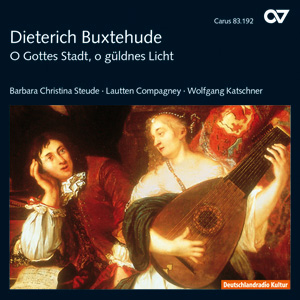
Barbara Christina Steude (soprano) was born in Mühlhausen in Thuringia, one of the cities most closely associated with Bach, where she received her early musical training. She studied church music and singing in Dresden. A much sought-after soloist, she regularly performs with conductors including Ludwig Güttler, Matthias Jung, Roderich Kreile, Georg Christoph Biller, Hans-Christoph Rademann, and Peter Schreier. Guest performances in Germany and abroad have taken her to the Rheingau Music Festival, Dresden Music Festival, to Japan, South Korea, France, Luxembourg, Austria, the Czech Republic, and Switzerland. As well as vocal chamber music and music theatre, she has a particular interest in the music of Bach. Her CD “O Gottes Stadt, o güldnes Licht” (Carus 83.192), released in 2007, with solo cantatas by Dieterich Buxtehude with the Lautten Compagney Berlin was highly acclaimed in the press, and Early Music Review acknowledged Barbara Christina Steude as “a wonderful voice for Buxtehude.” She is a founding member of concerto con voce. Personal details
Reviews
[...] Die ausgewählten Kompositionen dieser CD bestechen durch ihre Vielfalt, präsentieren die Solostimme teils in der freien Kantatenform, teils in der Strophenform der Aria. Die Begleitung der Streicher variiert von nur einer Violine mit Basso continuo bis zu 2 Violinen, Viola, Viola da Gamba und Orgel und kann in den Violinen schon ziemlich virtuos werden. Die aus Mühlhausen/Thüringen stammende Sopranistin Barbara Christina Steude erweist sich als einfühlsame Interpretin, die den Text im Sinne des Komponisten zu deuten weiß. Mit der Lautten Compagney hat sie ideale Partner für diese CD gefunden. [...]
Quelle: Singende Kirche 2007/2
[...] There is much else to savour here - on the tercentenary of Buxtehude's death this is a fitting tribute. Steude is clearly a very promising talent and I hope we shall hear a good deal more of her. She lets no one down on this debut recording. The work of her instrumental accompanists can be given unqualified praise; indeed I find them at least as satisfying, and in some respects more exciting, than the more famous accompanists who appear with Kirkby. All in all, this makes a valuable and thoroughly enjoyable addition to the slowly growing library of Buxtehude's vocal works. [...]
Glyn Pursglove
Quelle: www.musicweb-international.com
[...] Katschners exquisites Spezialensemble musiziert auf historischen Instrumenten in kleiner Besetzung - mit einer klanglichen Eloquenz und Hingabe, als wäre dies die vollkommen natürlichste Ausdrucksform unserer Zeit.
Die tiefe Spiritualität dieser Werke entspricht gerade in der von Katschner & Co. vorgestellten Werktreue, die einerseits dynamische und farbige Akzente zur Geltung bringt, andererseits niemals vordergründige Virtuosität praktiziert, der heutigen Sehnsucht nach geistlicher Kontemplation. Diesem Anliegen kommt auch die Wahl der bemerkenswerten Solistin entgegen: Die junge, in Mühlhausen geborene Sopranistin Barbara Christina Steude überzeugt mit ihrem CD-Debüt - bei aller Klarheit und Reinheit - durch uneitel angemessenes Spiel mit fruchtigen Valeurs. Das Anhören dieser CD ist sinnlicher Genuss und zeitigt eine Wirkung wahrhafter Befriedigung.
Wolfgang Hirsch
Quelle: Thüringische Zeitung, 31.3.2007
(BC) It is astonishing that this CD can boast no fewer than four world modern premiere recordings! Buxtehude can scarcely be classed as a minor composer - quite apart from the immense value of his own music, the influence he had on subsequent generations is beyond question - so it is shocking to realise that at least four beautiful works for solo soprano with strings and continuo have not yet made it into the catalogue. Barbara Christina Steude has a wonderful voice for Buxtehude - the moods of his settings vary from section to section, and she finds a tone colour to match each. The strings and continuo (theorbo, guitar, harpsichord and organ in various combinations) accompany very well - I especially like the way they sing the words with the singer: [...]
Quelle: Early Music Review, June 2007
[...] Man mag sich kaum vorstellen, dass die Werke, die durchweg hohe bis höchste Anforderungen an das stimmliche Können und den gestalterischen Willen stellen, ursprünglich von Knaben gesungen wurden. Auf Knabensoprane der örtlichen Lateinschule nämlich musste Buxtehude für seine Aufführungen zurückgreifen. Insofern fügt es sich gut, dass für diese Produktion mit Barbara Christina Steude eine junge Sopranistin gewonnen wurde, deren Timbre zum Mezzo tendiert und die in den hohen Lagen den Ton etwas spröde werden lässt. Die bronzene Färbung der Stimme und ein vorbildlich exaktes Bemühen um eine am Text orientierte, auch einmal hysteriefrei bis ins Theatralische reichend Gestaltung nehmen sogleich für Steudes Leistung ein. Steudes Virtuosität in den Koloraturen ist niemals kalt, ihr Empfinden der frommen, teils weltabgewandten Texte wirkt stets echt.
Gerade dies ist notwendig, denn die überwiegend strophisch strukturierten Werke zeichnen sich zumeist durch einen meditativen Duktus innigster Andacht aus. Häufig hebt Buxtehude im Kontrast dazu nur einzelne Textpassagen durch kompositorische Mittel besonders heraus. Das ganze spielt sich vor einem höchst filigra und kunstfertig gearbeiteten instrumentalen Hintergrund ab, den die Lautten Compagney unter ihrem Leiter Wolfgang Katschner mit einem perfekten Ebenmaß an lebendigem, fast tänzerischem Schwung und kontrapunktischer Strenge gestaltet. [...]
Sven Kerkhoff
Quelle: Musik-an-sich
[...] sie schafft virtuos den Spagat zwischen einer geläufigen Technik und ausdrucksstark, individuell modellierten Tönen mit warmem Timbre. [...] Hier wechseln Deklamation und farbige Koloratur einander stetig ab und sorgen damit für spannungsreiche Abwechslung. [...]
Christiane Bayer
klassik.com, 14.05.2007
Reviews on our website can only be submitted by customers with a registered user account. A check whether the rated products were actually purchased does not take place.
Frequent questions about this work
 There are no questions and answers available so far or you were unable to find an answer to your specific question about this work? Then click here and send your specific questions to our Customer Services!